Within the European Central Bank (ECB)—an institution whose mandate remains strictly anchored to the preservation of price stability—the rhetoric among key policymakers has undergone a definitive transition toward an increasingly restrictive posture. This shift is most notably evidenced by traditionally dovish members, such as Fabio Panetta, who have begun to forcefully underscore the imperative of preempting second-round inflationary effects—specifically the structural risk of a wage-price spiral. While Panetta maintains that any eventual policy response must remain proportional to the threat, his characterization of "decisive action" as the baseline scenario signals a broadening institutional openness toward further interest rate hikes in the coming quarters.
This burgeoning hawkish sentiment has been further reinforced by Governing Council member Gabriel Makhlouf. He recently asserted that the institution stands ready to intervene aggressively once the broader economic ramifications of the current regional conflict become more transparent. Makhlouf cautioned that a protracted military engagement would likely push the Eurozone economy toward the "adverse scenario" currently modeled by the bank’s analysts. For the time being, the ECB is maintaining a posture of strategic neutrality, carefully avoiding either the confirmation or discounting of any specific policy trajectory until more data is available.
Parallel to these developments, the U.S. labor market demonstrated remarkable resilience throughout March, according to the latest figures released by the Bureau of Labor Statistics (BLS). The domestic economy added a robust 178,000 jobs, a figure that vastly outperformed the conservative market expectation of 60,000. This headline strength arrived alongside a significant downward revision for February’s data, which now reflects a deeper contraction of 133,000 positions compared to the previously reported loss of 92,000. Despite these revisions, the underlying health of the employment sector remained indisputable as the national unemployment rate ticked lower to 4.3%, descending from the previous 4.4%.
However, the report also highlighted a localized moderation in wage growth—a metric that remains a primary focus for inflation hawks. Average hourly earnings rose by a modest 0.2% month-over-month, missing the 0.3% forecast and decelerating from the prior month’s 0.4%. On an annual basis, wage growth settled at 3.5%, trailing the anticipated 3.7% and marking a visible slowdown from the 3.8% reading seen previously. This cooling of wage pressures was strategically balanced by other indicators of economic vitality; the ISM Manufacturing PMI ascended to 52.7 in March, building upon previous gains and exceeding analyst consensus.
Earlier in the week, the labor market delivered an additional hawkish surprise via the ADP Employment Change, which reported an addition of 62,000 positions, vastly exceeding the projected 40,000. Consumer resilience was further evidenced by a 0.6% surge in February Retail Sales, signaling a sharp recovery from January’s downwardly revised contraction. Consequently, according to the CME FedWatch Tool, market participants have aggressively recalibrated their expectations. Investors now widely anticipate that the Federal Reserve will maintain interest rates within the 3.50%–3.75% range for the remainder of the year. This represents a significant departure from earlier 2026 forecasts, which had previously priced in at least two rate cuts.
On the geopolitical front, President Trump delivered a strategic national address regarding the administration's current stance on Iran. The central narrative propagated by the White House focused on the assertion that "fundamental U.S. strategic objectives" are nearing completion. Trump reinforced this perspective by suggesting that a final resolution would materialize "very quickly," claiming the nation is "very close" to achieving its definitive goals. This rhetoric appears meticulously designed to manage public sentiment and mitigate domestic anxieties regarding a potential long-term military quagmire, drawing a sharp contrast to the historical entanglements seen in Iraq or Afghanistan.
Technical Analysis
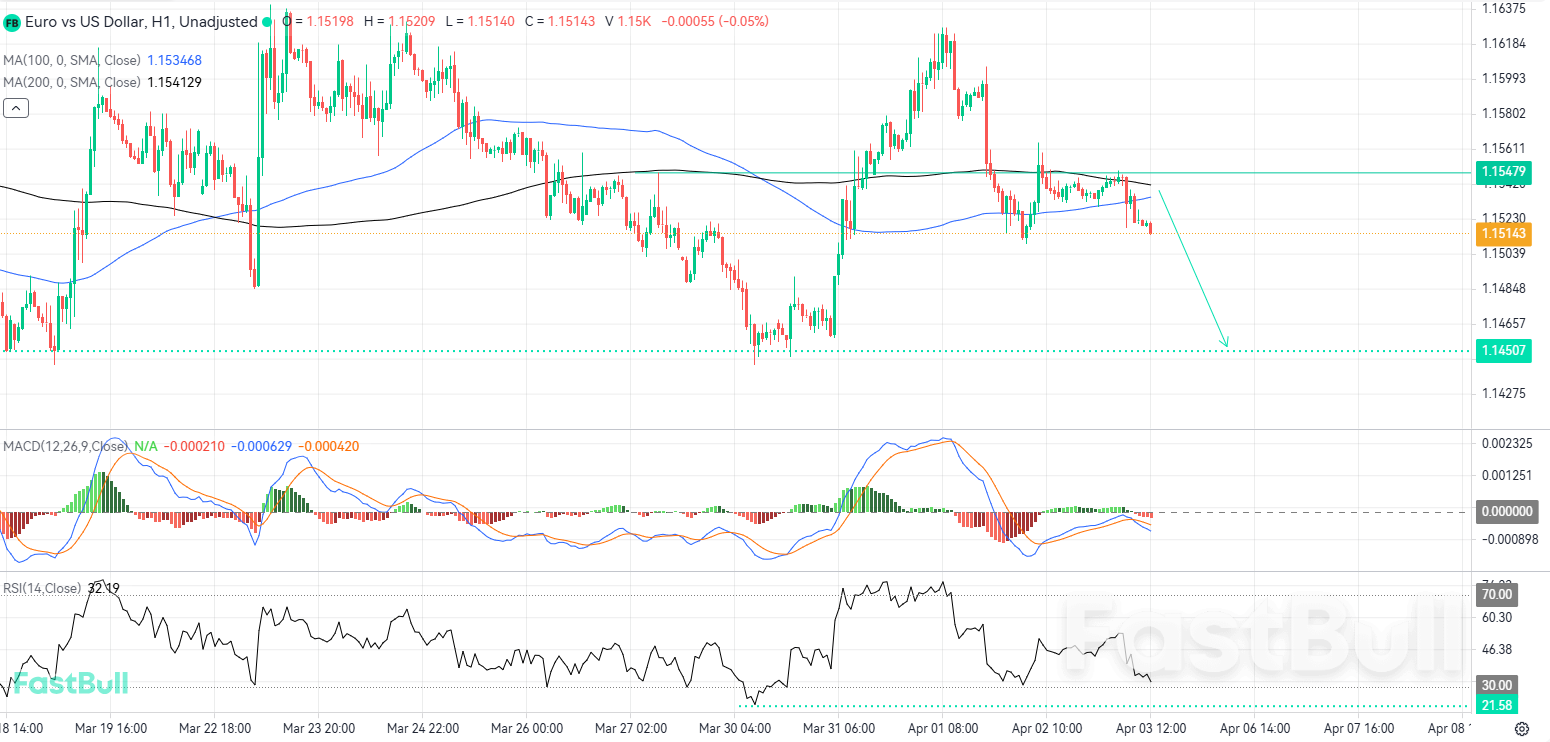
From a technical perspective, EUR/USD is currently encountering significant dynamic resistance at the 100 and 200-period Moving Averages (MAs) on the 1-hour (H1) chart, situated at 1.1534 and 1.1541, respectively. These technical levels are closely aligned with a local horizontal resistance zone at 1.1547. Should the pair fail to decisively breach this cluster to the upside, we could witness the inception of a secondary bearish leg. Such a move would likely extend the current downward impulse toward the 1.1450 handle, which represents the most critical structural support floor in the current configuration.
Our analysis of momentum oscillators provides further context for a potential downside move. The Relative Strength Index (RSI) is currently tracking at the 34 level. While this reflects bearish sentiment, it remains notably above the previous swing low of 21, suggesting that the pair retains sufficient "runway" for further depreciation before reaching extreme oversold conditions.
Simultaneously, the MACD continues to print a bearish histogram that shows potential for gaining further negative depth. With the signal lines entrenched beneath the neutral threshold, the path of least resistance appears to favor a continuation of the bearish trend. Traders should monitor the 1.1547 ceiling closely; a failure to reclaim this level on a closing basis would provide the technical validation required for a move toward the 1.1450 target.
Trading Recommendations
Trading direction: Sell
Entry price: 1.1514
Target price: 1.1450
Stop loss: 1.1580
Validity: Apr 15, 2026 15:00:00


