On the geopolitical front, the high-stakes, two-week ceasefire between the United States and Iran is rapidly approaching its expiration this Wednesday, with no formalized framework agreement currently in place to ensure a diplomatic extension. Over the weekend, regional tensions reached a fever pitch as Iran effectively closed the Strait of Hormuz, demanding an immediate termination of the U.S. maritime blockade—a strategic maneuver that has successfully restricted the navigation of Iranian-flagged vessels. Simultaneously, the U.S. Navy seized an Iranian ship that had reportedly ignored prior warnings to return to its port of origin, further complicating the search for a viable diplomatic off-ramp and heightening the risk of a kinetic escalation.
In Washington, Federal Reserve Chair nominee Kevin Warsh is prepared to testify before lawmakers during his highly anticipated confirmation hearing this Tuesday. According to his prepared opening remarks, Warsh intends to underscore a steadfast commitment to ensuring that the "conduct of monetary policy remains strictly independent" from any political influence, a sentiment aimed at reassuring markets during this period of heightened volatility.
Meanwhile, Fed officials have formally entered their "blackout period" in preparation for the April 28–29 monetary policy meeting. While market participants broadly expect the central bank to maintain the current interest rate range, expectations for year-end easing have been significantly recalibrated. Markets had previously priced in approximately 14 basis points of relaxation toward the close of 2026—a projection that is now under intense scrutiny. This shift follows a cooling but resilient U.S. economic landscape where Initial Jobless Claims outperformed expectations at 207,000, even as Industrial Production recorded a sharp 0.5% contraction in March, primarily driven by declines in the automotive and utility sectors.
In parallel, Swiss National Bank (SNB) Chairman Martin Schlegel underscored last Wednesday that uncertainty surrounding the medium-term inflationary outlook remains significantly elevated. He highlighted that the Swiss economy, given its systemic exposure to exogenous shocks, continues to face profound challenges in the calibration of monetary policy. Within this high-stakes environment, Schlegel issued a stern warning: should second-round inflationary effects begin to materialize, central banks must be prepared to respond with both promptness and institutional resolve. This cautious stance was echoed in the recently released minutes from the SNB’s March assembly, where policymakers noted that while Swiss inflation may experience a transitory spike in the near term—driven primarily by surging energy expenditures—the long-term trajectory is expected to remain largely consistent with the bank's mandate of price stability.
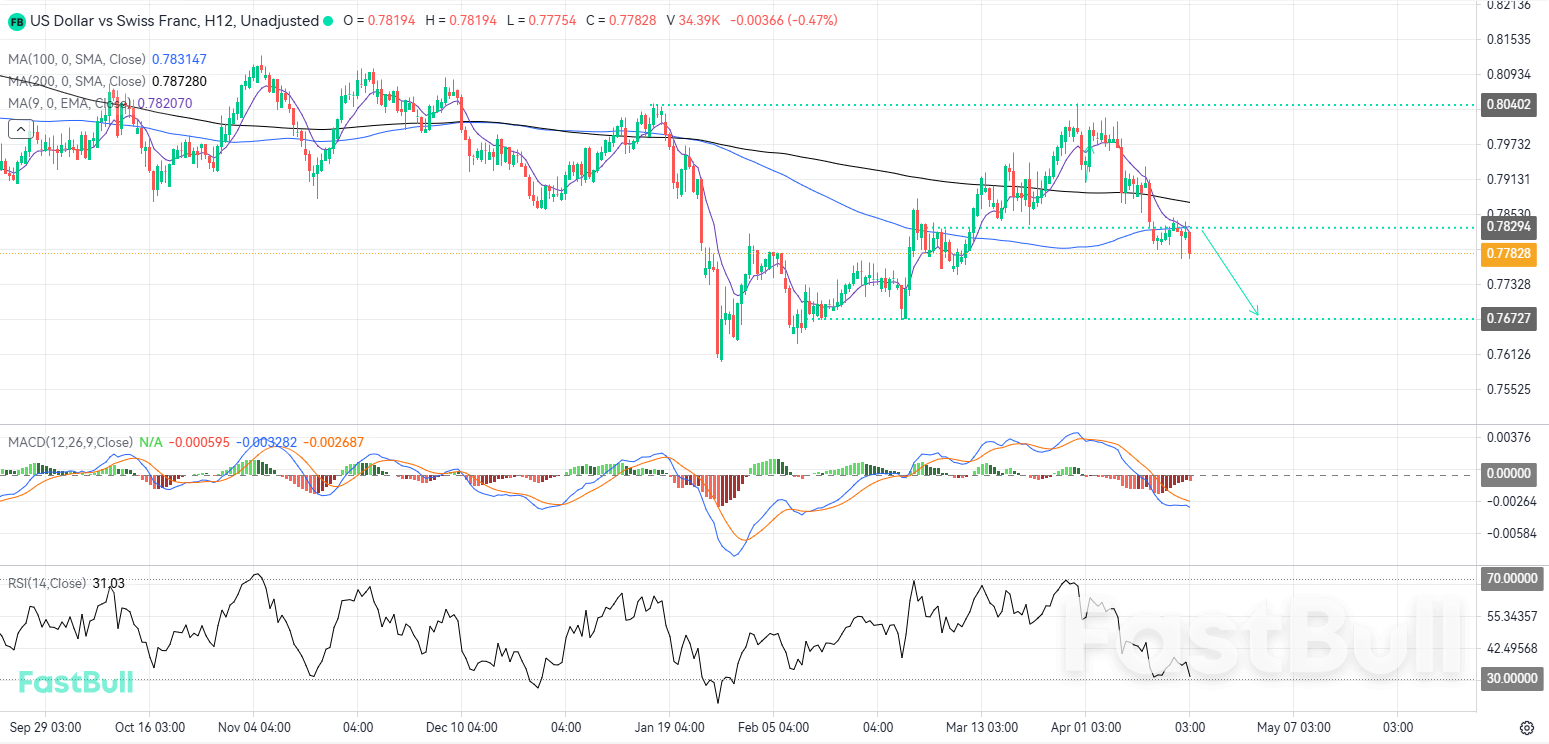
Technical Analysis
From a technical perspective, USD/CHF has recently entered a decisive corrective phase following its failure to sustain momentum above the 0.8040 handle. This downward impulse has intensified as the pair achieved a daily close below the 100 and 200-period Moving Averages (MAs), currently situated at 0.7831 and 0.7872, respectively. With these key dynamic indicators now functioning as resistance, the bearish trajectory appears poised to accelerate toward the 0.7672 zone, which represents the next major structural support floor.
Our analysis of momentum oscillators provides further validation for this continued downside bias. The Relative Strength Index (RSI) is currently tracking at the 31 level, signaling that while the pair is approaching oversold territory, there is still sufficient "runway" for the current move to extend further.
Meanwhile, the MACD is printing a persistent bearish histogram, with the signal lines entrenched beneath the neutral threshold. In the absence of immediate, high-volume support clusters, the path of least resistance remains firmly to the downside. Traders should monitor the 0.7672 level closely; a failure to stabilize at this juncture could open the door for a deeper retest of multi-month lows.
Trading Recommendations
Trading direction: Sell
Entry price: 0.7782
Target price: 0.7672
Stop loss: 0.7910
Validity: Apr 30, 2026 15:00:00


