During its March monetary policy deliberations, the Swiss National Bank (SNB) elected to maintain its primary policy rate at 0.00%, a decision that aligned seamlessly with broader market forecasts. However, the most striking development from the session was the bank’s significant shift in foreign exchange guidance. Citing the intensifying regional conflict, the SNB signaled a heightened readiness to intervene in the currency markets. This strategic pivot is specifically designed to thwart any rapid or excessive appreciation of the Swiss Franc (CHF), which policymakers believe could undermine domestic price stability and exacerbate deflationary pressures.
During the subsequent press conference, Chairman Martin Schlegel clarified that the existing regulatory agreement between Switzerland and the United States permits the SNB to participate in the FX market, provided such actions do not seek an unfair competitive advantage. Despite this transparency, specific data regarding first-quarter interventions will remain undisclosed until late June. Currently, inflation in Switzerland remains exceptionally subdued, printing at just 0.1% year-over-year in February. This weakness is largely attributed to a multi-year decline in the price of imported goods—a trend sustained by the historical structural strength of the Franc.
While the United States continues to orchestrate a high-stakes diplomatic offensive, Tehran has decisively rejected a proposed 15-point de-escalation framework. Iranian leadership maintains that any formal accord will be strictly dictated by their own strategic terms, contingent upon the fulfillment of specific prerequisites. These include ironclad security guarantees and the formal recognition of Iranian sovereignty over the Strait of Hormuz—a critical global energy chokepoint.
This rejection has significantly heightened the risk of a protracted regional conflict, a sentiment underscored by recent reports of additional U.S. troop deployments to the Middle East. State-affiliated Press TV cited Iranian military officials warning that any ground incursion would prove "more dangerous and costly" for the United States than anticipated. Simultaneously, the market is bracing for the conclusion of President Donald Trump’s five-day moratorium on planned military strikes, which is set to expire later this week. In a series of communications via Truth Social, Trump asserted that Iranian negotiators were effectively "pleading" for a deal, while starkly warning that a failure to reach a diplomatic resolution could soon lead to a point of "no return."
On the domestic front, the United States continues to demonstrate labor market resilience. The Department of Labor reported that initial jobless claims for the week ending March 21 settled at 210,000, aligning with analyst consensus and following a previous print of 205,000. However, this stability is contrasted by persistent inflationary headwinds. Import prices surged by 1.3% in February—marking the most aggressive spike since March 2022—primarily driven by escalating energy costs prior to the regional conflict. Compounding these concerns, S&P Global recently noted that U.S. enterprises are grappling with elevated input costs throughout March, exacerbated by volatile energy expenditures and localized supply chain bottlenecks.
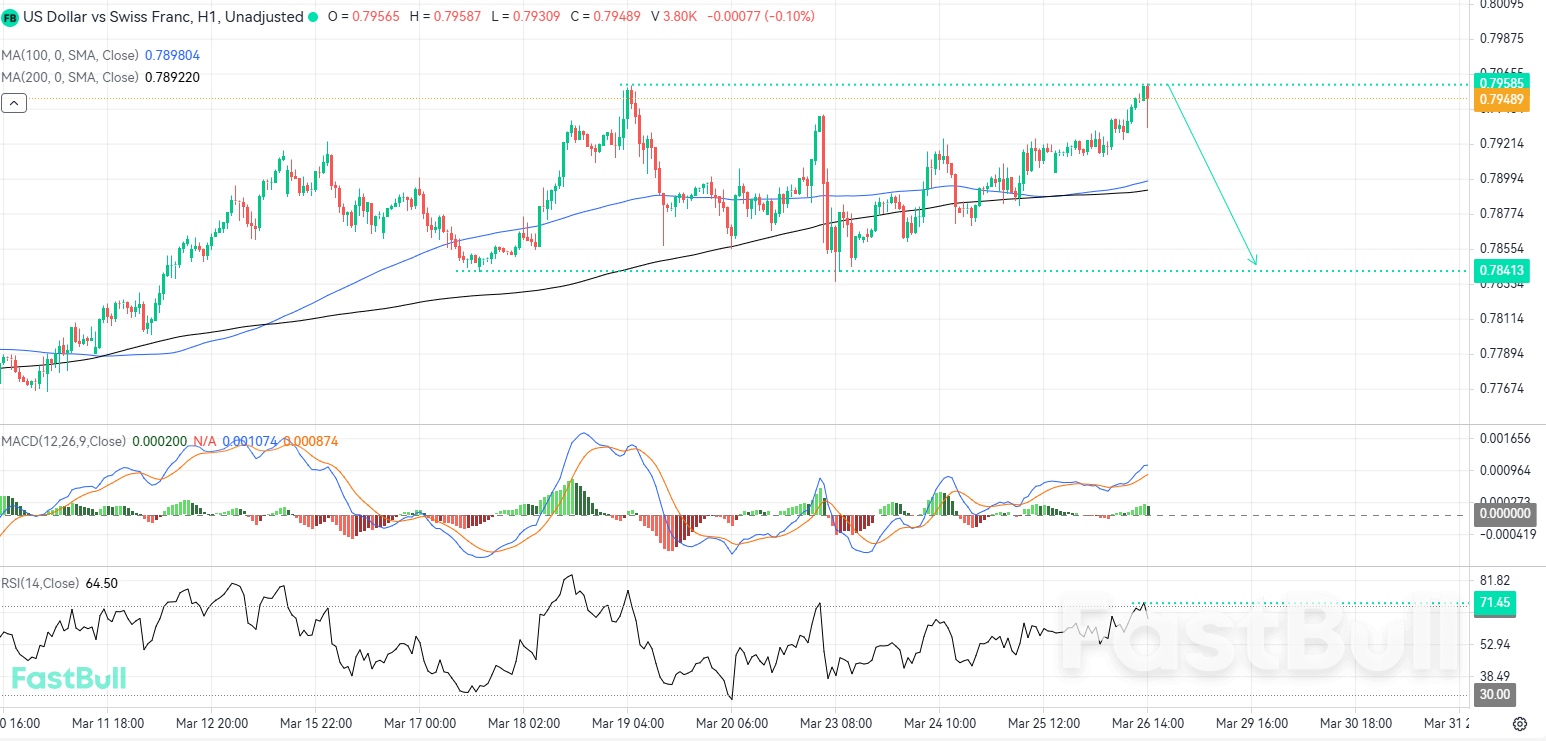
Technical Analysis
From a technical perspective, USD/CHF appears to have validated a significant double top formation at the 0.7958 handle. This level carries substantial structural weight, having served as a formidable ceiling on March 19, where price action was decisively rejected. On that occasion, the pair initiated a sharp bearish impulse that found support at the 0.7841 floor. A similar rejection from this current peak suggests that the path of least resistance is now skewed to the downside.
Notably, the 100 and 200-period Moving Averages (MAs) are currently situated at 0.7897 and 0.7892, respectively. These dynamic indicators are tracking near the median of the current range between local support and the 0.7958 resistance. There is a high probability that price action will oscillate within this cluster of moving averages as the market digests the double top rejection, potentially seeking a return to the 0.7841 support zone.
Our analysis of momentum oscillators reinforces this bearish outlook. The RSI recently struck the 71 level, moving into overbought territory and signaling technical exhaustion. Such extremes often serve as a catalyst for sellers to retake control of the narrative. Simultaneously, while the MACD is still printing a bullish histogram, the bars are visibly losing depth.
The shrinking MACD histogram suggests that a bearish crossover is imminent. If the signal lines successfully cross beneath the neutral threshold, it would provide the necessary technical validation for a sustained move toward the structural support. Given the current rejection of the double top, sell-side positions from these levels are increasingly favored in the short term.
Trading Recommendations
Trading direction: Sell
Entry price: 0.7958
Target price: 0.7845
Stop loss: 0.7980
Validity: Apr 07, 2026 15:00:00


