The USD/JPY complex extended its upside momentum during early European trading on Wednesday, with the dollar pressing against the 159.00 handle as a potent cocktail of surging energy costs and renewed geopolitical hostilities in the Middle East sapped demand for the safe-haven Japanese yen. The move higher comes despite a notably hawkish undercurrent from the Bank of Japan’s latest policy deliberations, underscoring a familiar dynamic in which external shocks and the gravitational pull of US interest rate expectations continue to overshadow Tokyo’s tentative steps toward policy normalization.
The pair last traded at 159.08, up 0.3% on the session, hovering just below the intervention-warning zone that keeps traders on high alert for potential jawboning from Japanese finance officials. Yet for now, the narrative is being dictated by events half a world away, where energy prices—already sensitive to supply disruptions—have been jolted by a dramatic escalation in the long-simmering confrontation between Iran and Israel.
Just 24 hours after headlines hinted at a potential diplomatic breakthrough, the geopolitical landscape has shifted violently back toward confrontation. On Tuesday, US President Donald Trump signaled progress in negotiations to end the war with Iran, with Reuters reporting that Washington had presented Tehran with a 15-point settlement proposal. That brief window of optimism, however, was shattered Wednesday when Iran’s Revolutionary Guards Corps claimed responsibility for missile strikes targeting Israel, as well as military installations hosting US forces in Kuwait, Jordan, and Bahrain.
The attacks represent a significant escalation, effectively putting a question mark over any near-term diplomatic resolution. For yen traders, the calculus is straightforward: as the world’s largest net importer of energy, Japan is acutely vulnerable to spikes in crude oil and liquefied natural gas prices. With Brent crude futures climbing 2.5% in the wake of the strikes, the yen has come under immediate pressure as the nation’s terms of trade deteriorate in real-time. The correlation between rising energy costs and yen weakness has been one of the most reliable themes of the past two years, and Wednesday’s price action is a stark reminder that geopolitical risk does not always translate into haven demand for the Japanese currency—particularly when that risk directly inflates Japan’s import bill.
On the dollar side of the equation, the US central bank is offering little reason to bet on a softening greenback. Federal Reserve Governor Michael Barr struck a decidedly cautious tone on Tuesday, telling an audience that the central bank may need to maintain steady interest rates “for some time” before further cuts are justified. Barr pointed to lingering inflation above the Fed’s 2% target and explicitly cited the Middle East conflict as a complicating factor that could keep price pressures elevated.
His remarks reinforce a growing consensus within the Federal Open Market Committee that the path to rate reductions is neither short nor linear. With the US economy still displaying resilience in labor market data and consumer spending, markets have pared back expectations for aggressive easing this year. That reality has kept the dollar’s yield advantage over the yen firmly intact, even as the BoJ inches away from its ultra-loose policy framework.
Adding nuance to the yen’s story, the Bank of Japan released the minutes from its January policy meeting earlier this week, revealing a central bank clearly preparing the ground for further rate hikes. Policymakers emphasized the need for “timely action” to address mounting inflationary pressures, with several members highlighting the transmission channel from a weak yen to domestic prices as a growing concern.
The minutes suggest that internal debate at the BoJ has shifted decisively from whether to normalize policy to how quickly it can do so without destabilizing a fragile economic recovery. Yet despite this increasingly hawkish tilt, the market’s reaction has been muted. Investors remain skeptical that the BoJ can raise rates aggressively enough—or fast enough—to narrow the vast interest rate differential with the US, particularly with US long-term yields anchored by expectations that the Fed will remain on hold for the foreseeable future.
Technical Analysis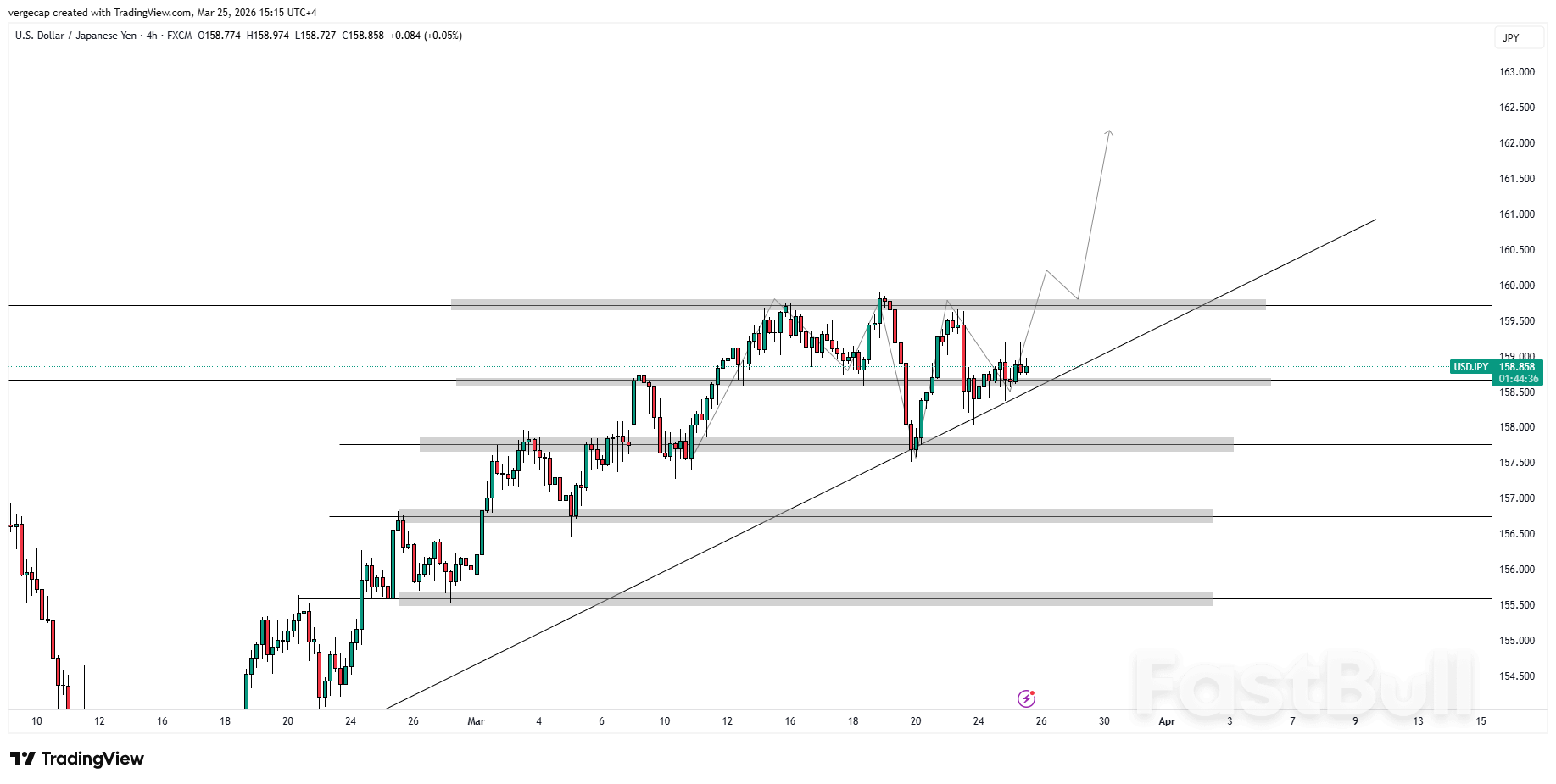
USD/JPY remains within a broader bullish structure, though price action is currently consolidating beneath a key resistance zone. On the 4-hour chart, the pair continues to respect an ascending trendline, which has acted as dynamic support and preserved the sequence of higher lows. This trendline, originating from the late-February lows, remains intact and reinforces the underlying bullish bias despite recent volatility.
Price is currently trading around the 158.80–159.00 region, which sits within a mid-range consolidation zone. This area has acted as both support and resistance in recent sessions, highlighting a period of equilibrium between buyers and sellers. Below, the 157.50–158.00 zone represents a more critical layer of support, aligning with prior demand and the ascending trendline. A decisive break below this region would mark a structural shift, likely triggering a deeper pullback toward the 156.50 level, with further downside exposing the 155.50 support zone.
On the upside, the 159.80–160.00 region remains a key resistance barrier. This level has repeatedly capped bullish attempts, forming a clear supply zone. A sustained break and close above 160.00 would confirm bullish continuation, potentially accelerating momentum toward the 161.50–162.00 region, as indicated by the projected path on the chart. Such a move would reaffirm the strength of the prevailing uptrend and likely attract further buying interest.
The recent price action shows a sharp rejection from the 160.00 area followed by a pullback that respected the ascending trendline, suggesting that buyers are still defending higher levels. However, the lack of immediate follow-through to the upside indicates temporary consolidation rather than impulsive continuation.
Momentum-wise, although indicators are not displayed, the structure suggests a cooling phase after a strong bullish leg. The formation of smaller candles and choppy price action near resistance points to indecision and reduced momentum, consistent with consolidation before a potential breakout.
Overall, the technical outlook remains cautiously bullish as long as price holds above the ascending trendline and key support zones.
TRADE RECOMMENDATION
BUY USD/JPY
ENTRY PRICE: 159.00
STOP LOSS: 157.40
TAKE PROFIT: 161.80


