The USD/CAD currency pair remained trapped in a narrow consolidation range through the first half of Friday’s European session, hovering around the 1.3575–1.3570 region—its lowest level since early March. The subdued price action reflects a broader tug-of-war between a weakening US Dollar and a Canadian Dollar that continues to draw underlying support from elevated, albeit volatile, crude oil prices.
On the surface, the US Dollar appears to be losing momentum, slipping to a two-week low amid a lack of fresh bullish catalysts. This softness has acted as a primary drag on USD/CAD, keeping the pair under pressure and preventing any meaningful recovery. However, the downside remains constrained, as the Canadian Dollar’s strength is far from absolute, largely due to mixed signals from energy markets.
Crude oil prices, a key driver of the Loonie, have struggled to establish a clear directional bias despite remaining relatively elevated. While prices have eased modestly in recent sessions, they continue to hold near historically firm levels, supported by intensifying geopolitical risks in the Middle East. The lack of aggressive selling in oil markets has helped stabilize the Canadian Dollar, even as intraday volatility persists.
At the center of this geopolitical narrative is the ongoing standoff between the United States and Iran. Diplomatic efforts appear increasingly fragile, with negotiations effectively stalling and tensions showing little sign of easing. US President Donald Trump has taken a firm stance, rejecting Iran’s proposal to reopen the strategically vital Strait of Hormuz—a key global oil transit chokepoint—in exchange for deferring nuclear-related discussions. Instead, Trump reiterated his administration’s commitment to maintaining a naval blockade until Tehran agrees to terms addressing Washington’s concerns over its nuclear ambitions.
The situation has been further complicated by reports suggesting that the US has considered potential military action to break the impasse. Iran, in turn, has issued warnings of retaliation against American interests should hostilities escalate. In my view, this increasingly confrontational rhetoric underscores the fragility of the current geopolitical environment and significantly reduces the likelihood of a near-term diplomatic resolution.
For financial markets, the implications are twofold. First, the persistent uncertainty continues to provide a floor under crude oil prices, as traders price in the risk of prolonged supply disruptions. Second, elevated energy prices are feeding into broader inflation expectations, reinforcing the narrative that the Federal Reserve may be forced to maintain a restrictive policy stance for longer than previously anticipated.
This dynamic offers a degree of underlying support to the US Dollar, despite its recent weakness. In effect, while the greenback is currently under pressure, the macro backdrop does not fully justify a sustained bearish trend. As a result, USD/CAD appears to be finding buyers on dips, preventing a sharper decline even as it trades near multi-week lows.
Looking ahead, market participants are likely to focus on incoming US economic data, particularly the ISM Manufacturing PMI, for short-term direction. However, in my opinion, macroeconomic releases may take a back seat to geopolitical developments, which continue to dominate sentiment and drive cross-asset volatility.
Despite the current consolidation, USD/CAD remains on track to post its fourth consecutive weekly decline, reflecting the broader shift in market positioning against the US Dollar. That said, unless there is a decisive breakdown in oil prices or a clear de-escalation in Middle East tensions, the downside in the pair may remain limited. For now, the market appears caught between conflicting forces, with neither bulls nor bears able to establish firm control.
Technical Analysis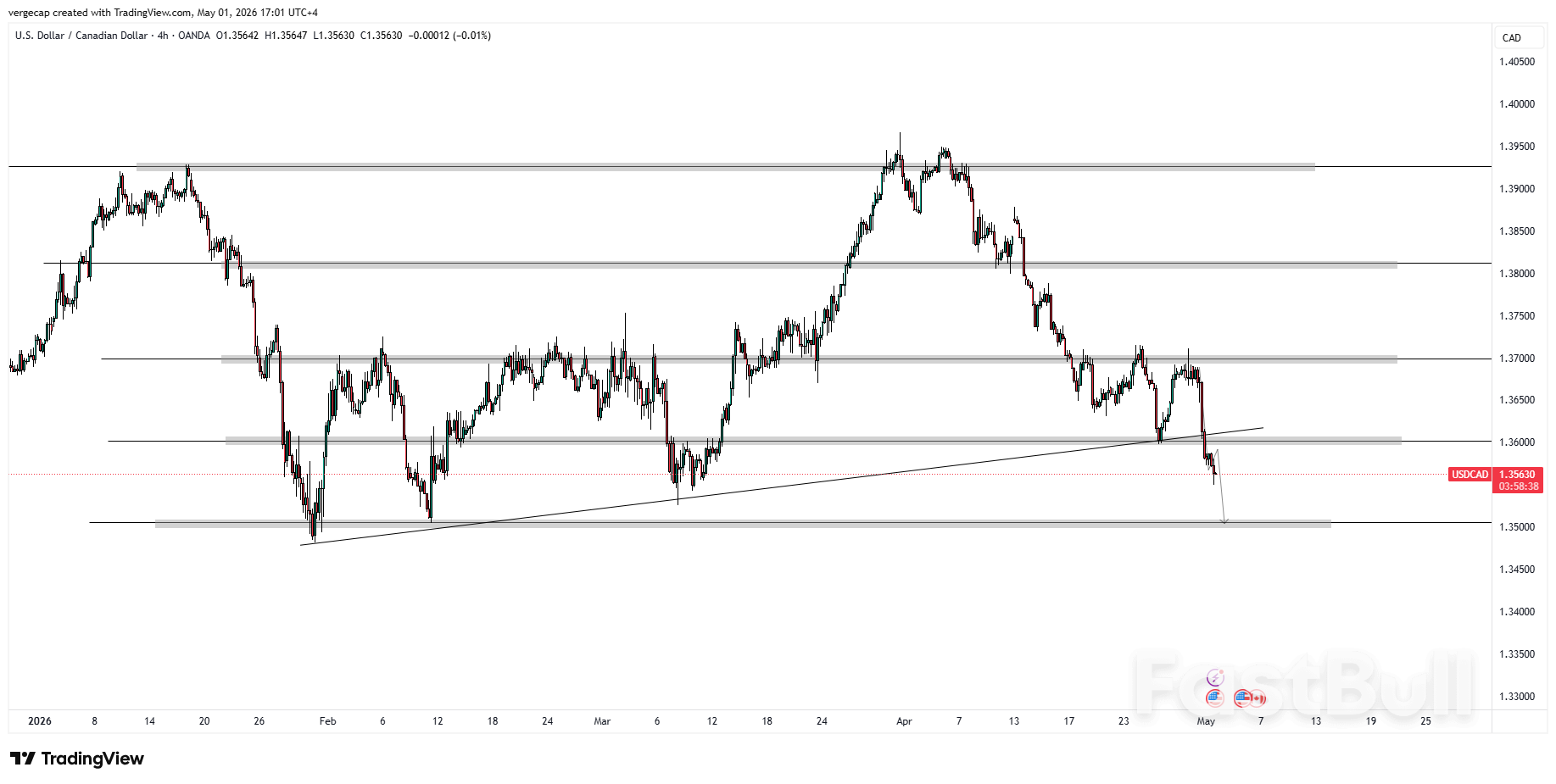
USD/CAD is transitioning from a broader consolidation phase into a developing bearish structure. On the 4-hour chart, price action has recently broken below a rising trendline that had been supporting the market since late February, signaling a potential shift in directional bias. The pair is currently trading near 1.3560, hovering just above a key horizontal support zone around 1.3500–1.3520, which has historically acted as a strong demand area.
The breakdown below the 1.3600 level is technically significant, as this zone previously served as a confluence of support, including prior range lows and the ascending trendline. Its failure suggests weakening bullish control and opens the door for further downside extension. While the market may attempt a short-term rebound toward 1.3600–1.3620, this area now acts as immediate resistance and is likely to attract fresh selling interest if retested.
Looking at the broader structure, USD/CAD has formed a series of lower highs since peaking near the 1.3950 region in early April. This pattern reinforces the emerging bearish trend and suggests that rallies are increasingly being sold into rather than extended. A sustained move below the 1.3500 psychological level would confirm continuation of this downtrend and expose deeper support targets near 1.3450, followed by 1.3400.
On the upside, any meaningful recovery would require a decisive break back above 1.3700, where previous consolidation occurred. A move above this level would challenge the bearish outlook and potentially shift momentum back toward the 1.3800 region. However, given the current structure, such a scenario appears less probable in the near term.
Although moving averages are not displayed, price behavior indicates a bearish alignment, with downside momentum accelerating following the recent breakdown. The sharp rejection from the 1.3700 area and the impulsive move lower suggest strong seller participation.
Momentum indicators, while not explicitly shown, can be inferred to reflect increasing bearish pressure. The lack of strong bullish retracements and the persistence of downward moves indicate that momentum is favoring sellers. However, as price approaches the 1.3500 support zone, some consolidation or a temporary bounce could occur before the next directional move.
TRADE RECOMMENDATION
SELL USD/CAD
ENTRY PRICE: 1.3560
STOP LOSS: 1.3650
TAKE PROFIT: 1.3450


