The US Dollar came under heavy selling pressure on Thursday, reversing earlier gains as investors turned cautious ahead of a crucial batch of US macroeconomic data that could redefine expectations for monetary policy in the months ahead. Market participants are bracing for the release of the preliminary first-quarter Gross Domestic Product (GDP) figures and the March Personal Consumption Expenditures (PCE) Price Index—widely regarded as the Federal Reserve’s preferred inflation gauge—both due at 12:30 GMT.
At the time of writing, the US Dollar Index (DXY), which measures the Greenback against a basket of six major currencies, is trading roughly 0.7% lower near the 98.28 level. The pullback comes after an initially firm tone in the wake of the Federal Reserve’s latest policy decision, suggesting that traders are opting to reduce exposure rather than take aggressive directional bets ahead of potentially market-moving data.
Expectations heading into the release point to a solid rebound in economic activity. According to forecasts from the Bureau of Economic Analysis, the US economy is projected to have expanded at an annualized rate of 2.3% in the first quarter, a significant acceleration from the subdued 0.5% pace recorded previously. Such a reading would reinforce the narrative of underlying economic resilience, even as global uncertainty remains elevated.
At the same time, inflation dynamics continue to command attention. The core PCE Price Index is expected to have risen to 3.2% year-on-year in March, up from 3.0% in February, signaling persistent price pressures within the economy. On a monthly basis, the gauge is forecast to increase by 0.3%, a slight moderation from the prior 0.4% reading but still indicative of sticky inflation trends.
In my view, this combination of stronger growth and firm inflation could present a challenging backdrop for policymakers. Should the data come in as expected—or stronger—it would likely reinforce the “higher-for-longer” interest rate narrative, potentially reviving discussions around additional tightening by the Federal Reserve later this year. That said, the market’s immediate reaction suggests a degree of caution, with traders reluctant to fully commit ahead of confirmation.
The Federal Reserve’s latest policy decision has only added to the complexity of the outlook. The central bank opted to leave interest rates unchanged within the 3.50%–3.75% range, in line with expectations. However, the decision carried a distinctly hawkish undertone. Notably, three members of the rate-setting committee dissented, advocating for a shift away from the current dovish bias, while one member surprisingly voted in favor of a rate cut. This divergence highlights growing internal debate within the Fed regarding the appropriate policy path.
Speaking after the decision, Jerome Powell struck a balanced but cautious tone, stating that policymakers believe the current policy rate is “in a good place.” At the same time, he emphasized that the economic outlook remains “highly uncertain,” pointing specifically to the inflationary risks posed by elevated energy prices. This acknowledgment underscores the delicate balancing act facing the Fed as it navigates between supporting growth and containing inflation.
From a broader market perspective, the Dollar’s current weakness appears more tactical than structural. While near-term positioning is being driven by event risk and uncertainty, the underlying fundamentals—particularly relative yield differentials and economic resilience—continue to favor the Greenback over the medium term. However, today’s data releases could serve as a critical inflection point.
If GDP growth surprises to the upside and inflation proves stickier than anticipated, the Dollar could quickly regain traction as rate expectations adjust accordingly. Conversely, any downside surprises may reinforce the current pullback, potentially extending losses as markets reassess the Fed’s policy trajectory.
Ultimately, the next directional move for the US Dollar will likely hinge on how these data points reshape expectations around monetary policy. For now, the market remains in a holding pattern—caught between a fundamentally supportive backdrop and short-term uncertainty that is keeping traders on the sidelines.
Technical Analysis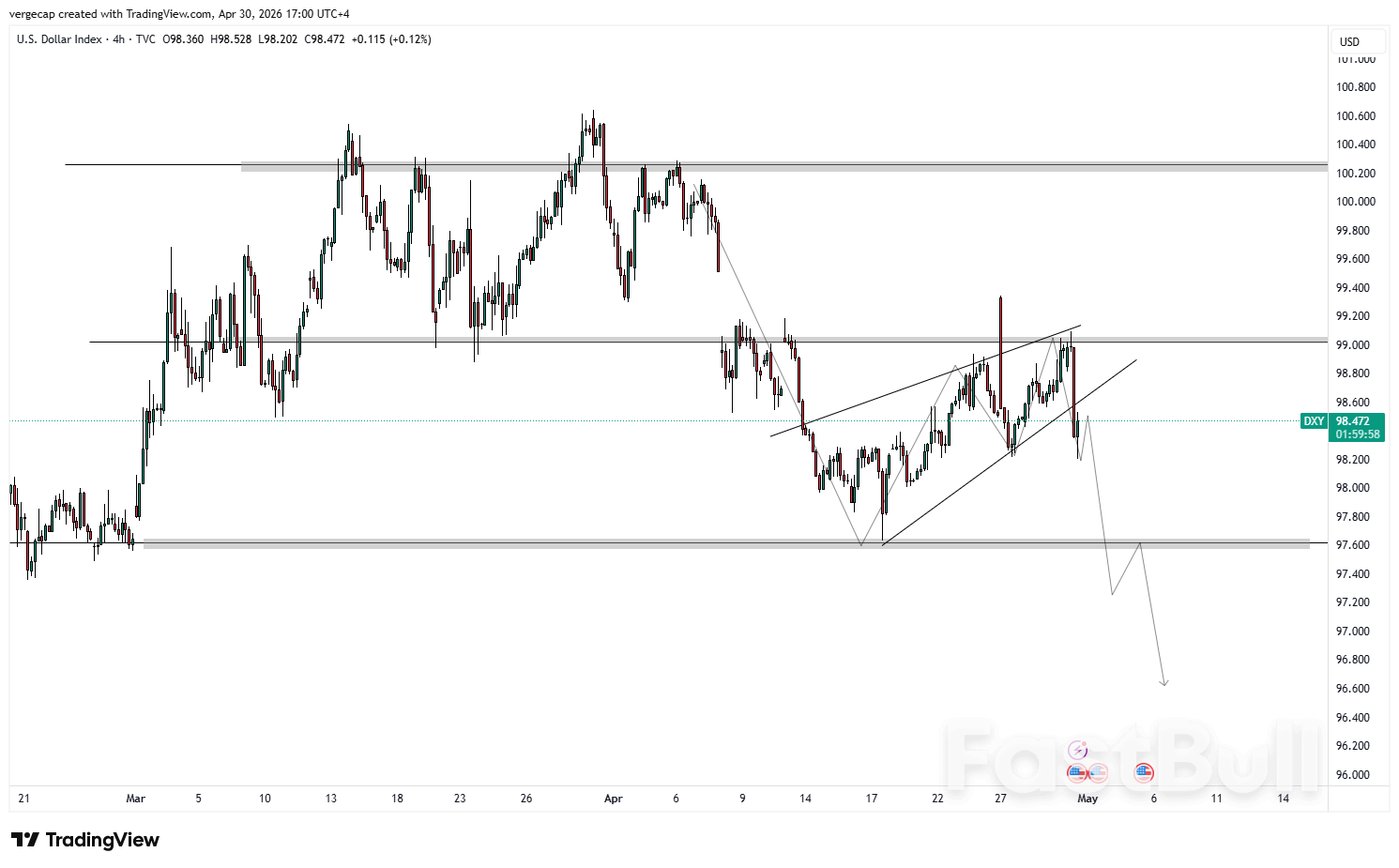
the US Dollar Index (DXY) is showing signs of a weakening structure following a failed recovery attempt within a broader corrective phase. On the 4-hour chart, price action had been attempting to build a short-term bullish structure, forming a sequence of higher lows within an ascending channel. However, this recovery now appears increasingly fragile as the index struggles to sustain momentum above key resistance levels.
The 99.00–99.20 zone stands out as a critical horizontal resistance area, having repeatedly capped upside attempts throughout April. The latest rejection from this region reinforces its significance, suggesting that sellers remain firmly in control at higher levels. Despite a brief spike toward this zone, the inability to hold gains above it signals fading bullish conviction and raises the risk of a deeper pullback.
On the downside, the ascending trendline support—previously guiding the short-term recovery—has come under pressure and appears vulnerable to a breakdown. A decisive move below this dynamic support would confirm a bearish shift in market structure, effectively ending the sequence of higher lows that defined the recent rebound phase.
Immediate support is located near the 98.20–98.30 region, which is currently being tested. A sustained break below this level would likely accelerate selling pressure and expose the next key support zone around 97.60. This level represents a major horizontal demand area and aligns with prior consolidation, making it a critical downside target.
Should bearish momentum persist, a further extension lower could see the index move toward the 97.00–96.60 region, as projected by the measured move from the breakdown. Such a move would confirm a broader corrective phase and signal a more pronounced deterioration in the Dollar’s technical outlook.
On the upside, any recovery attempt would need to reclaim the 99.00 level to regain bullish traction. A sustained move above 99.20 would be required to invalidate the current bearish bias and shift attention back toward the 100.20 resistance zone. However, given the recent rejection and weakening structure, such a scenario appears less likely in the near term.
Momentum indicators, while not explicitly shown, are consistent with a market transitioning from consolidation to distribution. The sharp rejection from resistance, combined with lower highs and increasing downside pressure, suggests that bullish momentum is fading and that sellers are gradually gaining control.
In my view, the DXY is at a pivotal juncture. The failure to break higher, coupled with mounting pressure on support levels, points to an increased probability of a downside continuation. While short-term rebounds cannot be ruled out, they are likely to be corrective in nature unless key resistance levels are decisively reclaimed.
TRADE RECOMMENDATION
SELL DXY
ENTRY PRICE: 98.40
STOP LOSS: 99.30
TAKE PROFIT: 96.80


