The US Dollar is attempting to find its footing after a volatile start to the trading week, characterized by a sharp legal setback for the White House and an immediate, forceful political response that has reignited global trade tensions. The US Dollar Index (DXY), a critical measure of the currency’s strength against a basket of six major rivals, plummeted to session lows near 97.40 during European hours before staging a partial recovery. As of press time, the index remains under pressure, trading 0.2% lower on the day at approximately 97.60.
The initial wave of selling was triggered by a bombshell ruling from the Supreme Court late Friday. In a decision that sent shockwaves through currency markets, the nation’s highest court struck down a cornerstone of President Trump’s trade agenda, deeming the administration’s tariff implementations “illegal.” The ruling specifically targeted the use of the International Emergency Economic Powers Act (IEEPA) as the legal bedrock for unilaterally imposing duties. The decision has immediately cast a pall of uncertainty over the predictability of US trade policy, prompting investors to question the stability and credibility of the nation's economic governance. This legal rebuke was the primary catalyst for the Dollar’s sharp decline to start the session.
However, the currency found a temporary floor after President Trump delivered a blistering response. In a statement that has rattled global supply chains, the President condemned the Supreme Court’s intervention and vowed to circumvent the ruling by announcing a blanket 15% increase on all US import duties globally. This aggressive countermeasure, designed to offset the court's decision, has effectively raised the stakes of the trade war to a new, more indiscriminate level. While the announcement initially triggered a flight-to-safety bid that helped the Dollar trim its losses, the long-term implications for the US economy and its currency remain deeply bearish, as such broad-based tariffs threaten to stifle growth and reignite inflation.
Compounding the political turmoil is a deteriorating domestic economic backdrop. The greenback’s underlying fragility was underscored by a series of disappointing data releases on Friday. The Bureau of Economic Analysis (BEA) delivered a stark revision to fourth-quarter growth, showing the US economy expanded at a year-on-year rate of just 1.4%. This figure stands in stark contrast to both the 3% forecast and the robust 4.4% growth recorded in the previous quarter, signaling a dramatic loss of momentum as the year came to a close.
Adding to the gloomy picture, the latest S&P Global Purchasing Managers’ Index (PMI) for February revealed a broad-based slowdown in private sector activity. The Composite PMI dipped to 52.3 from January’s 53.0, with both manufacturing and services sectors reporting moderating growth. This data suggests that the high-interest-rate environment and prevailing policy uncertainties are beginning to take a tangible toll on the real economy.
Technical Analysis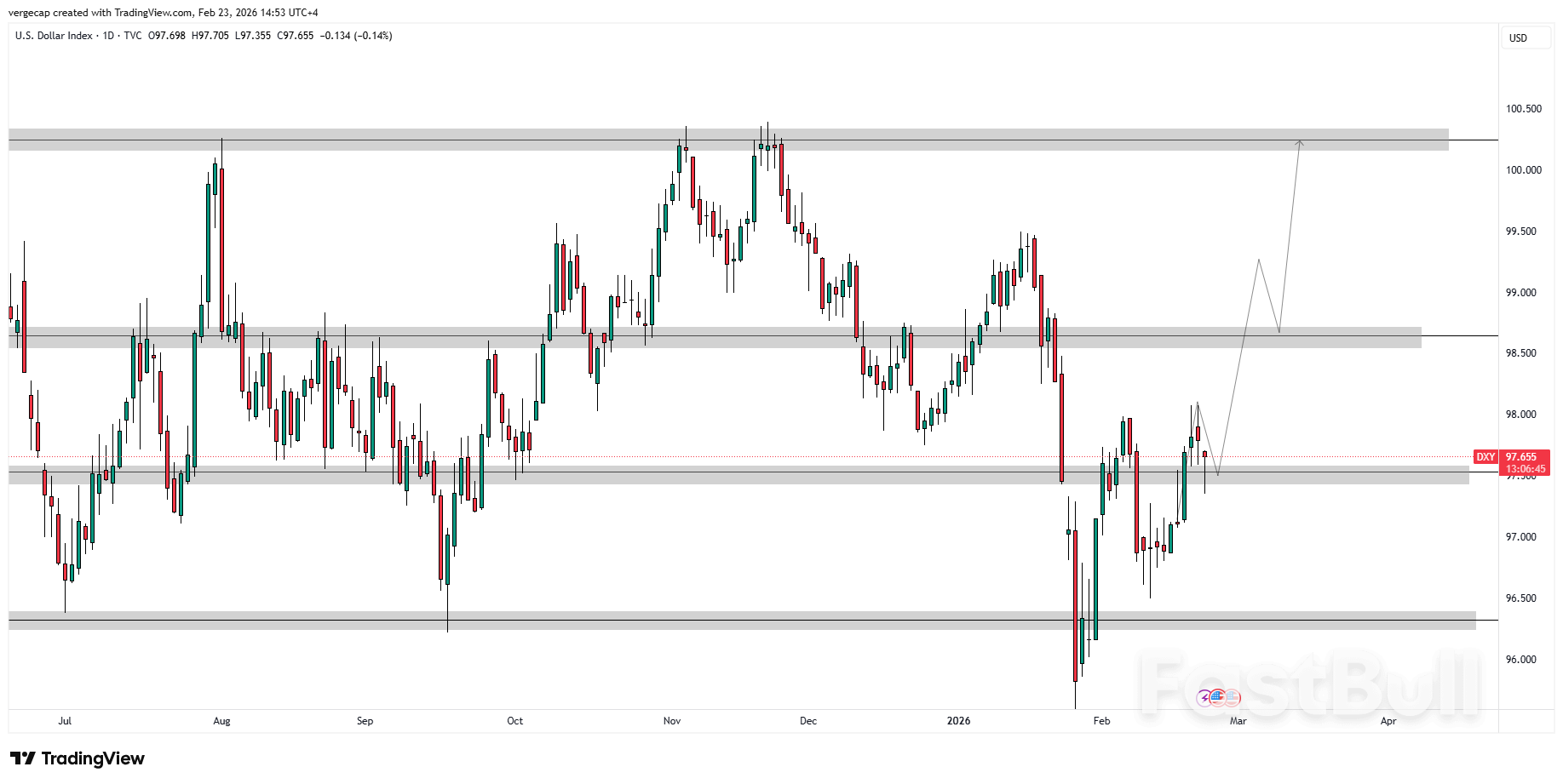
From a technical perspective, the U.S. Dollar Index (DXY) is attempting to stabilize after a sharp corrective decline, with price action now consolidating within a clearly defined demand zone. On the daily chart, the index is trading around the 97.60–97.80 region, an area that has repeatedly acted as both support and resistance in the past, highlighting its importance as a structural pivot.
The recent selloff drove DXY sharply into the lower support band near 96.00–96.50, where aggressive buying interest emerged. This level aligns with prior consolidation lows and marks a key medium-term demand zone. The strong bullish reaction from this area suggests that sellers are losing momentum for now, and that the latest move lower may represent a corrective leg rather than the start of a sustained bearish trend.
From a trend perspective, DXY is currently attempting to reclaim lost ground after failing to hold above the 98.80–99.00 support-turned-resistance zone. This region has capped recent recovery attempts and now represents the first major upside hurdle. A sustained daily close above this level would signal improving bullish momentum and open the door for a broader recovery toward the 100.00–100.30 resistance band, which coincides with the upper supply zone highlighted on the chart.
On the downside, immediate support remains anchored at 97.00, followed by the more critical 96.00–96.50 zone. A decisive breakdown below this lower band would significantly weaken the broader structure and suggest that the index is transitioning into a deeper bearish phase. In such a scenario, downside risk would likely extend toward the 95.00 psychological level, exposing the lowest prices seen since mid-2025.
Momentum indicators favor consolidation rather than trend continuation. The Relative Strength Index (RSI) has rebounded from oversold territory and is now stabilizing near neutral levels, indicating that downside pressure has eased but bullish momentum is not yet dominant. This behavior supports the view of range-bound price action in the near term. Meanwhile, the MACD is attempting to base after a bearish crossover, with downside momentum slowing but not yet fully reversing, reinforcing expectations for choppy consolidation before the next directional move.
Overall, DXY remains at a technical crossroads. Holding above the 97.00 handle keeps the recovery scenario intact, while a break above 99.00 would materially improve the bullish outlook. Conversely, failure to defend the 96.00 support zone would confirm a broader bearish continuation rather than a temporary correction.
TRADE RECOMMENDATION
BUY DXY
ENTRY PRICE: 97.70
STOP LOSS: 96.40
TAKE PROFIT: 100.20


