The Bank of England (BoE) delivered a significant policy shift during its March assembly, voting unanimously to maintain the benchmark bank rate at 3.75%. This decision marks a profound departure from the narrow 5-to-4 split witnessed in February. Notably, previous advocates for policy easing, such as Sarah Breeden and Swati Dhingra, pivoted toward a "hold" stance in direct response to the escalating energy expenditures triggered by Middle Eastern hostilities.
The BoE warned that the Consumer Price Index (CPI) is likely to ascend toward the 3.0%–3.5% range in the coming quarters. This inflationary pressure is compounded by a stagnant Gross Domestic Product (GDP) and a labor market that has seen unemployment climb to a ten-year peak of 5.2%. Consequently, the upcoming S&P Global Services PMI—with a market consensus of 51.2—remains the critical barometer for Sterling’s near-term trajectory.
On the geopolitical front, U.S. President Donald Trump recently indicated via Truth Social a two-week suspension of planned military strikes against Iran. This strategic moratorium is strictly contingent upon Tehran ensuring the immediate, complete, and secure navigation of the Strait of Hormuz. Simultaneously, Iranian Foreign Minister Seyed Aragchi announced that the U.S. has accepted the broad framework of a 10-point proposal, suggesting that Tehran will cease defensive operations provided that hostilities against the country are halted.
Parallel to these shifts, the U.S. labor market continues to exhibit a complex profile of resilience. The Bureau of Labor Statistics (BLS) reported that the domestic economy generated a robust 178,000 new jobs in March, significantly outperforming market forecasts of 60,000. This headline strength arrived alongside a notable downward revision for February’s data, which now reflects a contraction of 133,000 positions compared to the previously estimated loss of 92,000. Meanwhile, the national unemployment rate exhibited a slight improvement, descending to 4.3% from its previous 4.4% reading.
While the headline employment figures appeared formidable, internal wage metrics provided a more moderate counter-narrative for inflation hawks. Average hourly earnings rose by a modest 0.2% month-over-month in March, trailing the 0.3% expectation and decelerating from the prior month’s 0.4% advance. On a year-over-year basis, wage growth settled at 3.5%, likewise falling beneath the anticipated 3.7% and the previous 3.8% print.
Collectively, this data set reinforces the growing consensus that the Federal Reserve will maintain a prudent, "wait-and-see" posture before considering any pivot toward policy easing. This caution is particularly relevant as inflationary risks tied to volatile energy costs continue to generate systemic uncertainty. Consequently, market participants have aggressively recalibrated their expectations; according to the CME FedWatch Tool, the probability of near-term rate cuts has diminished significantly, with an increasing number of investors betting on a prolonged pause that could see rates held steady well into 2026. Looking ahead, the market's focal point shifts toward the upcoming release of the March FOMC meeting minutes and the latest Consumer Price Index (CPI) data.
Technical Analysis
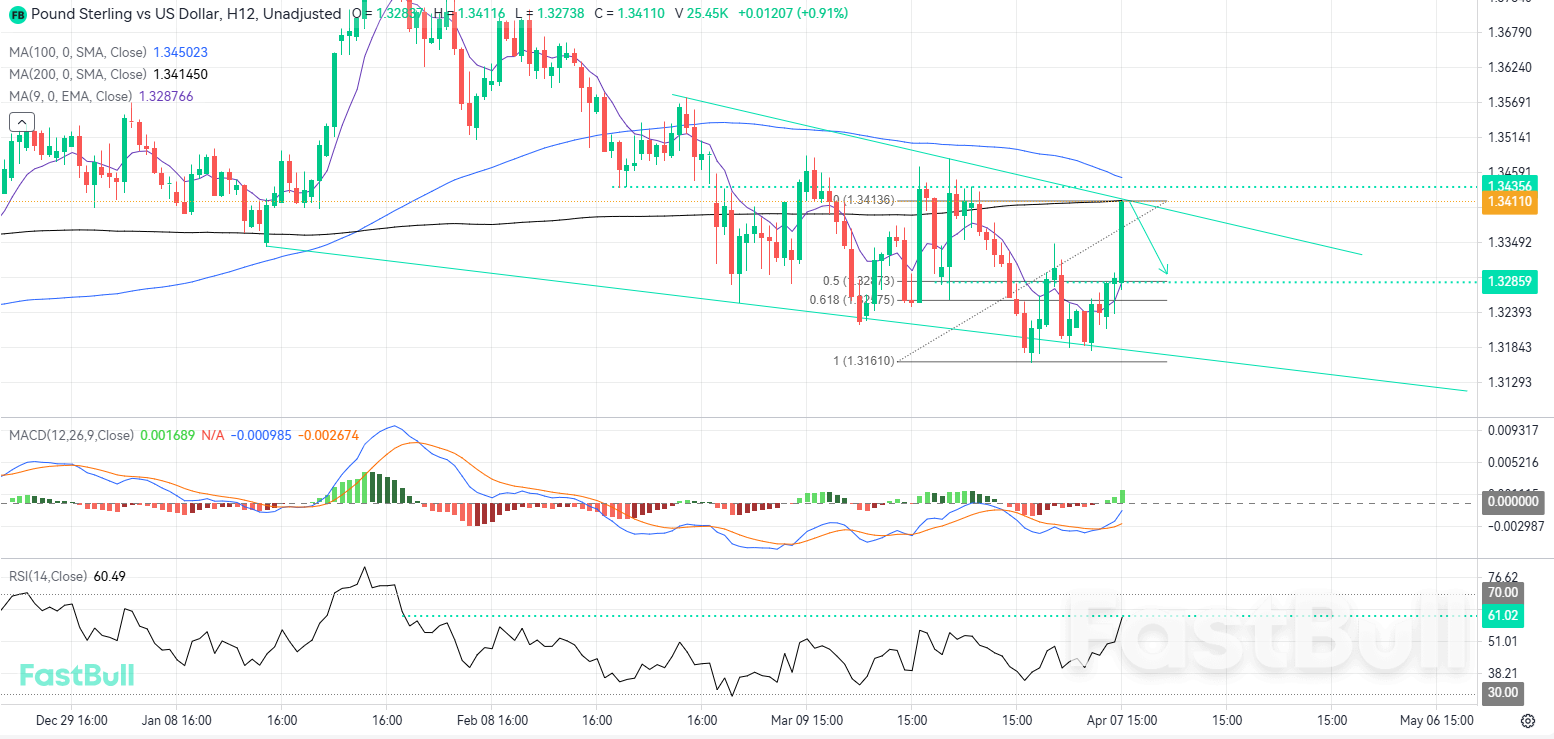
From a technical perspective, GBP/USD has executed a powerful bullish impulse originating from the 1.3161 handle on March 30. This rally has recently brought the pair into direct contact with the 200-period Moving Average (MA) on the 12-hour chart, situated at 1.3408, while the 100-period MA tracks higher at 1.3489. It is critical to note that this resistance zone aligns perfectly with the upper boundary of a primary descending channel.
Should price action face a definitive rejection from this structural ceiling, we anticipate a corrective retracement toward the 1.3285 zone. This target represents the 0.50 Fibonacci retracement level—a region historically characterized by significant buy-side interest during corrective phases within a broader trend.
Our analysis of momentum oscillators provides further evidence of potential exhaustion. The Relative Strength Index (RSI) has ascended to the 60 level, reaching levels not seen since late January. However, current price levels are significantly lower than they were during that period, creating a bearish divergence that signals diminishing upward conviction.
Simultaneously, the MACD is currently printing a bullish histogram; however, the signal lines remain entrenched beneath the neutral threshold. A transition in the histogram, coupled with the signal lines failing to reclaim the zero-line, would provide the technical validation required for a sustained downward pullback toward the Fibonacci support.
Trading Recommendations
Trading direction: Sell
Entry price: 1.3406
Target price: 1.3290
Stop loss: 1.3490
Validity: Apr 17, 2026 15:00:00


