Fundamentals
Industry insiders revealed that, for shipments departing from London, silver is currently facing even greater stress than gold. This year, silver prices have experienced sharp volatility, partly due to large-scale buying by retail investors, which has pushed China's silver inventories to a ten-year low. The recent logistics disruptions have undoubtedly worsened an already tight supply situation. The supply chain for precious metals is not the first challenge — last year, the threat of potential U.S. tariffs prompted massive inflows of precious metals into the United States for hoarding, significantly disrupting global gold circulation patterns. Analysts and traders widely agree that the ultimate impact of the current shock depends on how long the situation persists. If flight interruptions are resolved quickly, markets may be able to absorb the shock; however, if hostilities drag on, supply shortages and price premiums in Asian markets will be unavoidable, further amplifying volatility in gold and silver prices. On the other hand, the precious metals market faces a potential physical delivery crisis. With the gap between COMEX-registered silver inventory and delivery demand narrowing sharply, Bill Holter warns that once silver experiences a delivery default, the ripple effects could rapidly spread to the gold market and ultimately trigger a meltdown in the global derivatives system, valued at up to $2 quadrillion. Precious metals analyst Bill Holter publicly warned that March could see a failure in physical silver deliveries on COMEX. According to his calculations, COMEX registered silver stocks currently stand at about 86 million ounces, while 52 million ounces were already queued for physical delivery as of early March, leaving only 30–35 million ounces available — a clear risk of shortage. Holter believes that once silver defaults on delivery, the gold market could face its own delivery crisis within 24 hours, with collapsing confidence triggering broader financial turmoil. He pointed out that the global economic system currently carries around $350 trillion in debt, compared to an annual GDP of roughly $100 trillion — this imbalance forms the underlying logic for a derivatives crisis. The tightness in the silver market stems from simple arithmetic between supply and demand. Holter noted that COMEX registered silver stocks total 86 million ounces, yet on just the second day of March, 52 million ounces had already entered the queue for physical delivery. After deducting those applications, only about 30–35 million ounces remain uncommitted. As the month progresses, the volume of contracts seeking delivery generally increases or holds steady. Holter stated that if delivery demand continues to accumulate beyond available stock, COMEX could face an inability to fulfill all obligations, resulting in physical delivery failure. Such an event would be highly contagious across the precious metals market. Once silver defaults, gold buyers who previously engaged only in financial speculation would likely shift to demanding physical delivery, rapidly depleting already limited gold inventories. Holter predicts that under such circumstances, the gold market could experience its own delivery crisis within 24 hours.
Released last Friday, the U.S. February nonfarm payroll report showed a loss of 92,000 jobs, with the unemployment rate ticking up slightly to 4.4%. The deterioration in hiring has heightened concerns over labor market fragility. Meanwhile, Middle East hostilities have raised serious risks of global energy supply disruptions, sending energy prices soaring. These two factors could place the Fed in a policy dilemma. A weak labor market might prompt rate cuts to provide support. Last year, despite inflation exceeding the 2% target, the Fed lowered rates by 0.75 percentage points to a range of 3.5%–3.75% to boost employment. Following the latest jobs data, market expectations for rate cuts have clearly risen. Boston Fed President Susan Collins said the same day that she sees no urgent need to change interest rates, and that the outlook for accommodative monetary policy depends on whether inflation can fall further toward the 2% target. In her speech, Collins stated that "a patient and cautious approach is appropriate" and "see no urgency for further policy adjustments." She noted that inflation prospects remain uncertain and carry upside risks, while the labor market remains relatively stable, so policy rates should stay at their current mildly restrictive level for some time. The Fed's next meeting will be held on March 17–18, with markets widely expecting rates to remain unchanged. However, significant uncertainty remains about the future policy path. Hammack said inflation is possible to fall to 2% by 2027, but it is not guaranteed. She added that even if inflation does not reach the target, there is no automatic need for easing; conversely, if confidence grows that inflation will meet the target, the Fed could opt to cut rates. Collins emphasized that she needs to see "clear evidence" that inflation is moving back to target levels, which "may" not occur until the second half of this year.
Technical Analysis
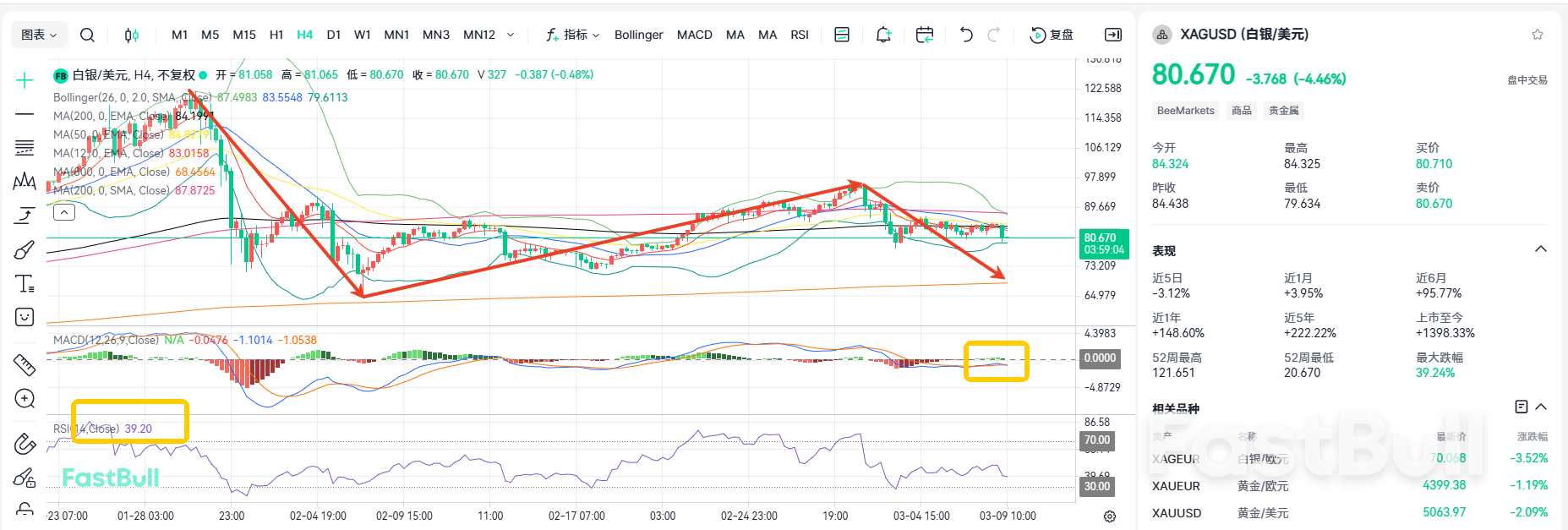
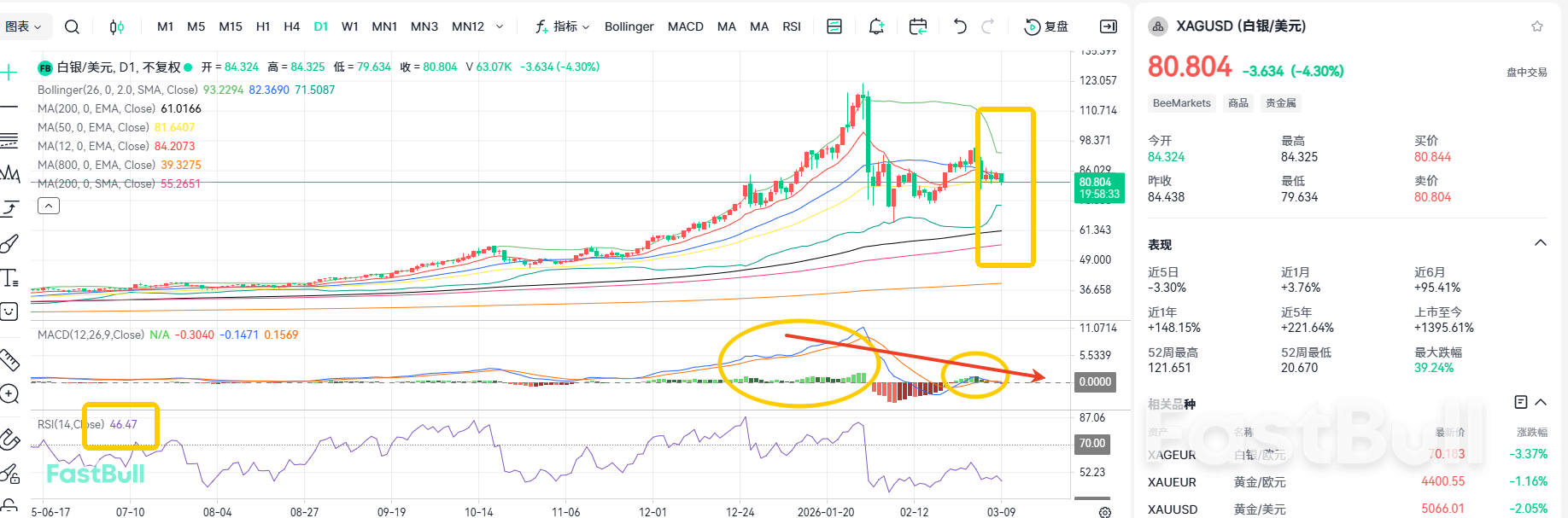
Based on the 4-hour chart, the Bollinger Bands are contracting, moving averages are flattening, and price is oscillating near the EMA12 line. A golden cross emerges, with the MACD and signal lines pulling back toward the zero line, indicating an imminent trend reversal. RSI stands at 39, suggesting prevailing selling pressure, but the RSI lows are gradually rising, forming a divergence signal with price —a small rebound may come first before further declines. Support lies near round-number levels and previous lows at around $80 and $72. Regarding the daily chart, Bollinger Bands are also narrowing, moving averages are flat, and price is hovering near the Bollinger Middle Band. Moreover, holding above the Bollinger Middle Band could lead to a push toward the Bollinger Upper Band, while failing to hold could send the price down toward the Bollinger Lower Band and EMA200, near $71 and $61, respectively. RSI stays at 46, placing the market in a neutral/observation zone. MACD lines hover near the zero line, signaling potential for sudden shifts. Thus, a sell-then-buy strategy is recommended.
Trading Recommendations:
Trading direction: Sell
Entry Price: 83
Target Price: 60
Stop Loss: 97
Support: 80/75/60
Resistance: 93/95/100


