The latest preliminary inflation data from the Eurozone—the first comprehensive set released since the escalation of Middle Eastern hostilities—has signaled the early impact of resurgent energy costs. This catalyst has propelled headline inflation back above the European Central Bank’s (ECB) mandated 2% target. Specifically, the headline Harmonized Index of Consumer Prices (HICP) recorded a notable 1.2% monthly advance in March, a significant acceleration from the 0.6% increase seen in February. On an annual basis, inflation climbed to 2.5% from its previous 1.9% reading, though it marginally undershot market projections of 2.7%.
Conversely, core inflationary pressures remained comparatively subdued. The Core HICP rose by 0.8% month-over-month, matching the prior month’s pace, while the annual rate decelerated slightly to 2.3%—falling below both the consensus forecast of 2.4% and the previous reading. This data set reinforces the argument for the ECB to consider tightening monetary policy in the coming months should crude prices remain structurally elevated.
However, market participants are simultaneously scaling back expectations for an immediate rate hike. The surge in energy expenditures is fueling concerns regarding a potential economic deceleration, a vulnerability particularly acute in the Eurozone given its high dependency on energy imports. EU Energy Commissioner Dan Jørgensen has warned member states to prepare for a protracted period of energy market disruption, while ECB policymaker Madis Müller noted on Tuesday that the bank must act if high energy prices persist, adding that an April rate hike cannot be entirely dismissed.
In the United States, recent labor metrics have begun to signal a gradual cooling of the economy. The Job Openings and Labor Turnover Survey (JOLTS) revealed that vacancies plummeted from 7.24 million in January to 6.882 million in February. Furthermore, hiring activity underwent a noticeable deterioration, falling by 3.1 percentage points to settle at 3.4%, according to the U.S. Department of Labor.
While employment stability was momentarily supported by Initial Jobless Claims for the week ending March 21—which settled at 210,000, largely in line with analyst expectations—this stability is sharply contrasted by persistent inflationary headwinds. Import prices surged by 1.3% in February, marking the most aggressive spike since March 2022. This move was primarily catalyzed by escalating energy expenditures prior to the onset of the current regional conflict.
Compounding these structural concerns, S&P Global recently observed that U.S. enterprises are grappling with elevated input costs throughout March, exacerbated by volatile energy prices and localized supply chain bottlenecks. Looking ahead, the economic calendar remains packed with high-impact releases, most notably the Non-Farm Payrolls (NFP) data. This report is expected to exert significant influence over the Federal Reserve’s (Fed) monetary policy trajectory as the central bank navigates the delicate line between supporting growth and ensuring price stability. Currently, the CME FedWatch Tool indicates that markets expect the Fed to hold rates steady within the 3.50%–3.75% range for the remainder of the year.
Technical Analysis
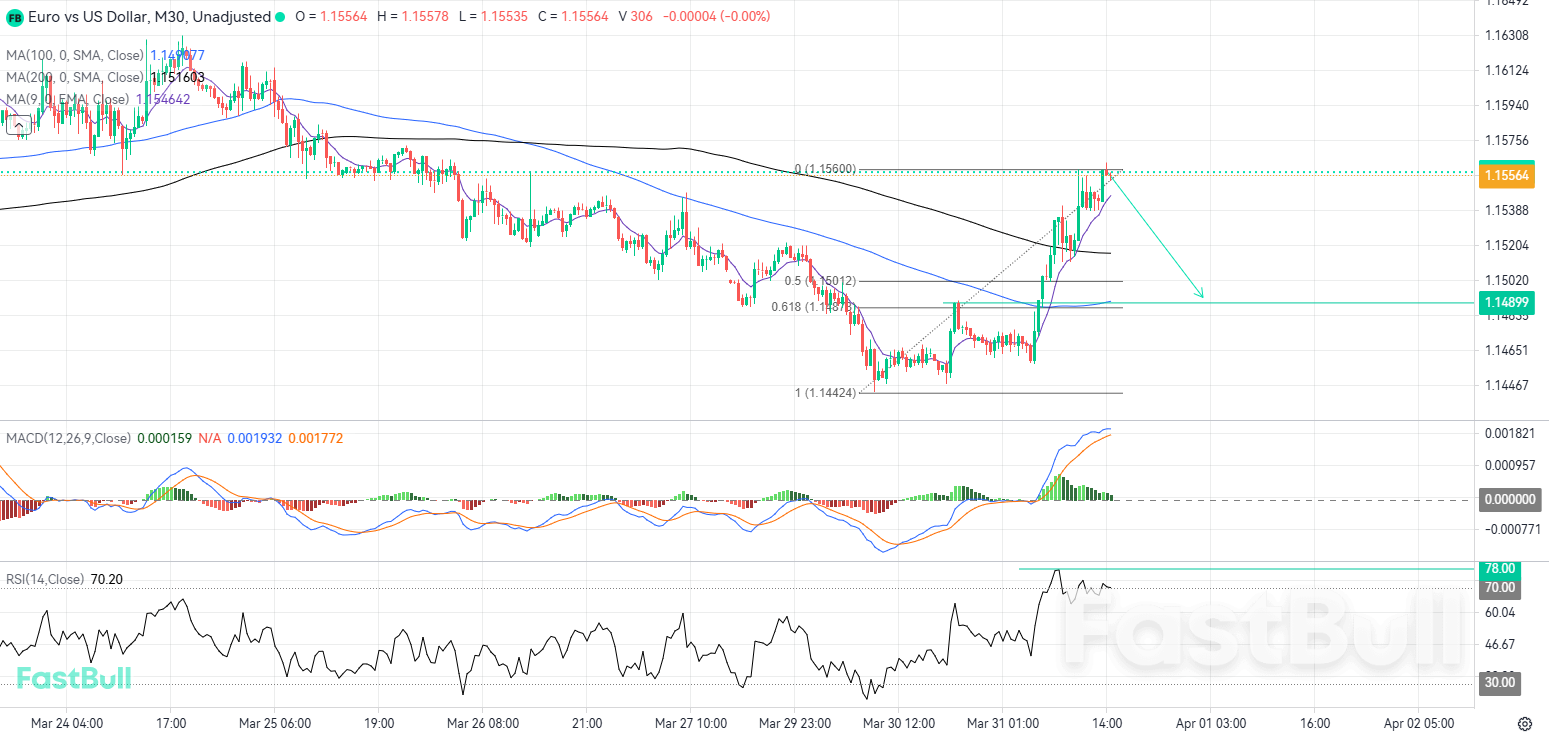
From a technical perspective, EUR/USD has recently exhibited a powerful bullish impulse, reaching a formidable resistance level at 1.1558. This specific handle has historically functioned as a major pivot point, where price action has repeatedly encountered significant selling pressure. A decisive rejection from this ceiling could serve as the catalyst for a bearish correction toward the 1.1489 support zone.
The structural integrity of this downside objective is reinforced by the 100 and 200-period Moving Averages (MAs) on the 30-minute (M30) chart, currently tracking at 1.1490 and 1.1516, respectively. Notably, the 100-period MA is perfectly aligned with the primary support floor and the 0.618 Fibonacci retracement level, creating a high-confluence target cluster for any corrective move.
Our analysis of momentum oscillators supports the case for a tactical reversal. The RSI recently struck the 78 level, moving deeply into overbought territory and inviting buy-side exhaustion. Simultaneously, the MACD is printing a bullish histogram that is visibly losing depth, signaling that a bearish crossover is imminent.
While the technical setup favors a downside move, the fact that the MACD signal lines remain well above the neutral threshold suggests this should be treated as a mean-reversion correction rather than a fundamental trend reversal.
Trading Recommendations
Trading direction: Sell
Entry price: 1.1556
Target price: 1.1489
Stop loss: 1.1585
Validity: Apr 10, 2026 15:00:00


