The global energy complex is staring down the barrel of a supply shock not seen in decades, with West Texas Intermediate crude catapulting to its highest level since June 2022 during Asian trading on Monday. The front-month contract gapped higher at the open, climbing for a fifth consecutive session to hit an intraday peak of $110.73 per barrel, before settling to trade near $110.60.
This parabolic rally is no longer merely a reflection of geopolitical jitters; it is now a hard reality of disrupted flow. The Strait of Hormuz, the world’s most critical oil chokepoint through which roughly a fifth of global consumption passes, remains effectively sealed amid the escalating conflict with Iran. The result is a cascase of production halts across the Gulf.
Kuwait, a heavyweight in the Organization of the Petroleum Exporting Countries (OPEC), has implemented precautionary cuts, though the market is far more focused on the catastrophic collapse in Iraqi supply. Southern Iraq’s output has cratered to a mere 1.3 million barrels per day—a staggering drop from the 4.3 million barrels per day the region was pumping just weeks ago. The loss of Iraqi heavy crude is particularly punishing for Asian refiners who rely on it to produce higher-margin fuels.
The rhetoric coming from within OPEC is turning alarmist. In a stark interview with the Financial Times over the weekend, Qatar’s Energy Minister Saad Sherida Al-Kaabi delivered a chilling forecast: Gulf producers could be forced to halt exports entirely within weeks. Such a scenario, he warned, would propel oil prices to the psychologically devastating level of $150 per barrel. While such a price point was unthinkable just a month ago, the rapid depletion of global spare capacity means the market is now trading on existential risk rather than physical barrels.
The Biden administration, or what remains of its energy policy, appears to be bracing for a long war. However, the perspective from the incoming administration is starkly different. President-elect Donald Trump, never one to mince words on energy policy, addressed the spiraling situation directly over the weekend.
Speaking to The Telegraph on Sunday, Trump characterized the rising pain at the pump as a necessary evil. He stated that the increase in oil prices is a “very small price to pay” for the ultimate goal of defeating Iran and securing global peace. This "whatever it takes" approach was amplified by his social media platform, Truth Social, where he laid out a stark ultimatum: Iran’s only option is unconditional surrender. In a move that will send shivers through the corridors of Tehran’s regime, Trump added that following such a capitulation, Washington would play a direct role in selecting Iran’s next leader.
That prospect seems increasingly unlikely. The conflict has now entered its second week with no diplomatic off-ramp in sight. The death of Ali Khamenei in US-Israeli strikes—a seismic event in itself—was followed by a swift and defiant succession. His son, Mojtaba Khamenei, was appointed Supreme Leader just over a week later, a clear signal that the hardline clerical establishment has zero intention of bowing to external pressure. The swift consolidation of power suggests Tehran is preparing for a protracted conflict, betting that the economic pain inflicted on the global economy will eventually fracture the coalition against it.
For now, the oil market is caught in a feedback loop of fear. With the Strait closed, spare capacity evaporating, and the world’s largest importer (China) watching its energy security hang in the balance, the path of least resistance for prices remains firmly to the upside. The only question is whether the next stop is $120—or $150.
Technical Analysis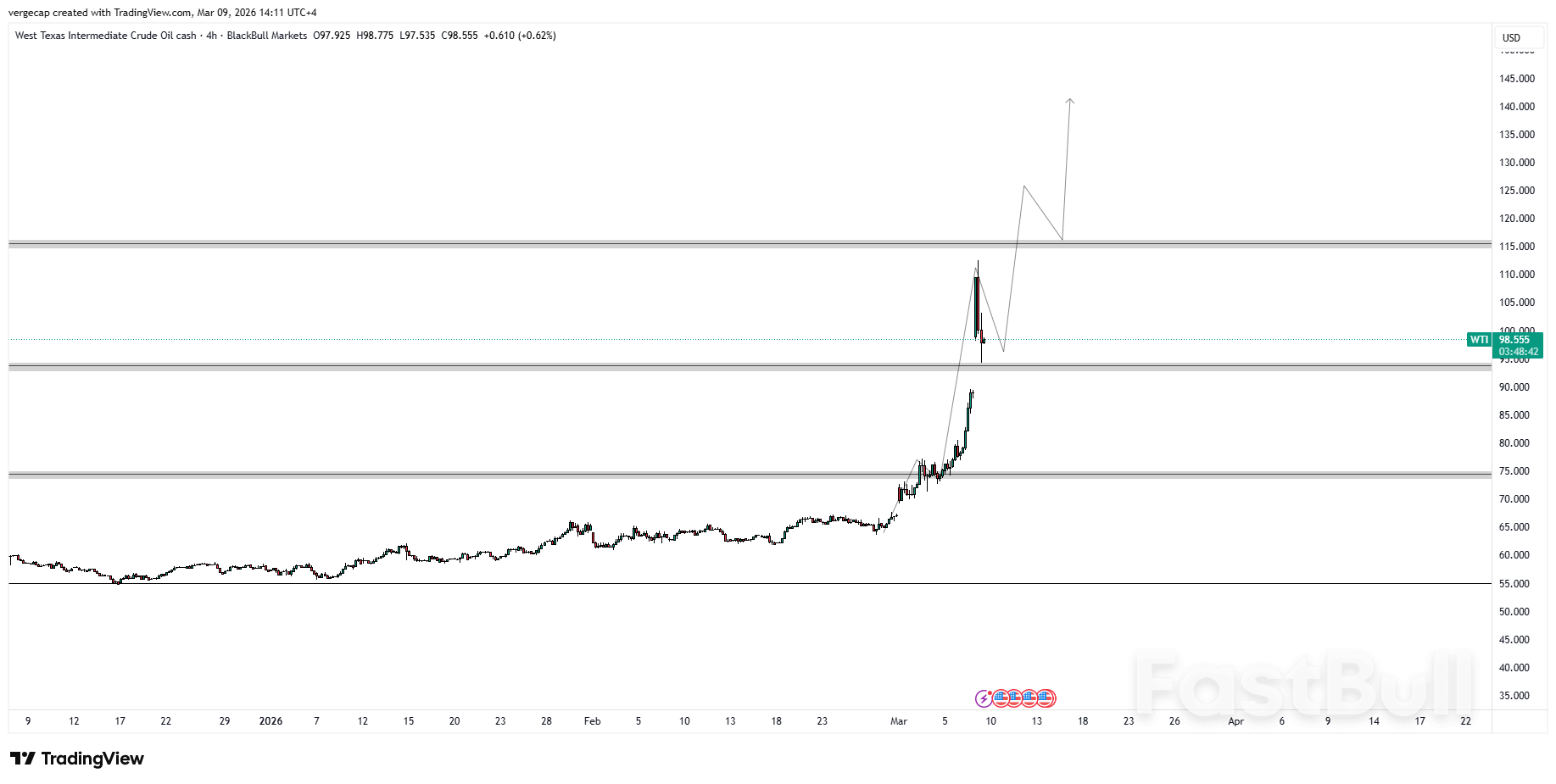
From a technical perspective, WTI crude oil remains firmly embedded within a powerful bullish structure, with the 4-hour chart highlighting a strong impulsive rally that has pushed prices sharply higher over the past several sessions. The broader trend is characterized by a series of higher highs and higher lows, confirming that bullish momentum remains dominant despite the recent short-term pullback.
The latest rally accelerated after prices broke decisively above the $75.00–$76.00 resistance zone, a level that previously capped upside attempts and acted as a consolidation ceiling during February. The breakout from this range triggered an aggressive bullish expansion that propelled WTI rapidly toward the $110.00 area, where the market encountered significant supply pressure.
Following the sharp surge, price experienced a strong rejection from the $110.00 resistance region, forming a notable bearish retracement candle that has pushed prices back toward the $95.00–$100.00 support zone. This region now represents a key structural demand area, as it coincides with the midpoint of the recent breakout leg and could attract renewed buying interest if the market stabilizes.
If prices hold above this $95.00 support band, the current pullback may simply represent a healthy correction within the broader uptrend, allowing the market to consolidate before attempting another upward leg. A rebound from this zone would likely shift bullish focus back toward the $110.00 resistance level. A decisive break above that barrier could trigger a fresh wave of momentum buying, potentially opening the door for an extended move toward the $115.00 region, which represents the next major technical resistance visible on the chart.
Beyond that level, the projected price structure suggests that a sustained breakout could allow WTI to accelerate toward the $125.00–$130.00 region, with the longer-term bullish extension targeting the $140.00 psychological zone if momentum remains strong.
However, failure to maintain support above $95.00 would weaken the near-term bullish structure and could trigger a deeper corrective move. In such a scenario, prices may retrace toward the $90.00 support zone, which marks the first major consolidation area from the most recent rally. A sustained break below this region would expose the $75.00–$76.00 level, the former breakout point that now serves as a critical structural support and potential accumulation zone.
Momentum dynamics currently suggest consolidation rather than trend exhaustion. The sharp rejection from $110.00 indicates short-term profit-taking, but the broader bullish structure remains intact as long as higher support levels continue to hold. Such pauses are common following strong impulsive rallies and often precede the next directional move.
Overall, as long as WTI crude oil remains supported above the $95.00 zone, the technical outlook continues to favor the upside, with pullbacks likely to be viewed as buying opportunities within the prevailing bullish trend.
TRADE RECOMMENDATION
BUY WTI CRUDE OIL
ENTRY PRICE: 98.80
STOP LOSS: 90.00
TAKE PROFIT: 115.00


