In March, Canadian inflation experienced a notable and sharp acceleration, primarily catalyzed by surging energy expenditures. Official data released by Statistics Canada revealed that the Consumer Price Index (CPI) ascended by 0.9% monthly, a significant step up from the 0.5% recorded in February, though it remained marginally beneath the 1.1% market consensus. On an annual basis, the headline CPI surged to 2.4% from its previous 1.8% print, landing slightly lower than the 2.5% projection.
The Bank of Canada’s (BoC) preferred underlying metrics presented a more nuanced and mixed narrative for March. Monthly core CPI moderated to 0.2%, decelerating from the 0.4% seen in February, while the annual core rate climbed to 2.5% from 2.3%. This inflationary backdrop reinforces expectations that the BoC will maintain a high degree of institutional caution during its upcoming policy deliberations at the end of the month. The central bank will keep a vigilant eye on inflation expectations, the deceleration in core price growth provides the BoC with essential flexibility to address what remains a fragile economic environment, characterized by an stubbornly elevated unemployment rate.
On the geopolitical front, the high-stakes, two-week ceasefire between the United States and Iran is rapidly approaching its expiration this Wednesday, with no formalized framework agreement currently in place. Over the weekend, regional tensions reached a fever pitch as Iran closed the Strait of Hormuz, demanding an immediate termination of the U.S. maritime blockade that has successfully restricted the navigation of Iranian-flagged vessels. Simultaneously, the U.S. Navy seized an Iranian ship that reportedly ignored prior warnings to return to its port of origin, further complicating the search for a diplomatic off-ramp.
In Washington, Federal Reserve Chair nominee Kevin Warsh is prepared to testify before lawmakers during his confirmation hearing this Tuesday. According to his prepared opening remarks obtained by Reuters, Warsh will underscore a steadfast commitment to ensuring that the "conduct of monetary policy remains strictly independent" from any political influence.
Meanwhile, Fed officials have formally entered their "blackout period" in preparation for the April 28–29 monetary policy meeting. While market participants broadly expect the central bank to maintain the current interest rate range, expectations for year-end easing have been significantly recalibrated. Markets had previously priced in approximately 14 basis points of relaxation toward the close of 2026—a projection that is now under intense scrutiny. This follows a cooling but resilient U.S. economic landscape where Initial Jobless Claims outperformed expectations at 207,000, though Industrial Production recorded a sharp 0.5% contraction in March, led by declines in the automotive and utility sectors.
Technical Analysis
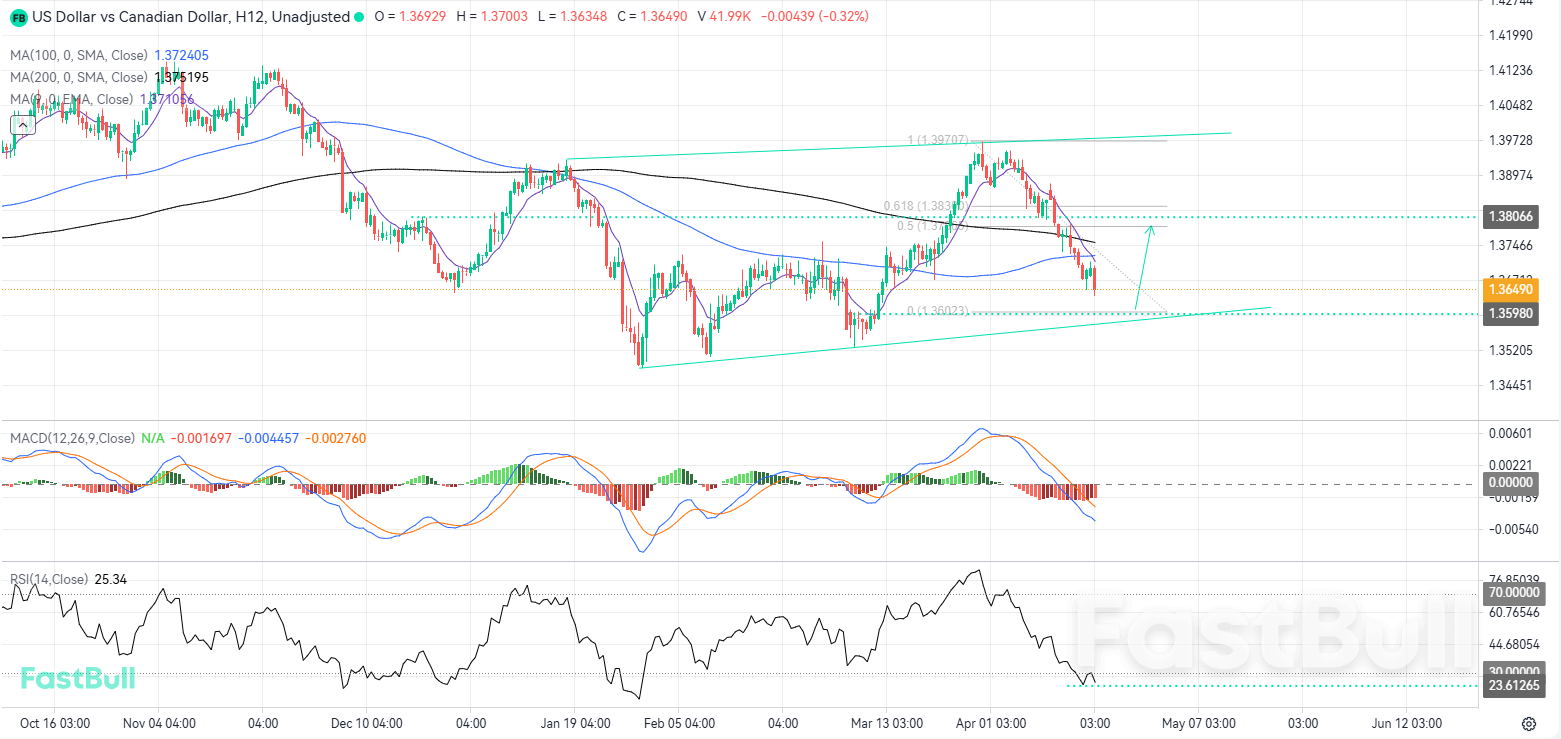
From a technical perspective, USD/CAD appears to be navigating within a well-defined ascending channel that originated from the 1.3486 handle on January 29, extending to the recent peak of 1.3970 established on March 31. Following this local high, the pair entered a corrective phase that is now threatening to reach the lower boundary of the channel, currently situated near the 1.3598 support zone.
As price action descends, it is approaching the 100 and 200-period Moving Averages (MAs), which are currently tracking at 1.3724 and 1.3751, respectively. Should the price exhibit a decisive bullish rejection from the channel floor, we anticipate a resurgent upward move. In such a scenario, the primary upside objectives are targeted at 1.3806, a region that aligns with the 0.50 and 0.618 Fibonacci retracement levels. This area represents a high-confluence target situated near the channel’s median line.
Our analysis of momentum oscillators provides compelling evidence of a potential pivot. The Relative Strength Index (RSI) recently plummeted to the 23 level and is currently hovering near 25, signaling overbought conditions. Such technical exhaustion suggests that bulls may attempt to reclaim control at any moment.
Simultaneously, the MACD is printing a bearish histogram, though the bars are beginning to lose depth. An eventual transition to a positive histogram near the support zone would provide an early signal of a directional shift. While the signal lines recently crossed into negative territory, a bullish crossover would add significant structural weight to a resurgent bullish impulse.
Trading Recommendations
Trading direction: Buy
Entry price: 1.3600
Target price: 1.3805
Stop loss: 1.3520
Validity: Apr 30, 2026 15:00:00


