Fundamentals
In Canada, Prime Minister Mark Carney has announced the establishment of an expanded Canada-US Economic Relations Advisory Committee to prepare for the upcoming review of the trade agreement. This new committee comprises 24 members, retaining only a few from the Trudeau era, and will be chaired by Dominique Leblanc, the Minister responsible for Canada-US trade affairs; it is scheduled to hold its first meeting on 27 April. The committee’s membership spans representatives from politics, business and labour organisations, demonstrating Ottawa’s desire to consolidate a broader range of interests and unify its negotiating stance with the US ahead of crucial talks. This move comes against the backdrop of the USMCA’s scheduled review by 1 July, an agreement that is vital to the Canadian economy. Currently, approximately 70% of Canadian exports are destined for the US, with the vast majority of goods enjoying duty-free treatment. This mechanism has effectively cushioned the impact of US tariff policies over the past few years and, to some extent, prevented the Canadian economy from falling into recession. However, with the agreement’s future uncertain, businesses are becoming more cautious about investment and recruitment, and various sectors are stepping up their lobbying efforts to urge the government to ensure the agreement’s continuation and stability.
At the macro level, US economic data reveals a pattern of ‘short-term strength amid underlying pressures’. Retail sales rose by 1.7% month-on-month in March, significantly exceeding expectations, driven primarily by rising oil prices. Geopolitical tensions have caused global oil prices to surge, leading to a marked increase in US petrol prices in March and consequently boosting sales at petrol stations. At the same time, car sales promotions have also provided support for consumer spending. However, this growth pattern is not sustainable. High oil prices are squeezing household disposable income; annual per capita expenditure on petrol is expected to rise by approximately $857, thereby reducing the scope for growth in other areas of consumption. Although tax rebates have provided some support to consumption, the overall scale remains below expectations. While core retail sales, which are more representative, have continued to grow, there are already signs of a slowdown in consumption momentum. The Atlanta Fed forecasts first-quarter economic growth of just 1.3%, down from previous levels, whilst consumer confidence fell to a historic low in April, indicating a weakening outlook for future demand. This potential slowdown will also have an indirect impact on trade demand and the North American industrial chain. Against this backdrop, uncertainty surrounding US monetary policy has further increased. Kevin Warsh, the nominee for Chair of the Federal Reserve, has proposed a ‘reshaping’ of the existing policy framework, including the establishment of a new inflation control mechanism and adjustments to the way the central bank communicates its interest rate path to the public. He attributes post-pandemic inflation to policy errors by the Federal Reserve and emphasises that the central bank must assume greater responsibility. Although he acknowledges the independence of monetary policy, he is more open to expressing views on interest rates at the political level; this stance may alter the way expectations are managed in the future policy environment.
Technical Analysis
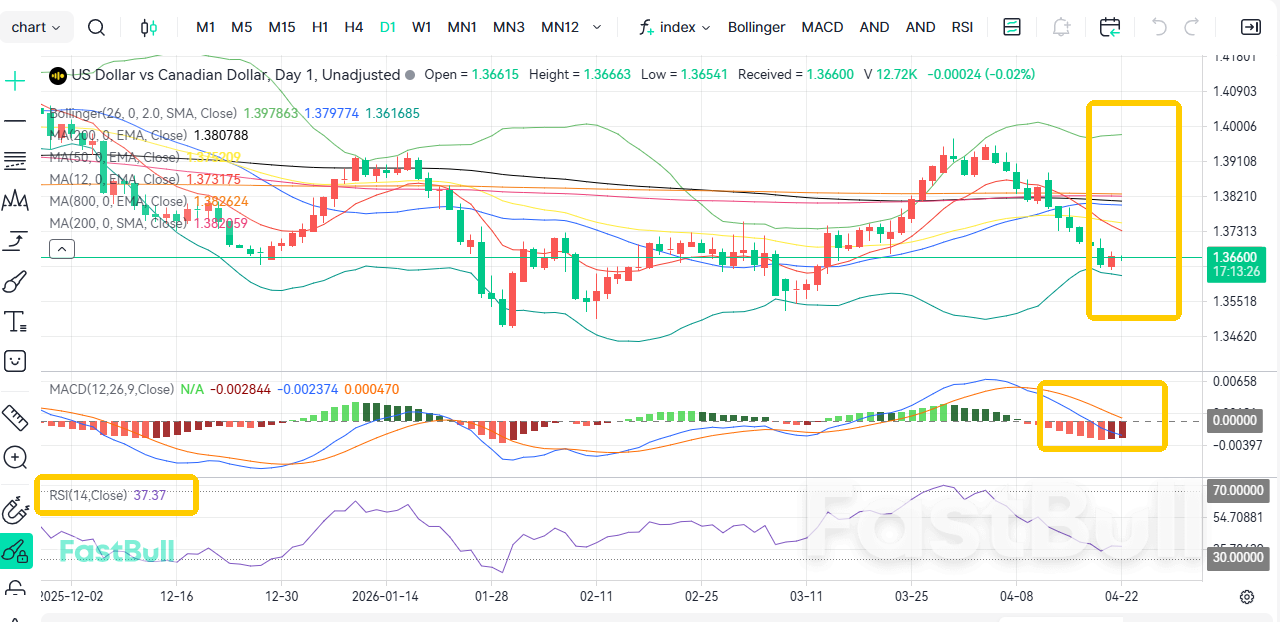
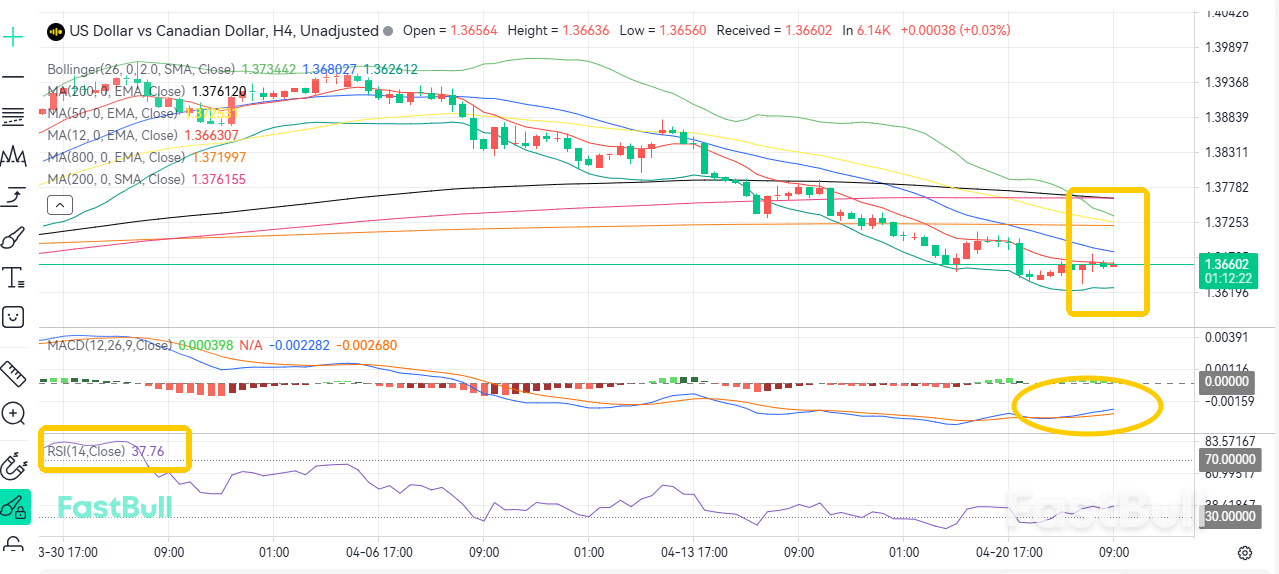
Looking at the USD/CAD on the four-hour chart, the Bollinger Bands are widening downwards and the moving averages are diverging downwards, with prices fluctuating around the 12-period EMA. The short-term downtrend has not yet been confirmed to have reversed. However, the MACD fast and slow lines have formed a ‘kiss’, indicating that downward momentum is weakening and a rebound could occur at any time. Resistance lies near the middle Bollinger Band and the 50-period EMA, at 1.368 and 1.372 respectively. The RSI stands at 37, indicating that market sentiment is predominantly bearish. On the daily chart, the Bollinger Bands are narrowing and the moving averages are flattening out. The price has reached the support level of the trend line in the short term, making a rebound highly likely. With the RSI at 37, the market is dominated by pessimism. The recommended strategy is to buy on dips.
Trading Recommendation
Trading Direction: Buy
Entry Price: 1.366
Target Price: 1.41
Stop-loss: 1.35
Support Levels: 1.35, 1.325, 1.28
Resistance Levels: 1.4, 1.41, 1.42