Fundamentals
For Canada, economic performance in 2025 can be described as "stable but with concerns." Although trade tensions with the United States were once seen as a potential trigger for recession, GDP still maintained positive growth, albeit slowing noticeably toward year-end. The labor market remained resilient, with unemployment steady around 6.5%, yet this level remains above historical averages, reflecting that underlying pressures have not dissipated. Entering 2026, new risks are gradually emerging, most notably in trade, financial markets, and employment prospects. Trade uncertainty is expected to remain a significant drag on the Canadian economy. The Canada–United States–Mexico Agreement (CUSMA) will undergo review in July 2026, a process itself likely to dampen corporate investment appetite. While most U.S. industry groups favor retaining the agreement, the current review mechanism grants the U.S. considerable negotiating leverage, making the prospect of smooth continuation until 2036 uncertain. The U.S. has made clear its focus on issues such as Canada's dairy supply management system and the Online Streaming Act, which could become friction points in negotiations. Currently, about 90% of Canadian exports to the U.S. enjoy tariff exemptions under rules of origin; if negotiations deteriorate or the agreement collapses, Canadian exporters could face rising tariffs. This uncertainty may continue to suppress investment and growth expectations until talks conclude. Meanwhile, rapid global expansion of AI investment also poses indirect but inevitable financial risks for Canada. As large tech firms increase spending on AI infrastructure, their debt levels rise significantly, sparking market concerns over potential asset bubbles. If these companies fail to meet return expectations, stock prices and financing conditions could deteriorate quickly. The Bank of Canada has warned that if U.S. markets substantially reprice AI prospects, triggering equity adjustments, negative effects could spill over into Canada via financial and confidence channels. Recent notable pullbacks in some tech stocks from their highs also indicate that excessive optimism toward AI is cooling.
Investors will closely watch the minutes of the Federal Open Market Committee (FOMC) for the latest clues on the monetary policy outlook. At its most recent meeting, the Fed cut rates for the third consecutive time by 25 basis points, lowering the target range to 3.50%–3.75%. The Fed also signaled it will only cut rates once in 2026. Nomura economists noted that although 2025 growth was clearly weighed down by trade and immigration policies, overall resilience remained, and these headwinds are now easing, while fiscal and monetary policy are shifting toward more stimulative stances. At the same time, the U.S. economy still faces multiple risks, including a weakening labor market, persistently high inflation, and internal rifts over policy priorities. In addition, President Trump is set to appoint a new Fed chair to replace Jerome Powell, whose term ends in May. Markets widely expect the new chair to favor pushing for rate cuts. This year, the U.S. job market has gradually cooled, with monthly job additions significantly lower than a year ago and the unemployment rate edging up. These changes prompted Fed policymakers to unanimously support a series of rate cuts toward year-end. November's unemployment rate was 4.6%, but economists note possible distortions due to limited data collection during the government shutdown. Stubbornly high inflation may still constrain room for further cuts. Although Q3 inflation came in well below expectations, economists believe this may underestimate actual price pressures, and it will take months to confirm whether goods inflation driven by tariffs fades as policymakers anticipate. Consumer concern over the labor market is rising. The Conference Board's latest data show consumer sentiment on the job market has deteriorated to its lowest since early 2021. This trend leads some economists to expect households may choose to save rather than spend extra income from tax reforms.
Technical Analysis
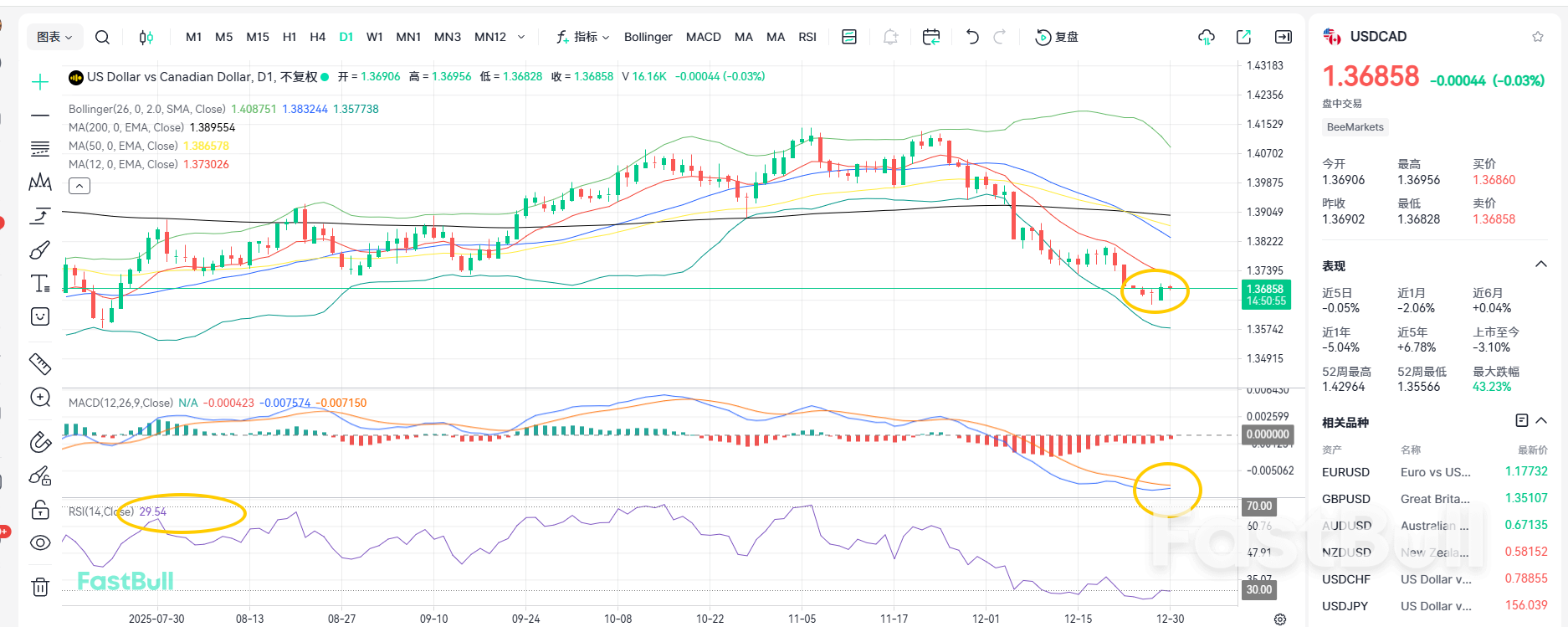
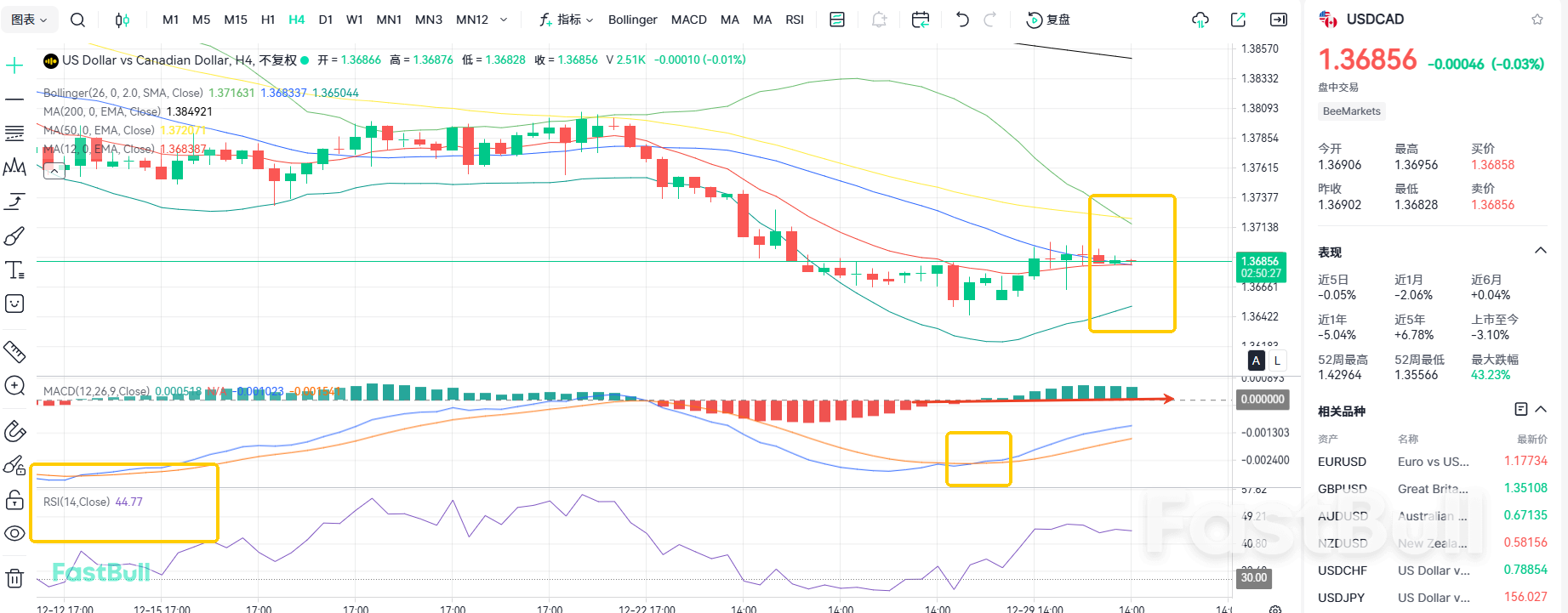
Based on the daily chart, USD/CAD has broken below the EMA200 and is oscillating lower along the EMA12, with MACD and signal lines crossing below the zero axis, indicating entry into a bearish trend. However, a bullish engulfing pattern has emerged, breaking out of the descending channel, suggesting a short-term rebound may occur. MACD is close to forming a golden cross, RSI at 29 signals oversold territory: meaning the downtrend is still valid, but a rebound could happen at any time. In the 4-hour chart, Bollinger Bands are narrowing, moving averages are converging, and downward momentum is gradually weakening. After a golden cross, the MACD and signal lines are retracing toward the zero axis but remain far from it, confirming that the rebound is incomplete. Resistance lies near EMA50 and EMA200 at approximately 1.372 and 1.384, respectively. RSI at 44 reflects prevailing pessimism. Therefore, it is recommended to buy now and sell later.
Trade Recommendations:
Trade Direction: Buy
Entry Price: 1.368
Target Price: 1.42
Stop Loss: 1.35
Support: 1.36/1.357/1.35
Resistance: 1.414/1.42/1.44