The latest economic data from the United States reveals that inflationary pressures remained persistent throughout February. On a monthly basis, the index advanced by 0.4%, reflecting a notable acceleration compared to the 0.3% recorded in January. Conversely, the year-over-year comparison for the Personal Consumption Expenditures (PCE) price index—the Federal Reserve’s preferred inflation gauge—remained stable at 2.8%. Within the core component, prices also climbed 0.4% for the month, aligning perfectly with market forecasts. On an annual basis, core prices exhibited a marginal moderation, retreating from 3.1% to 3%.
In the labor sector, figures continue to demonstrate remarkable resilience, despite emerging mixed signals. Initial jobless claims for the week ending April 4 ascended to 219,000, surpassing both the previous print of 203,000 and analyst expectations of 210,000. Nevertheless, the figure remains anchored near the four-week moving average of 209,500. On a more constructive note, continuing claims descended by 38,000 to 1.794 million—the lowest level recorded since May 2024—suggesting that the underlying structural integrity of the labor market remains sound.
Regarding economic expansion, analyst estimates indicate that the U.S. economy grew at a rate below 0.7% year-over-year during the final quarter of 2025, signaling a perceptible deceleration in aggregate activity. Market focus is now shifting toward the upcoming Consumer Price Index (CPI) release scheduled for Friday. Consensus forecasts anticipate a significant spike in monthly inflation, potentially reaching 0.9% from the previous 0.3%, while the annual rate is projected to climb to 3.3% from its previous 2.4% handle.
On the geopolitical front, investors are maintaining a high degree of vigilance regarding negotiations between the United States and Iran. The initial round of dialogue is set to commence this Saturday in Pakistan, aimed at securing a durable ceasefire and the guaranteed reopening of the Strait of Hormuz. However, Iranian President Masoud Pezeshkian has warned that any military escalation, such as strikes in Lebanon, could destabilize the diplomatic process.
Reinforcing this cautious atmosphere, U.S. President Donald Trump signaled via Truth Social that American forces "will remain in their current positions, and in the vicinity of Iran, until the actual agreement reached is fully fulfilled."
Meanwhile, in Europe, German industrial production experienced an unexpected contraction in February, retreating 0.3% month-over-month. This figure trailed the 0% recorded in January and fell significantly short of the anticipated 0.9% expansion. Consequently, the European Central Bank (ECB) has adopted an increasingly hawkish tone. Policymakers, including Pierre Wunsch and Dimitar Radev, have signaled a potential shift toward further tightening should price pressures persist, noting that an interest rate hike in April remains a distinct possibility, though most officials view a June adjustment as the more likely outcome.
Technical Analysis
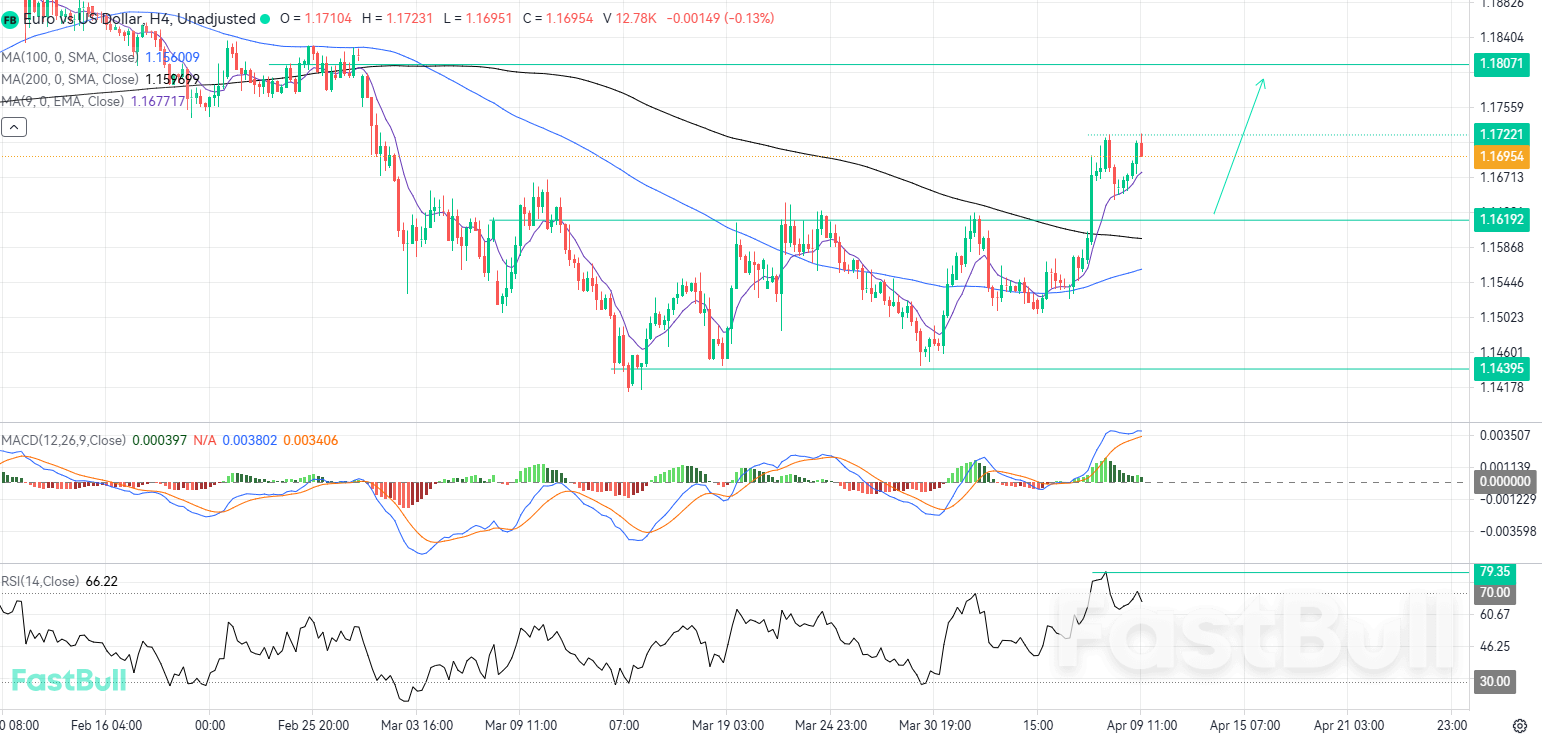
From a technical perspective, EUR/USD recently encountered a formidable supply wall at the 1.1722 level—a zone that has successfully rejected price action twice in recent sessions. This rejection has cleared the path for a tactical correction toward the primary support floor situated at 1.1619. Notably, this level functioned as a major resistance handle in the recent past; its recent breach suggests a classic "Resistance-turned-Support" flip, which would confirm a definitive shift in market bias.
The structural integrity of this support zone is further bolstered by a high-confluence cluster of dynamic indicators. The 200-period Moving Average (MA) is currently tracking at 1.1597, while the 100-period MA sits just below at 1.1560. In the event of a continued downside retracement, these averages are expected to provide significant dynamic support. Consequently, buy-side participation near this confluence zone is highly favored for traders looking to capitalize on the broader trend.
Our analysis of momentum oscillators reinforces the necessity of a brief pullback. The Relative Strength Index (RSI) recently struck the 79 level, signaling extreme overbought conditions. This suggests that a corrective phase is a technical prerequisite before the bullish impulse can resume.
Simultaneously, the MACD is printing a bullish histogram, but the bars are visibly losing depth, indicating an impending transition. However, given that the signal lines remain well-entrenched above the neutral threshold, any immediate downward movement should be characterized strictly as a correction rather than a trend reversal.
Trading Recommendations
Trading direction: Buy
Entry price: 1.1620
Target price: 1.1807
Stop loss: 1.1530
Validity: Apr 17, 2026 15:00:00


