In a recent communication via Truth Social, U.S. President Donald Trump indicated that he has instructed the Department of Defense to defer "any and all" military strikes against Iranian energy and electrical infrastructure for a period of five days. Trump characterized ongoing diplomatic discussions as increasingly "constructive," though he emphasized that this strategic pause remains contingent upon continued progress in negotiations scheduled throughout the week.
However, Tehran has moved swiftly to contradict this narrative. According to reports from the Fars News Agency, internal sources claim there has been no direct or indirect contact with the United States. Furthermore, the Iranian Ministry of Foreign Affairs, via Mehr News, suggested that Trump’s remarks are a calculated effort to suppress global energy prices and secure a tactical advantage for future military maneuvers.
Against this volatile backdrop, West Texas Intermediate (WTI) is currently trading near $85.75 per barrel, marking a sharp decline of approximately 12%. Despite this localized retracement, prices remain significantly elevated compared to pre-conflict levels. Until a definitive de-escalation occurs and maritime traffic through the Strait of Hormuz is fully restored, systemic uncertainty is likely to persist, keeping the risk of energy-driven inflation at the forefront of market concerns.
Simultaneously, the market has been digesting a series of cautious remarks from Federal Reserve officials. Governor Stephen Miran cautioned against an overreliance on short-term headlines, signaling that he does not currently perceive a structural necessity for further interest rate hikes. Meanwhile, Chicago Fed President Austan Goolsbee highlighted the stagflationary nature of energy shocks, noting their propensity to simultaneously drive inflation higher and weaken employment. Goolsbee suggested that while a policy pivot toward rate cuts could materialize by late 2026, the committee still requires "clear and convincing" evidence of a sustained disinflationary trajectory.
The Swiss National Bank (SNB) maintained its primary policy rate at 0.00% during its March deliberation, fulfilling broader market forecasts. However, the most striking development was the bank’s significant shift in foreign exchange guidance. Citing the intensifying regional conflict, the SNB signaled a heightened readiness to intervene in the currency markets. This strategic pivot is designed to thwart any rapid or excessive appreciation of the Swiss Franc (CHF), which policymakers believe could undermine domestic price stability.
During the subsequent press conference, Chairman Schlegel clarified that the existing regulatory agreement between Switzerland and the United States permits the SNB to participate in the FX market, provided such actions do not seek an unfair competitive advantage. Despite this transparency, specific data regarding first-quarter interventions will remain undisclosed until late June. Currently, inflation in Switzerland remains exceptionally subdued, printing at just 0.1% year-over-year in February. This weakness is largely attributed to a multi-year decline in the price of imported goods, a trend sustained by the historical structural strength of the Franc.
Technical Analysis
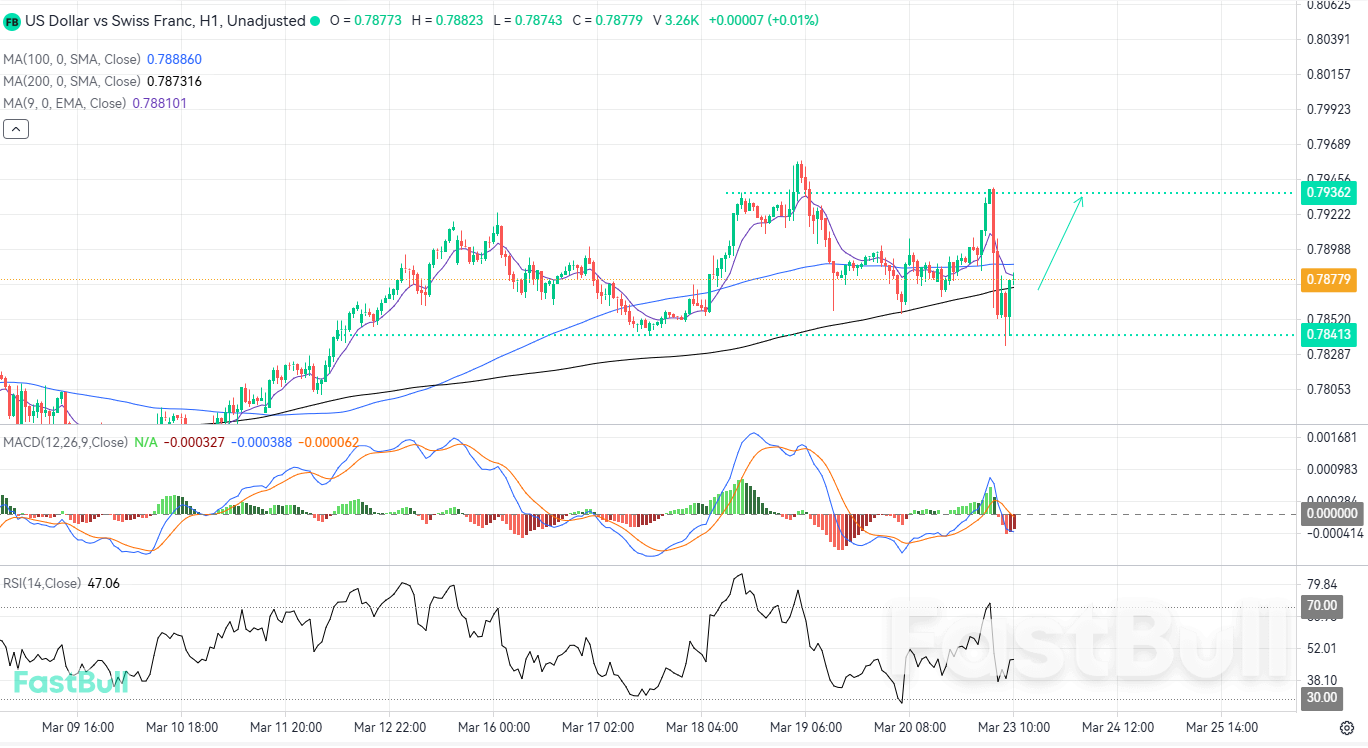
From a technical perspective, USD/CHF has recently executed a sharp bullish rejection after testing a structural floor at the 0.7841 handle. The pair recovered rapidly, reclaiming the 100-period Moving Average (MA) at 0.7873. Currently, the price is challenging the 200-period MA situated just above at 0.7888. This successful defense of support suggests that bulls are attempting to retake control of the narrative, with primary upside objectives targeted at the local resistance zone of 0.7936.
Our analysis of momentum oscillators reinforces the case for a bullish resumption. The RSI is currently hovering at the 47 level, sitting just beneath technical neutrality. This positioning indicates that the pair maintains significant "runway" for further upward expansion before reaching overbought extremes.
While the MACD is still printing a bearish histogram, the bars are visibly contracting in depth. The signal lines are currently oscillating just beneath the neutral threshold. A transition into a positive histogram, coupled with a bullish signal line crossover, would provide the necessary technical validation for a sustained move toward the 0.7936 resistance ceiling.
Trading Recommendations
Trading direction: Buy
Entry price: 0.7876
Target price: 0.7936
Stop loss: 0.7830
Validity: May 03, 2026 15:00:00


