The Bank of Japan’s (BoJ) recent Tankan Survey revealed a notable improvement in sentiment among large manufacturers during the first quarter. The headline index ascended to 17, marking its highest print since December 2021. This fourth consecutive quarterly increase reinforces market expectations regarding a gradual normalization of Japanese monetary policy—a trajectory that typically provides a structural tailwind for the Japanese Yen (JPY).
However, the celebratory mood is tempered by significant caution within the central bank. Some BoJ officials have pointed out that the survey may not fully encapsulate the burgeoning impact of the Middle Eastern conflict. Given Japan’s systemic reliance on energy imports from the region, any protracted escalation could severely dampen the nation’s economic outlook and cap the Yen's potential appreciation. Specifically, BoJ official Toichiro Asada observed that surging oil prices are currently exerting upward pressure on inflation while simultaneously weighing on aggregate growth. Asada characterized this as a burgeoning "stagflationary trend," noting that navigating such a complex economic environment remains a primary challenge for monetary policymakers.
🇺🇸 US Geopolitics: Diplomatic De-escalation and Economic Resilience
In a high-stakes communication from the Oval Office, U.S. President Donald Trump signaled a potential conclusion to regional hostilities, stating that the United States would likely "exit Iran very soon." Trump suggested a tactical withdrawal timeline of approximately two to three weeks, emphasizing a commitment to departure regardless of whether a formal diplomatic accord is reached. Simultaneously, Iranian President Masoud Pezeshkian expressed a reciprocal "necessary will" to terminate the ongoing conflict, though he remains steadfast in his demand for ironclad guarantees to ensure a durable and lasting peace.
This nascent diplomatic optimism coincides with a series of robust economic indicators from the United States, reflecting a resilient domestic landscape. The ISM Manufacturing PMI ascended to 52.7 in March, outperforming market expectations of 52.5 and improving upon the previous reading. Labor market data also delivered a hawkish surprise; the ADP Employment Change reported an addition of 62,000 positions, significantly exceeding the projected 40,000. Furthermore, consumer resilience was evidenced by a 0.6% surge in Retail Sales for February, which comfortably beat the 0.5% forecast and signaled a sharp recovery from January’s downwardly revised contraction.
According to the CME FedWatch Tool, these data points have led markets to price in a period of relative stability, with the Federal Reserve expected to maintain interest rates within the 3.50%–3.75% range through 2026. However, should geopolitical tensions continue to dissipate and catalyze a meaningful decline in global oil prices, expectations for a shift toward monetary easing could rapidly resurface.
Technical Analysis
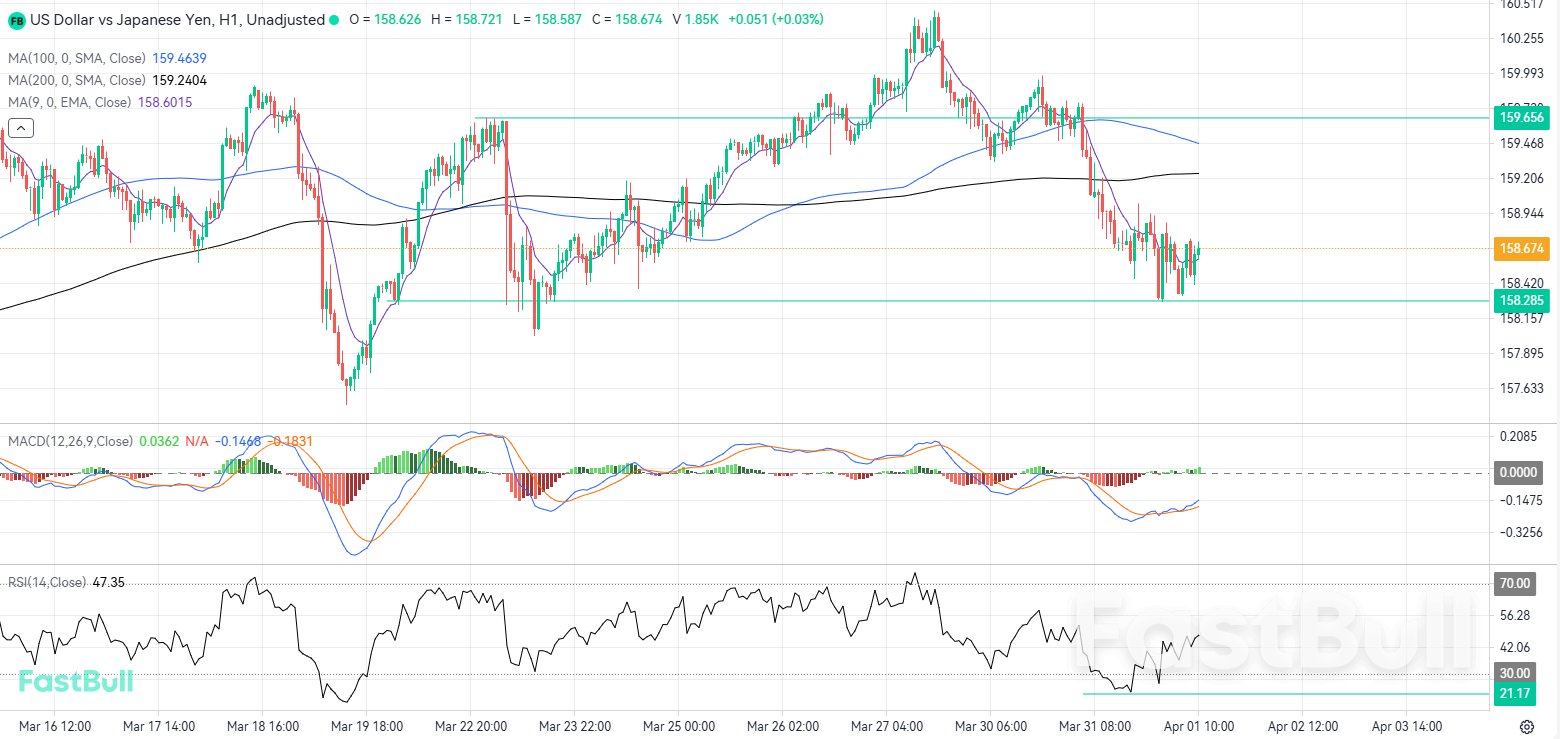
From a technical perspective, USD/JPY has recently undergone a significant corrective movement, retracing toward a critical support zone situated at 158.28. Within this territory, price action has begun to exhibit signs of technical resilience, characterized by the emergence of bullish candlestick formations. This suggests that a corrective rebound could materialize from this floor, with buyers eyeing a recovery toward the most immediate resistance clusters.
On the 1-hour (H1) chart, the 100 and 200-period Moving Averages (MAs) are currently tracking at 159.46 and 159.24, respectively. Given the pair’s historical tendency for mean reversion, the price is technically positioned to challenge these dynamic averages as it seeks to reclaim higher ground near the local resistance ceiling.
Our analysis of momentum oscillators provides further validation for a potential bullish pivot. The Relative Strength Index (RSI) recently plummeted to the 21 level, moving deeply into oversold territory and signaling extreme technical exhaustion for sellers. This positioning typically invites buy-side participation as traders look to capitalize on a price recovery.
Simultaneously, the MACD has already transitioned into a positive histogram, signaling that bulls may be in the early stages of a resurgent move. While the signal lines are currently entrenched in negative territory, their trajectory toward the neutral baseline is encouraging. A decisive crossover above the zero line would provide the necessary technical confirmation for a sustained bullish expansion toward the 159.46 target.
Trading Recommendations
Trading direction: Buy
Entry price: 158.66
Target price: 159.65
Stop loss: 157.90
Validity: Apr 10, 2026 15:00:00


