In a recent communication via Truth Social, U.S. President Donald Trump indicated that he has instructed the Department of Defense to implement a strategic moratorium, deferring "any and all" military strikes against Iranian energy and electrical infrastructure for a period of five days. Trump characterized these nascent diplomatic efforts as increasingly "constructive," though he underscored that this temporary pause remains strictly contingent upon continued progress in high-stakes negotiations scheduled throughout the week.
However, Tehran moved with remarkable swiftness to contradict this narrative. According to reports from the Fars News Agency, internal sources claim there has been no direct or indirect diplomatic contact with the United States. Furthermore, the Iranian Ministry of Foreign Affairs, via Mehr News, suggested that the President’s remarks are likely a calculated rhetorical maneuver designed to suppress global energy prices and secure a tactical advantage for future military contingencies.
Against this high-volatility backdrop, West Texas Intermediate (WTI) is currently trading near $85.75 per barrel, reflecting a sharp localized retracement of approximately 12%. Despite this cooling, prices remains significantly elevated when compared to pre-conflict levels. Until a definitive and verifiable de-escalation occurs—and maritime traffic through the Strait of Hormuz is fully restored—systemic uncertainty is likely to persist. This keeps the looming threat of energy-driven inflation at the absolute forefront of global market concerns.
Simultaneously, the market has been meticulously digesting a series of cautious remarks from Federal Reserve officials. Governor Stephen Miran cautioned participants against an overreliance on volatile short-term headlines, signaling that he does not currently perceive a structural necessity for further interest rate hikes. Meanwhile, Chicago Fed President Austan Goolsbee highlighted the inherently stagflationary nature of energy shocks, noting their propensity to simultaneously drive inflation higher while weakening employment metrics. Goolsbee suggested that while a policy pivot toward rate cuts could potentially materialize by late 2026, the committee still requires "clear and convincing" evidence of a sustained and durable disinflationary trajectory.
The Bank of Canada (BoC) also maintained its high-vigilance posture, electing to keep its benchmark overnight rate at 2.25%—a level that has remained unchanged since October. During the post-meeting press conference, Governor Tiff Macklem signaled that the Governing Council remains prepared to implement further tightening should energy-driven costs translate into persistent, broad-based inflationary pressures. Conversely, he maintained a degree of strategic optionality, suggesting that rate cuts remain on the table if energy prices retreat and broader economic activity exhibits further signs of deceleration.
In the official communiqué, Macklem emphasized that elevated levels of uncertainty continue to plague the outlook, primarily driven by shifting U.S. trade policy and heightened geopolitical risks. Specifically, he warned that the Middle Eastern conflict is driving crude prices higher, which could trigger an immediate, short-term inflationary spike. While higher oil prices historically bolster Canada’s energy export revenues, Macklem cautioned that this macro benefit is often offset by increased costs for domestic consumers, which effectively curtails discretionary spending across other vital sectors of the economy. Ultimately, the BoC indicated a preference to "look through" the transitory inflationary effects of the conflict, yet Macklem made it clear that if energy-derived pressures show signs of becoming entrenched, the bank will act decisively to fulfill its mandate.
Technical Analysis
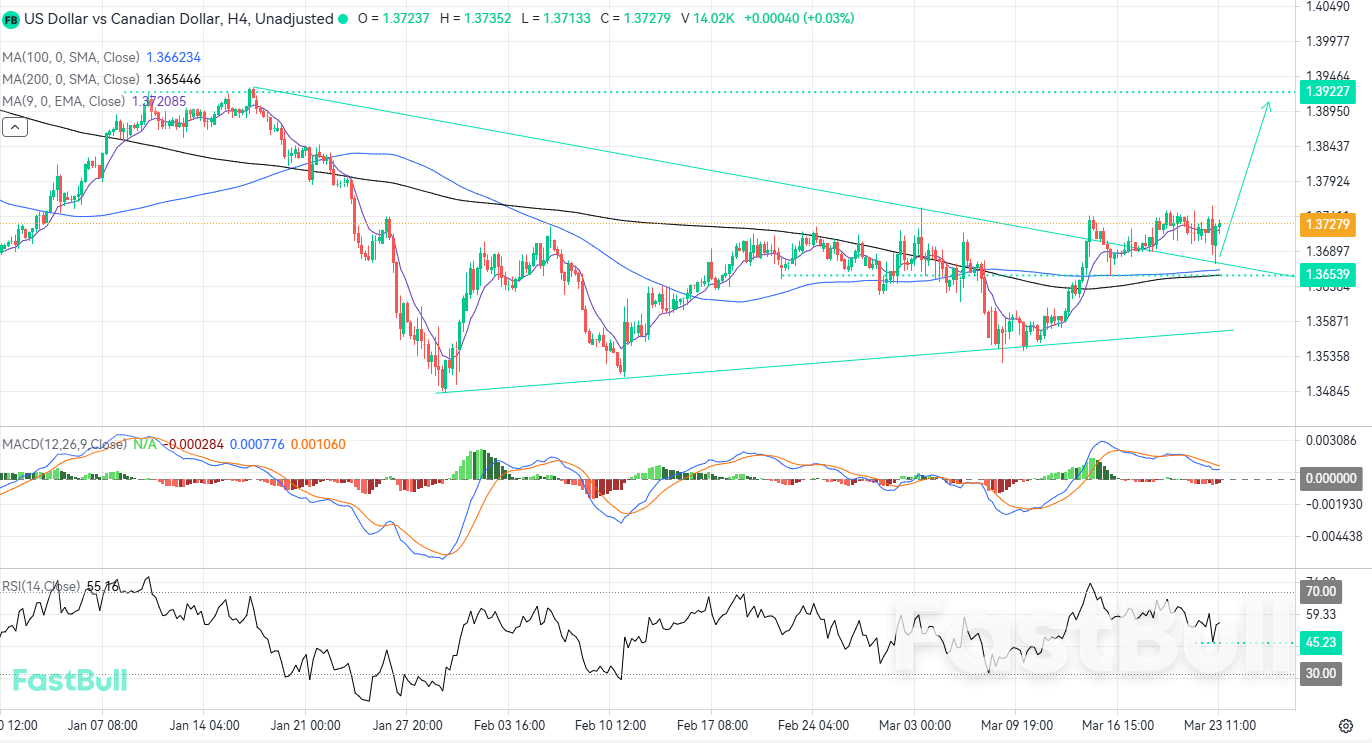
From a technical perspective, USD/CAD has successfully executed a bullish breakout from a triangle formation. Critically, this move was accompanied by a textbook retest of the upper boundary, a price action sequence that typically serves to confirm the validity of the structural shift. Consequently, we anticipate a renewed bullish impulse toward the 1.3922 handle—a major resistance zone and local peak established in mid-January of this year.
The structural integrity of this move is further reinforced by the 100 and 200-period Moving Averages (MAs), currently situated at 1.3662 and 1.3654, respectively. These dynamic indicators are currently tracking just beneath the triangle’s upper boundary, functioning as a support cluster. As a result, buy-side positions initiated near these levels appear increasingly favored in the current setup.
Our analysis of momentum oscillators provides further technical validation for the upside thesis. The RSI recently descended to the 45 level; notably, this reflects a deeper retracement than the one seen on March 16 despite price action holding at similar levels. This suggests that bearish momentum is dissipating rapidly, clearing the path for buyers to retake control.
While the MACD has printed recent bearish bars, they exhibit very little structural depth. Furthermore, the signal lines have remained resiliently north of the neutral threshold, signaling that the broader bullish trend remains intact. A positive transition in the MACD histogram, accompanied by increasing depth, would provide the final confirmation for a sustained upward expansion.
Trading Recommendations
Trading direction: Buy
Entry price: 1.3726
Target price: 1.3922
Stop loss: 1.3610
Validity: May 03, 2026 15:00:00


