The Swiss National Bank (SNB) opted for stability during its March deliberations, maintaining its primary policy rate at 0.00% in a move that aligned seamlessly with broader market forecasts. However, the true focal point of the session was the central bank’s significant recalibration of its foreign exchange guidance. Citing the intensifying regional conflict, the SNB signaled a reinforced readiness to intervene directly in the currency markets. This strategic pivot is specifically designed to thwart any rapid or excessive appreciation of the Swiss Franc (CHF)—a safe-haven asset—which policymakers fear could undermine domestic price stability and exacerbate existing deflationary pressures.
During the subsequent press conference, Chairman Martin Schlegel clarified that the prevailing regulatory agreement between Switzerland and the United States permits the SNB to participate in the FX market, provided such actions do not seek an unfair competitive advantage. Despite this transparency, specific data regarding first-quarter interventions will remain undisclosed until late June. Currently, Swiss inflation remains exceptionally subdued, printing at just 0.1% year-over-year in February. This structural weakness is largely attributed to a multi-year decline in the price of imported goods—a trend sustained by the historical and persistent strength of the Franc.
The geopolitical landscape continues to provide a volatile backdrop, as reports that the U.S. Pentagon is deploying an additional 10,000 troops to the Middle East have intensified fears of a broadening conflict. In response, Iranian Brigadier General Ebrahim Zolfaqari issued a blunt warning on state television, asserting that American forces would face severe consequences in the Persian Gulf. Reinforcing this hostile stance, Parliament Speaker Mohammad Bagher Ghalibaf warned that Iran is prepared to respond with force to any territorial incursions, pushing the region ever closer to a full-scale military confrontation.
On the domestic front, the United States continues to demonstrate remarkable labor market resilience. The Department of Labor reported that initial jobless claims for the week ending March 21 settled at 210,000, aligning with analyst consensus and following a previous print of 205,000. However, this employment stability is sharply contrasted by persistent inflationary headwinds. Import prices surged by 1.3% in February—the most aggressive spike since March 2022—primarily driven by escalating energy costs prior to the regional conflict.
Compounding these concerns, S&P Global recently noted that U.S. enterprises are grappling with elevated input costs throughout March, exacerbated by volatile energy expenditures and localized supply chain bottlenecks. Looking ahead, the U.S. economic calendar is packed with high-impact releases, most notably the Non-Farm Payrolls (NFP) data. This report is expected to exert significant influence over the Federal Reserve’s (Fed) monetary policy outlook as the central bank navigates the delicate line between supporting growth and ensuring price stability.
Technical Analysis
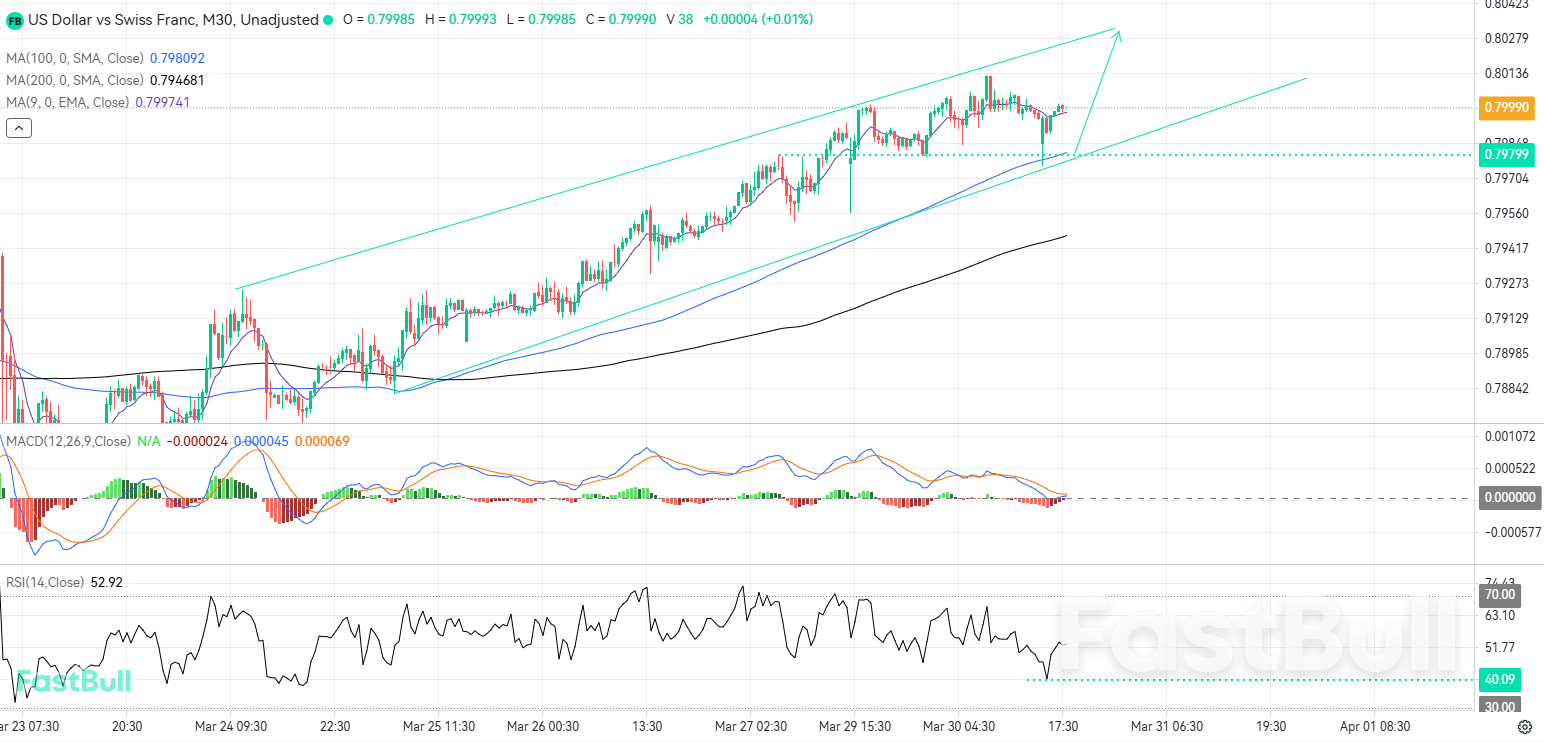
From a technical perspective, USD/CHF is currently navigating a well-defined ascending channel. On the 30-minute (M30) timeframe, the price has recently undergone a technical retracement to the 100-period Moving Average (MA), situated at 0.7980. Meanwhile, the 200-period MA tracks slightly lower at 0.7946, providing a secondary layer of structural defense. Notably, the 100-period MA is currently aligned with the lower boundary of the bullish channel, creating a high-confluence support zone that adds significant weight to the thesis of a bullish continuation toward the 0.8020 handle.
Our analysis of momentum oscillators provides further validation for a potential rebound. The RSI recently struck the 40 level; while this does not represent extreme oversold territory, it marks the lowest reading since March 24. Interestingly, the RSI reached this level despite price action holding higher lows compared to previous sessions, signaling a technical convergence that often precedes a renewed upward impulse.
Analyst Note: While the MACD currently exhibits a bearish histogram, the bars are visibly diminishing in size, suggesting that the corrective momentum is exhausting. With the signal lines still entrenched above the neutral threshold, a transition into a positive histogram appears imminent. Under these conditions, the path of least resistance remains skewed to the upside.
Trading Recommendations
Trading direction: Buy
Entry price: 0.8000
Target price: 0.8025
Stop loss: 0.7980
Validity: Apr 10, 2026 15:00:00


