The optimism surrounding a potential diplomatic understanding between Washington and Tehran recently catalyzed a wave of positive sentiment across Wall Street, propelling all three major indices to close in green territory. However, the momentum of these discussions appears to have moderated as both delegations focus on the intricate drafting of a memorandum intended to prevent further regional escalation.
According to high-level sources, the United States and Iran have successfully narrowed several critical gaps, particularly those concerning maritime security in the Strait of Hormuz. Nevertheless, a point of friction remains: Tehran continues to demand that Washington release frozen Iranian assets as a prerequisite for ensuring unhindered maritime transit through Omani waters.
On the broader geopolitical front, U.S. President Donald Trump announced on Thursday that Israel and Lebanon have agreed to implement a temporary 10-day ceasefire, effective as of 5:00 PM EST (21:00 GMT). This tactical pause is aimed at containing the volatility between Israel and Hezbollah within the context of the wider regional friction involving Iran.
Simultaneously, Federal Reserve officials have reaffirmed their current policy orientation. New York Fed President John Williams warned that ongoing tensions involving Iran are generating additional inflationary headwinds, maintaining that the central bank's restrictive posture remains appropriate for the current environment. In a slightly more tempered but still cautious tone, Governor Stephen Miran indicated that he now anticipates only three interest rate cuts rather than four, citing an inflationary trajectory that has proven less favorable than previously forecasted.
Regarding domestic data, U.S. Initial Jobless Claims descended to 207,000 for the week ending April 11, outperforming market expectations and improving upon the previous print of 218,000. However, secondary labor indicators, such as JOLTS job openings, continue to paint a picture of tepid hiring and historically low layoff levels. Furthermore, U.S. Industrial Production recorded a monthly contraction of -0.5% in March, a sharp reversal from the prior 0.7% growth. The most pronounced declines were concentrated in the automotive sector and utilities, reinforcing the narrative of a cooling economic landscape.
Turning to the United Kingdom, February Gross Domestic Product (GDP) figures delivered a significant upside surprise, vastly outperforming consensus estimates due to robust, broad-based strength across the services, production, and construction sectors. Collectively, this data suggests that economic activity for the first quarter of 2026 may prove far more resilient than the Bank of England’s (BoE) Monetary Policy Committee (MPC) had initially anticipated.
The services sector spearheaded this expansion with a monthly increase of 0.5%, notably higher than the 0.2% expected by analysts. Within this segment, 12 of the 14 sub-components reported growth, with wholesale and retail trade exhibiting particular dynamism alongside professional and administrative services.
Despite these positive figures, UK policymakers remain deeply concerned about entrenched inflationary pressures. They have cautioned that the full impact of the recent energy shock—fueled by surging global prices—may take several months to fully permeate the domestic economy. Furthermore, because this GDP data reflects a period prior to the most recent geopolitical escalations, it is unlikely to be the primary driver of the BoE’s April policy decision, thereby limiting its immediate impact on Sterling’s valuation.
Technical Analysis
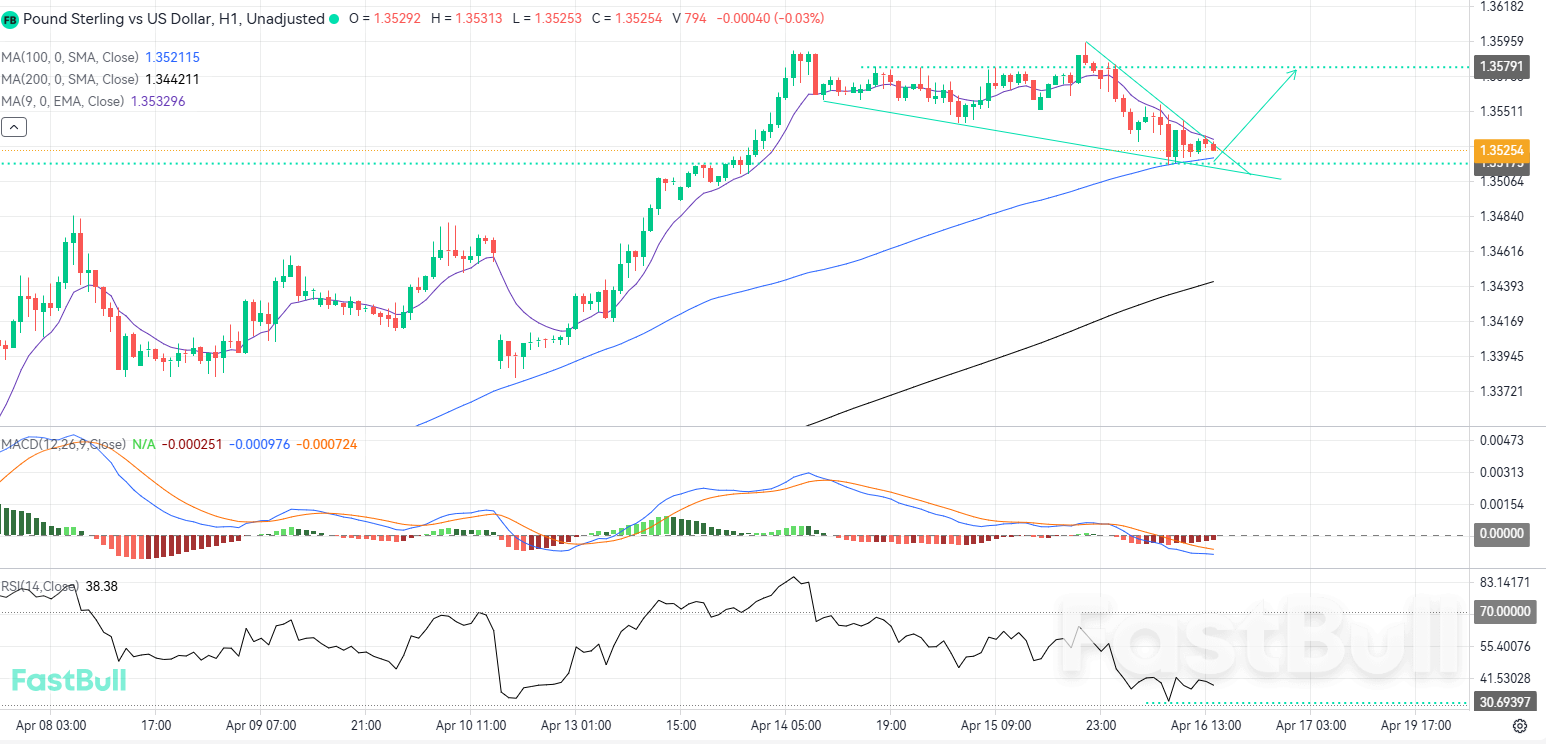
From a technical perspective, GBP/USD is currently undergoing a corrective retracement following its ascent to a local peak of 1.3594 during the previous session. Price action has descended to test the 100-period Moving Average (MA) on the 1-hour chart, situated at 1.3515. Previously, the pair has exhibited a slight bullish rejection from this dynamic level, while the 200-period MA tracks further below at 1.3427.
If the bulls successfully defend this 100-MA support cluster, a decisive breakout above the current short-term descending trendline would likely serve as the catalyst for a recovery toward the next horizontal resistance at 1.3579.
Our analysis of momentum oscillators provides further evidence of a potential pivot. The Relative Strength Index (RSI) plummeted rapidly toward the 30.69 level, entering oversold territory. This aggressive descent suggests that bearish momentum may be approaching a point of exhaustion; if sellers fail to breach the current support floor, they risk losing technical control.
Simultaneously, the MACD is printing a bearish histogram, though it is visibly losing depth. However, the signal lines remain entrenched beneath the neutral baseline. For a sustained bullish expansion to materialize, we would need to see a positive histogram transition accompanied by the signal lines crossing back into bullish territory, validating the resumption of the primary trend.
Trading Recommendations
Trading direction: Buy
Entry price: 1.3522
Target price: 1.3580
Stop loss: 1.3490
Validity: Apr 24, 2026 15:00:00


