Attention across British markets remains firmly fixed on the political landscape, as Andy Burnham is widely anticipated to become the next Prime Minister of the United Kingdom. During a speech outlining his economic vision, Burnham assured that he will respect the fiscal rules established by Chancellor Rachel Reeves, reaffirming his commitment to budgetary discipline.
The Labour leader also noted that he will not make appointments for government positions until the electoral process concludes. Likewise, he reiterated his intention to maintain the core proposals included in the 2024 Labour Party manifesto, including the fiscal guidelines driven by Reeves.
The continuity of current economic policies reduces the likelihood of a significant increase in government financing needs through new debt—a phenomenon that typically occurs during political transitions between parties with contrasting economic approaches. In this context, British 10-year bond yields erased modest gains recorded at the start of the European session and were trading slightly lower, near 4.73%.
On the monetary front, investors continue to assess how long the Bank of England (BoE) will maintain its benchmark rate at 3.75%. In its most recent meeting, the institution decided to keep interest rates unchanged through a 7-2 vote. Among the more hawkish voices, Monetary Policy Committee (MPC) member Megan Greene stood out by supporting a rate hike, viewing it as a preemptive measure against potential second-round inflationary effects.
Meanwhile, the geopolitical focus remains on the Middle East. Tensions escalated over the weekend after Tehran and Washington exchanged strikes near the Strait of Hormuz, an episode that caused disruptions along major maritime routes and raised uncertainty surrounding the peace process between both nations.
Despite the temporary deterioration of the situation, a U.S. official indicated on Sunday that negotiations between the United States and Iran will resume as long as the current cessation of hostilities is maintained, fueling expectations of a potential reduction in diplomatic tensions over the coming weeks.
On the other side, markets are also cautiously awaiting the publication of the U.S. Non-Farm Payrolls (NFP) report, a key reference for evaluating the direction of the Federal Reserve's monetary policy. The importance of this data has increased after the new Fed Chair, Kevin Warsh, stated during a recent conference that the central bank should avoid providing explicit guidance on its next moves in the current political environment.
Traders' expectations reflect this uncertainty. According to the CME FedWatch Tool, markets are currently pricing in nearly a 48% probability that the Federal Reserve will implement an interest rate hike at the September meeting.
Technical Analysis
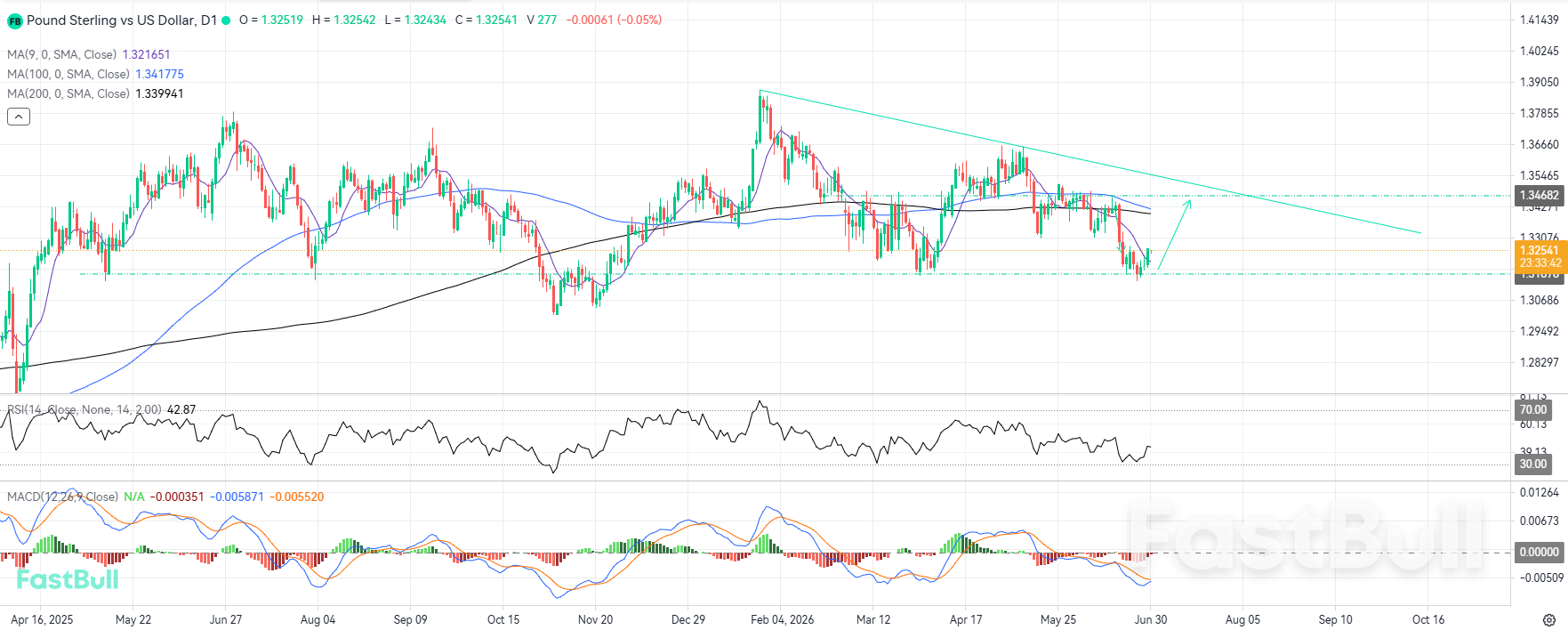
GBPUSD has strongly rejected upward from the support located at 1.3171, a zone that has bounced to the upside on several occasions over the last two years. Consequently, this fresh rejection could bring buying opportunities targeting the 1.3468 area, which marks the next overhead resistance level. We can also observe that the 100 and 200-period moving averages are hovering near this zone at 1.3417 and 1.3399, respectively. Furthermore, this area aligns closely with the descending trendline of the broader structure, adding technical weight to a bullish target near these levels.
Looking at the oscillators, the RSI sits at the 42 level, holding just below the neutral zone and leaving sufficient room to continue its upward path. Meanwhile, the MACD shows a bearish histogram that has already lost all of its depth, suggesting a bullish crossover appears imminent. However, the signal lines remain deeply embedded in bearish territory; therefore, for the move to sustain itself over the longer term, the signal lines would need to cross into the bullish zone. For now, the path of least resistance points upward.
Trading Recommendations
Trading direction: Buy
Entry price: 1.3230
Target price: 1.3468
Stop loss: 1.3090
Validity: Jul 10, 2026 15:00:00


