The United Kingdom's economy exhibited a marginal advancement as 2025 drew to a close. According to the latest data from the Office for National Statistics (ONS), Gross Domestic Product (GDP) expanded by a tepid 0.1% in the fourth quarter, aligning seamlessly with the broader market consensus. On a year-over-year basis, growth remained stagnant at 1.0%. Compounding these concerns, the OECD recently recalibrated its growth projections for the UK, slashing its 2026 estimate from 1.2% down to a more conservative 0.7%.
This fundamental backdrop suggests the UK is gravitating toward a stagflationary environment. This duality is driven by a persistent surge in energy costs—amplified by intensifying Middle Eastern hostilities—colliding with an economy that is rapidly losing traction. Despite this, money markets have already fully priced in a potential easing cycle by the Bank of England (BoE), with cumulative rate cuts currently estimated near 59 basis points.
The geopolitical landscape remains fraught with risk. Iranian state media has indicated that the Islamic Revolutionary Guard Corps (IRGC) is considering significant reprisals against American interests in the region. Specifically, a list of 18 prominent corporations has been identified as potential targets, including global technological titans such as Microsoft, Apple, Google, Intel, and Boeing.
In the United States, recent labor metrics have begun to signal a gradual cooling of the economy. The Job Openings and Labor Turnover Survey (JOLTS) revealed that vacancies plummeted from 7.24 million in January to 6.882 million in February. Furthermore, hiring activity underwent a noticeable deterioration, falling by 3.1 percentage points to settle at 3.4%, according to the U.S. Department of Labor.
While employment stability was momentarily supported by Initial Jobless Claims for the week ending March 21—which settled at 210,000, largely in line with analyst expectations—this stability is sharply contrasted by persistent inflationary headwinds. Import prices surged by 1.3% in February, marking the most aggressive spike since March 2022. This move was primarily catalyzed by escalating energy expenditures prior to the onset of the current regional conflict.
Compounding these structural concerns, S&P Global recently observed that U.S. enterprises are grappling with elevated input costs throughout March, exacerbated by volatile energy prices and localized supply chain bottlenecks. Looking ahead, the economic calendar remains packed with high-impact releases, most notably the Non-Farm Payrolls (NFP) data. This report is expected to exert significant influence over the Federal Reserve’s (Fed) monetary policy trajectory as the central bank navigates the delicate line between supporting growth and ensuring price stability. Currently, the CME FedWatch Tool indicates that markets expect the Fed to hold rates steady within the 3.50%–3.75% range for the remainder of the year.
Technical Analysis
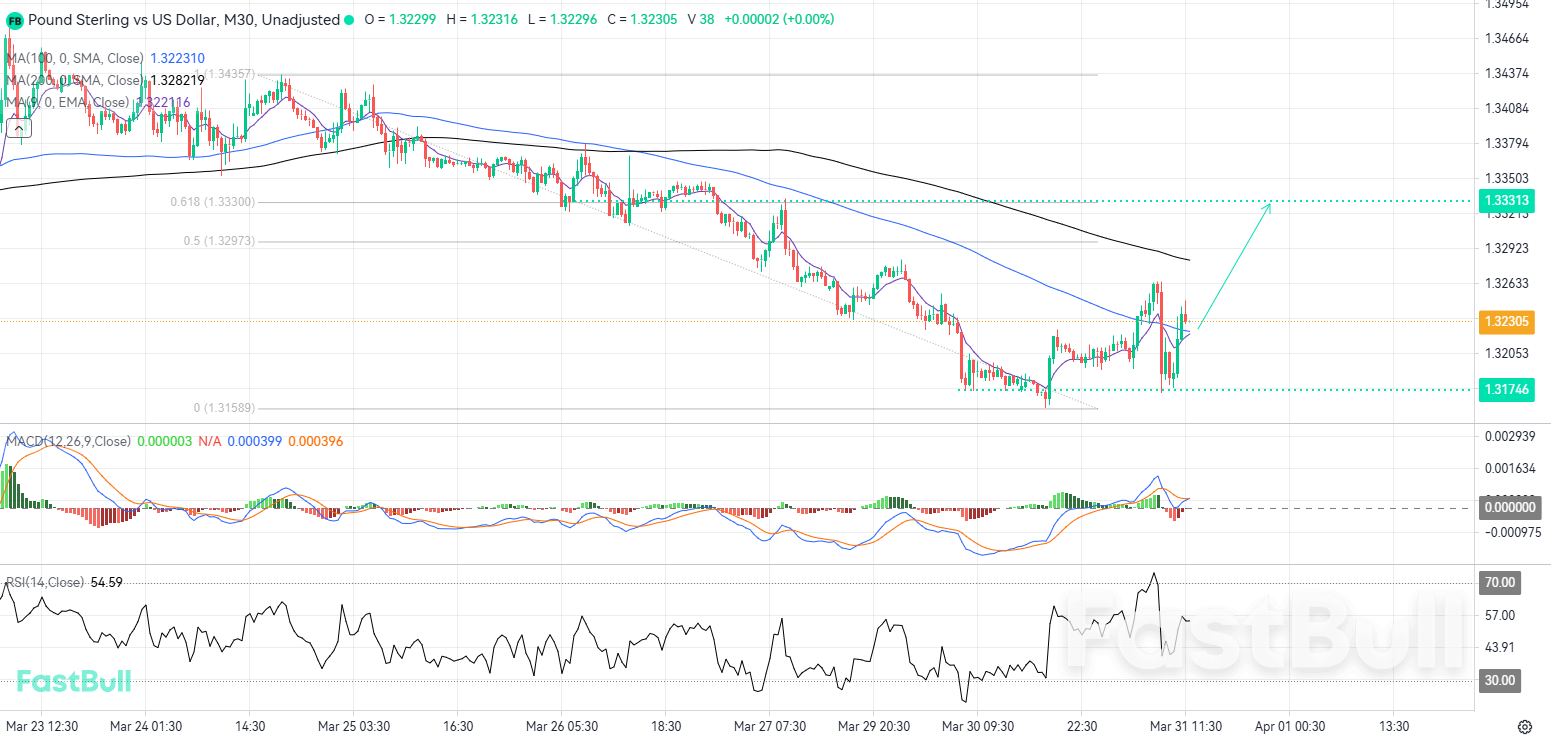
From a technical perspective, GBP/USD has established a solid baseline at the 1.3174 support handle. This level has functioned as a significant psychological and structural "wall" that sellers have been unable to decisively breach. The successful defense of this floor provides a solid foundation for a resurgent bullish impulse, with the primary objective targeted at the 1.3331 resistance zone. This target aligns perfectly with the 0.618 Fibonacci retracement level of the recent downward leg.
On the 30-minute (M30) chart, the pair is currently navigating a cluster of dynamic indicators. The 100 and 200-period Moving Averages (MAs) are situated at 1.3223 and 1.3282, respectively. Notably, the 100-period MA has already been reclaimed by the bulls, a development that could serve as a catalyst for an accelerated upward move toward the 200-period MA and beyond.
Our analysis of momentum oscillators reinforces this constructive outlook. The RSI is currently tracking at the 57 level, sitting comfortably above technical neutrality and providing ample "runway" for a sustained bullish expansion. Simultaneously, the MACD is printing a bearish histogram that is visibly losing depth and is on the verge of a bullish crossover.
Given that the MACD signal lines are already entrenched in positive territory, a confirmed histogram crossover would provide the final technical validation for a continuation of the bullish trend.
Trading Recommendations
Trading direction: Buy
Entry price: 1.3215
Target price: 1.3330
Stop loss: 1.3150
Validity: Apr 10, 2026 15:00:00


