The European Central Bank (ECB) Governing Council recently opted to maintain its current monetary policy trajectory, electing to keep the deposit facility rate at 2.00%, the main refinancing rate at 2.15%, and the marginal lending facility at 2.40%. In its official communiqué, the ECB acknowledged that the intensifying conflict in the Middle East is likely to exert a meaningful upward impact on short-term inflation, primarily through the channel of volatile energy prices. However, policymakers emphasized that the medium-term economic fallout remains strictly contingent upon the duration and intensity of the hostilities, as well as the efficiency with which these surging costs are transmitted to the broader economy.
During the subsequent press conference, ECB President Christine Lagarde underscored the Eurozone’s underlying structural resilience. She asserted that the current environment positions monetary policy effectively to absorb evolving external shocks and reaffirmed that the central bank will remain strictly data-dependent, evaluating its stance on a meeting-by-meeting basis. Despite this balanced tone, internal hawkish dissent is beginning to surface; Bundesbank President Joachim Nagel indicated in a recent interview that an interest rate hike as early as April remains "an option" if surging energy costs begin to unanchor long-term inflationary expectations.
In a parallel display of high vigilance, the Bank of Canada (BoC) elected to anchor its benchmark overnight rate at 2.25%—a level that has remained unchanged since October. During the post-meeting press conference, Governor Tiff Macklem signaled that the Governing Council remains prepared to implement further tightening should energy-driven costs translate into persistent, broad-based inflationary pressures. Conversely, he maintained a degree of strategic optionality, suggesting that rate cuts remain on the table if energy prices retreat and broader economic activity exhibits further signs of deceleration.
In the official communiqué, Macklem emphasized that elevated levels of uncertainty continue to plague the outlook, primarily driven by shifting U.S. trade policy and heightened geopolitical risks. Specifically, he warned that the Middle Eastern conflict is driving crude prices higher, which could trigger an immediate, short-term inflationary spike. While higher oil prices historically bolster Canada’s energy export revenues, Macklem cautioned that this macro benefit is often offset by increased costs for domestic consumers, which effectively curtails discretionary spending across other vital sectors of the economy. Ultimately, the BoC indicated a preference to "look through" the transitory inflationary effects of the conflict, provided they do not become entrenched.
Technical Analysis
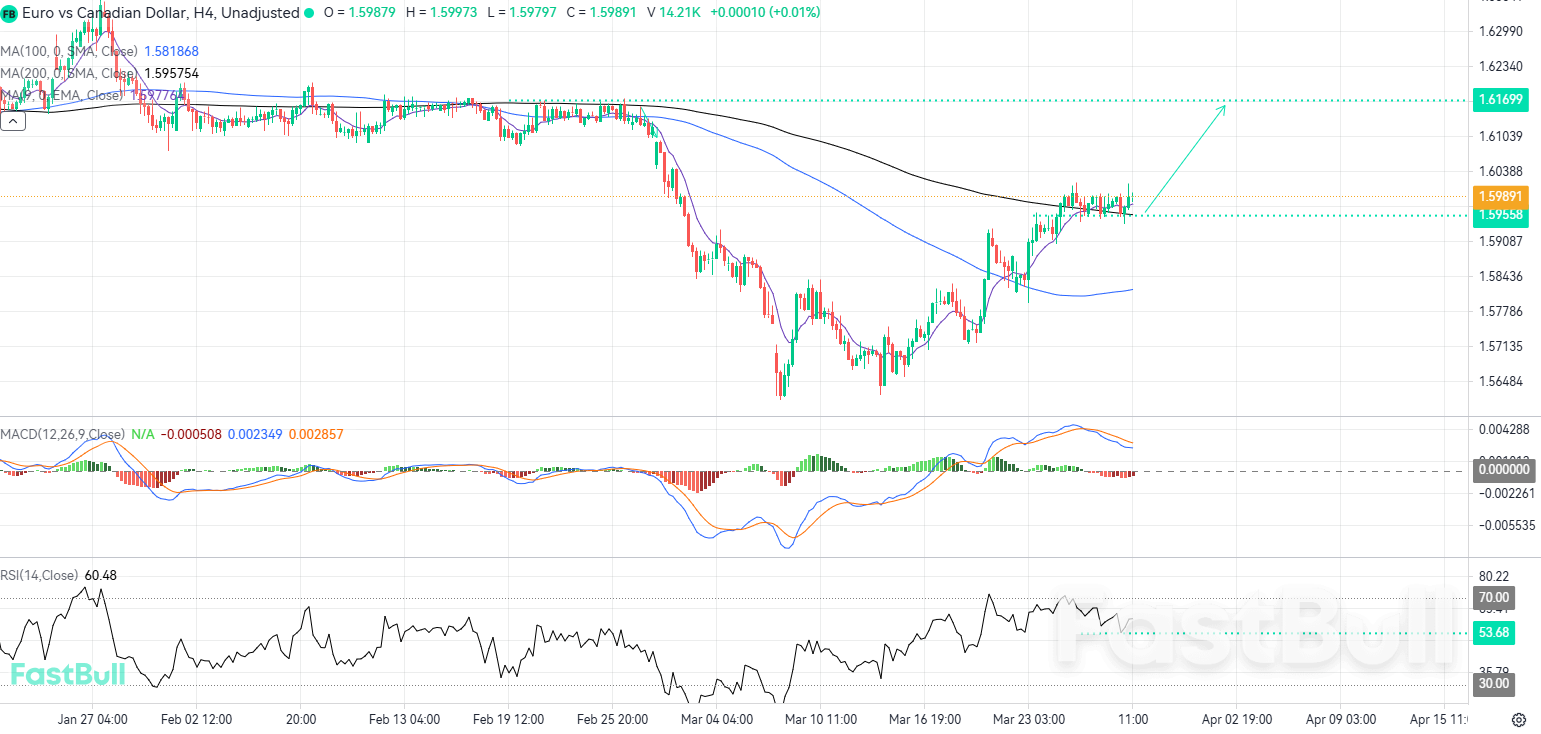
From a technical perspective, EUR/CAD has recently exhibited a powerful bullish impulse, initiating a significant rally on March 13 from the 1.5620 floor to a recent local peak of 1.6014. Critically, this upward move has achieved a decisive close above the 200-period Moving Average (MA) situated at 1.5980. Meanwhile, the 100-period MA tracks lower at 1.5821, providing a deep structural cushion for the current trend.
The successful breach of the 200-MA and the subsequent consolidation above the 1.5955 support zone suggests that the structural bias remains firmly to the upside. This technical configuration clears the path for a secondary bullish leg, with primary objectives targeted at the local resistance ceiling of 1.6169.
Our analysis of momentum oscillators reinforces the case for bullish continuity. The RSI recently moderated to the 53 level; however, the fact that price action underwent only a marginal retracement during this cooling period indicates that buyers maintain total control of the trend. Simultaneously, the MACD recently displayed a series of anemic bearish histogram bars that failed to gain structural depth and are already beginning to contract.
A bullish crossover on the MACD appears imminent. Given that the signal lines remain well-entrenched north of the neutral threshold, the technical backdrop strongly favors a continuation of the bullish impulse.
Trading Recommendations
Trading direction: Buy
Entry price: 1.5988
Target price: 1.6160
Stop loss: 1.5880
Validity: Apr 07, 2026 15:00:00


