On Tuesday, Israel’s Channel 12 reported that the United States has formally proposed a one-month truce designed to facilitate diplomatic breakthroughs, alongside a comprehensive 15-point framework aimed at terminating the ongoing regional hostilities. This proposal reportedly includes significant concessions such as the imposition of renewed restrictions on Iran's nuclear program and ironclad guarantees regarding the navigation of the Strait of Hormuz, in exchange for a gradual lifting of economic sanctions.
However, Tehran has largely downplayed the initiative. On Wednesday, state-affiliated Press TV reported that Iran remains committed to ending the conflict only on its own strategic terms. A high-ranking security and political official emphasized that the nation “will not allow Trump to dictate the conclusion of the war,” asserting that any final agreement is strictly contingent upon the fulfillment of Iranian demands. These prerequisites include a total cessation of military strikes and targeted assassinations, definitive guarantees against the resumption of hostilities, war reparations, the termination of regional combat across all fronts, and formal recognition of Iranian sovereignty over the Strait of Hormuz.
In the United States, the battle against inflationary persistence continues to face significant hurdles. Import prices surged in February at their fastest pace in four years, largely propelled by escalating energy costs prior to the outbreak of the Middle Eastern conflict. Prices climbed by 1.3%—the most substantial increase since March 2022—significantly overshooting market forecasts of a 0.5% advance following January's modest 0.2% rise. Compounding these concerns, S&P Global recently revealed that U.S. enterprises faced higher input costs throughout March, driven by rising energy expenditures and persistent supply chain bottlenecks.
Against this backdrop, the Swiss National Bank (SNB) maintained its primary policy rate at 0.00% during its March deliberation, fulfilling broader market forecasts. However, the most striking development was the bank’s significant shift in foreign exchange guidance. Citing the intensifying regional conflict, the SNB signaled a heightened readiness to intervene in the currency markets. This strategic pivot is designed to thwart any rapid or excessive appreciation of the Swiss Franc (CHF), which policymakers believe could undermine domestic price stability.
During the subsequent press conference, Chairman Schlegel clarified that the existing regulatory agreement between Switzerland and the United States permits the SNB to participate in the FX market, provided such actions do not seek an unfair competitive advantage. Despite this transparency, specific data regarding first-quarter interventions will remain undisclosed until late June. Currently, inflation in Switzerland remains exceptionally subdued, printing at just 0.1% year-over-year in February. This weakness is largely attributed to a multi-year decline in the price of imported goods, a trend sustained by the historical structural strength of the Franc.
Technical Analysis
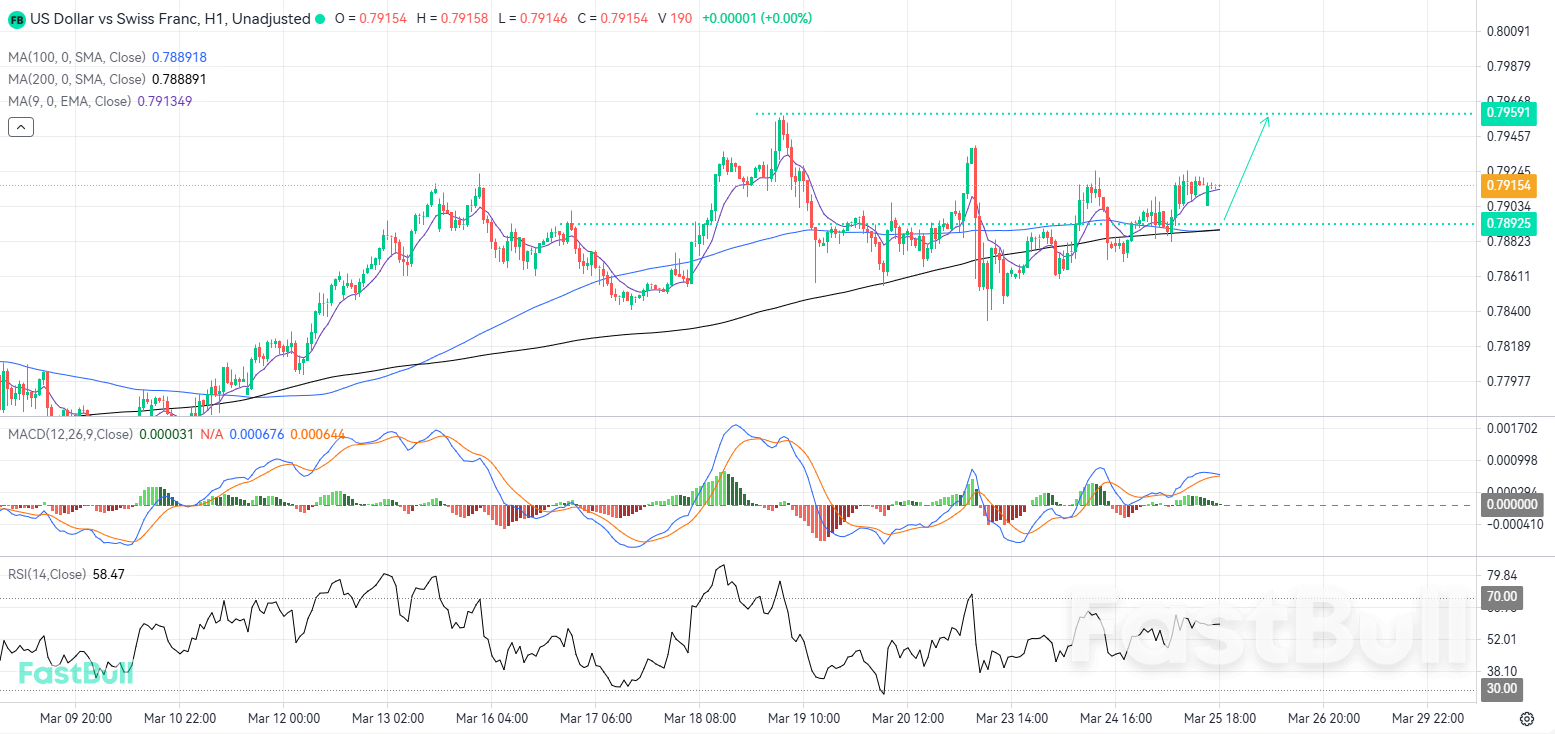
From a technical perspective, USD/CHF is currently exhibiting a bullish rebound after successfully reclaiming the 200-period Moving Average (MA) in recent sessions. The 100 and 200-period MAs are currently tracking in close proximity at the 0.7893 and 0.7881 handles, respectively.
This tight convergence suggests that the area will function as a formidable zone of dynamic support; consequently, any localized retracement toward this cluster is likely to attract buy-side participation. Furthermore, horizontal support at 0.7892 adds another layer of structural defense to this pivot point, increasing the probability of an upside extension toward recent highs.
Our analysis of momentum oscillators reinforces this constructive outlook. The RSI is currently situated at the 58 level, hovering just above the neutral baseline. This positioning suggests that the pair maintains sufficient "runway" for further upward expansion before reaching overbought extremes. Simultaneously, while the MACD histogram remains in positive territory with relatively shallow depth, the signal lines are well-entrenched above the neutral threshold.
While the current structure points toward a new bullish rally, traders should be prepared for a brief corrective phase or a consolidation period as the market absorbs the recent MA reclamation. A decisive break above current local resistance would provide the final confirmation for a sustained move higher.
Trading Recommendations
Trading direction: Buy
Entry price: 0.7892
Target price: 0.7959
Stop loss: 0.7860
Validity: May 03, 2026 15:00:00


