The Iranian military stated on Monday that Tehran has not yet fully closed the Strait of Hormuz and could expand the scope of its blockade to include the Bab al-Mandeb Strait and the Suez Canal. Meanwhile, the Houthis claimed to have attacked King Khalid International Airport in Riyadh, Saudi Aramco facilities in Yanbu on the Red Sea coast, the Shaybah oil field, and Saudi naval forces. These developments raise concerns about a potential expansion of the conflict and the security of key energy transportation routes, increasing the risk of further disruptions to global oil supplies and adding uncertainty to the inflation outlook.
In the United States, elevated energy prices linked to the war in the Middle East continue to contribute to inflationary pressures, with both the September Consumer Price Index (CPI) and Producer Price Index (PPI) reports coming in above expectations. The stronger-than-expected figures have reinforced expectations of another interest rate increase before the end of the year as the Federal Reserve seeks to bring inflation back toward its 2% target. If energy costs remain elevated and continue to affect broader consumer prices and production expenses, the central bank could face additional challenges in bringing inflation under control without further tightening monetary policy.
Recent comments from Fed officials also suggest that policymakers remain open to additional tightening, although they have not firmly indicated that rates will be raised at the October 27–28 meeting. Speaking in Bangkok on Friday, Fed Chair Kevin Warsh maintained his position of avoiding forward guidance, stating, “I do not prejudge meetings.” His remarks leave the timing of any potential rate increase uncertain, reinforcing the importance of upcoming economic releases and inflation data in shaping expectations for the Fed’s next policy decision. Persistent energy-related inflation could strengthen the case for further tightening, although the final decision will depend on how incoming data influence the central bank’s assessment of price pressures.
Swiss National Bank (SNB) Vice Chairman Antoine Martin recently stated that the economic outlook remains subject to a significant degree of uncertainty. However, Martin ruled out interest rate increases in the near term, noting that “we remain comfortably within the 0% to 2% price stability range.” His comments suggest that the current inflation environment does not justify an immediate adjustment to monetary policy, even as uncertainty surrounding global economic conditions and energy prices continues to influence the outlook. This position indicates that the SNB remains focused on its domestic inflation objectives rather than responding immediately to external risks.
The SNB continues to maintain its policy rate at 0%, with the threshold for a potential rate increase appearing relatively high as inflation remains within its 0% to 2% price stability range. This gives the central bank room to maintain its current stance while assessing incoming economic data and the evolution of inflation. Unless price pressures rise meaningfully or the inflation outlook changes, an immediate shift toward tighter monetary policy appears unlikely based on the latest comments from policymakers.
Technical Analysis
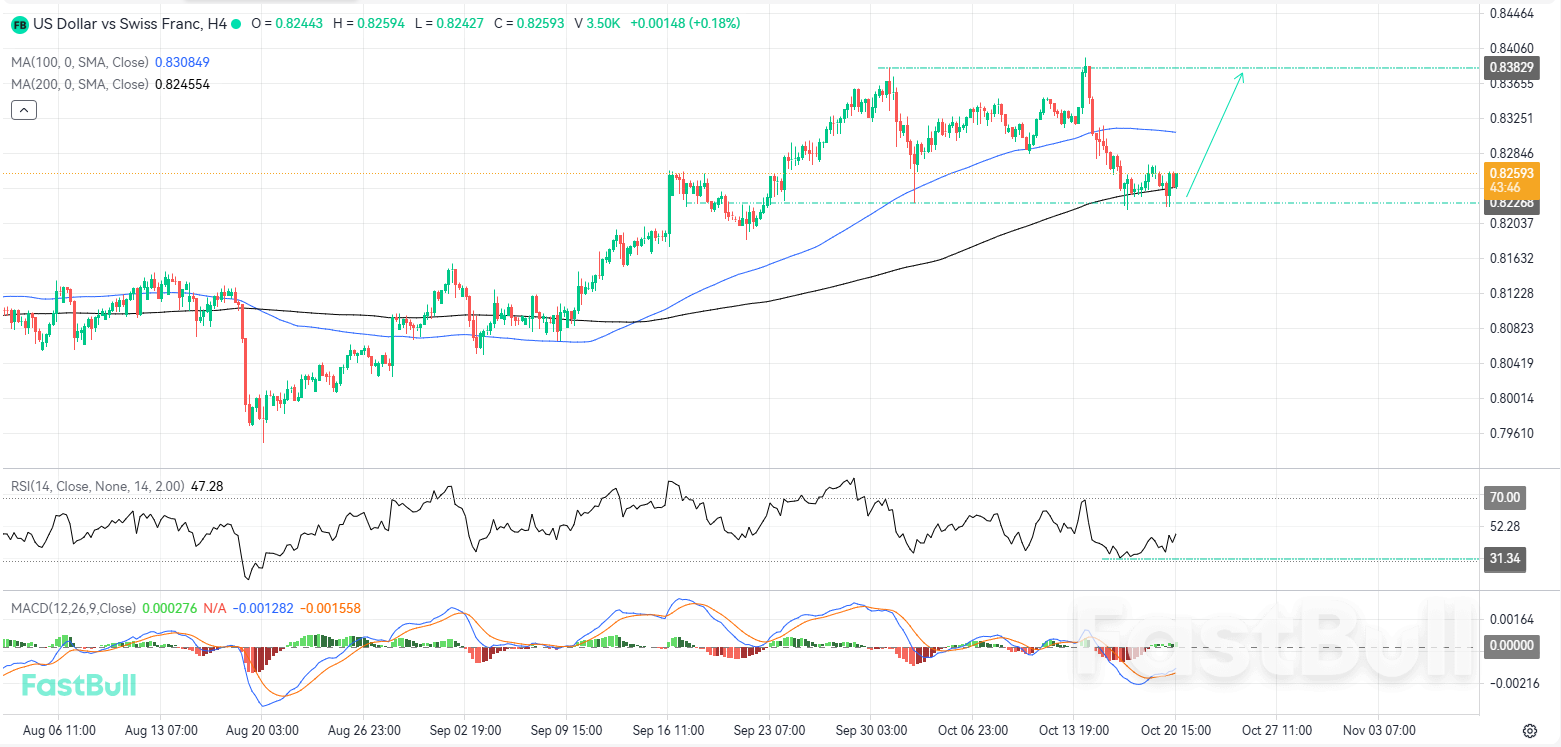
USDCHF has repeatedly failed to break below the local support level at 0.8226, which has now produced three bullish rejections. In addition, the pair has consistently recovered around the 200-period moving average, currently positioned at 0.8245, indicating that this indicator has been providing dynamic support. If buyers continue to defend this area and the pair avoids a sustained break below the support zone, the current price structure could favor a bullish continuation toward the local high at 0.8382, reached last week.
Looking at the oscillators, the RSI is currently near 46, approaching the neutral zone after recently falling to 31, close to oversold territory. A move above 50 could signal a shift toward improving bullish momentum and strengthen the case for a recovery. Meanwhile, the MACD is already displaying a bullish histogram that has started to gain depth, suggesting that upward momentum is gradually increasing. The signal lines, however, remain slightly below the neutral zone, meaning that further confirmation is still needed. If bullish price action develops over the coming sessions, the MACD could move into more clearly positive territory, potentially supporting a faster recovery toward the recent high. A sustained defense of support, combined with improving oscillator readings, would therefore strengthen the possibility of a bullish continuation.
Trading Recommendations
Trading direction: Buy
Entry price: 0.8245
Target price: 0.8382
Stop loss: 0.8170
Validity: Oct 30, 2026 15:00:00


