The United States labor market experienced a notable setback in February, delivering figures that significantly undershot expectations. The latest Non-Farm Payrolls (NFP) report revealed a surprising contraction, with the economy shed over 92,000 positions. This result stands in stark contrast to the market consensus, which had anticipated the addition of approximately 59,000 jobs. Consequently, the unemployment rate edged higher to 4.4%. While this indicates a cooling labor environment, it is worth noting that the figure remains just below the 4.5% threshold projected by the Federal Reserve for 2026.
Counterbalancing the labor weakness, consumer spending remains a pillar of strength. The Census Bureau reported that Retail Sales reached $733.5 billion in January, outpacing the market’s forecast of a 0.3% decline. On a year-over-year basis, sales grew by 3.2%, an acceleration from the previous 2.4% expansion. Within the specific segments, non-store (e-commerce) retailers led the charge with a robust 10.9% annual increase, while the food services and drinking establishments sector advanced by 3.9%.
The monetary policy narrative remains complex as Federal Reserve officials digest these diverging data points. Susan Collins, President of the Boston Fed, emphasized that the central bank requires "definitive evidence" of a sustainable disinflationary trend before considering rate cuts, noting no immediate urgency to shift the current policy stance. Similarly, Kansas City Fed President Jeffrey Schmid observed a noticeable slowdown in corporate hiring. Meanwhile, Governor Stephen Miran cautioned against over-interpreting a single monthly report, though he acknowledged that current policy might be reaching "excessively restrictive" territory.
San Francisco Fed President Mary Daly described the February data as "disappointing," suggesting it undermines the thesis of a stabilizing labor market. However, she indicated that the Fed would likely maintain its "wait-and-see" approach, holding rates steady while awaiting further clarity from upcoming data releases.
Across the Atlantic, the Eurozone continues to navigate a path of moderate growth. Final figures show that Gross Domestic Product (GDP) expanded by 0.2% in the fourth quarter, slightly trailing initial estimates. On an annual basis, the economy grew by 1.2%, reflecting a recovery that remains fragile due to persistent trade frictions and an uncertain global environment.
Against this backdrop, ECB board member Isabel Schnabel noted during the U.S. Monetary Policy Forum in New York that while the European Central Bank remains in a solid position, the ongoing conflict involving Iran has introduced significant upside risks to the inflation outlook, potentially complicating the path toward further monetary easing.
Technical Analysis
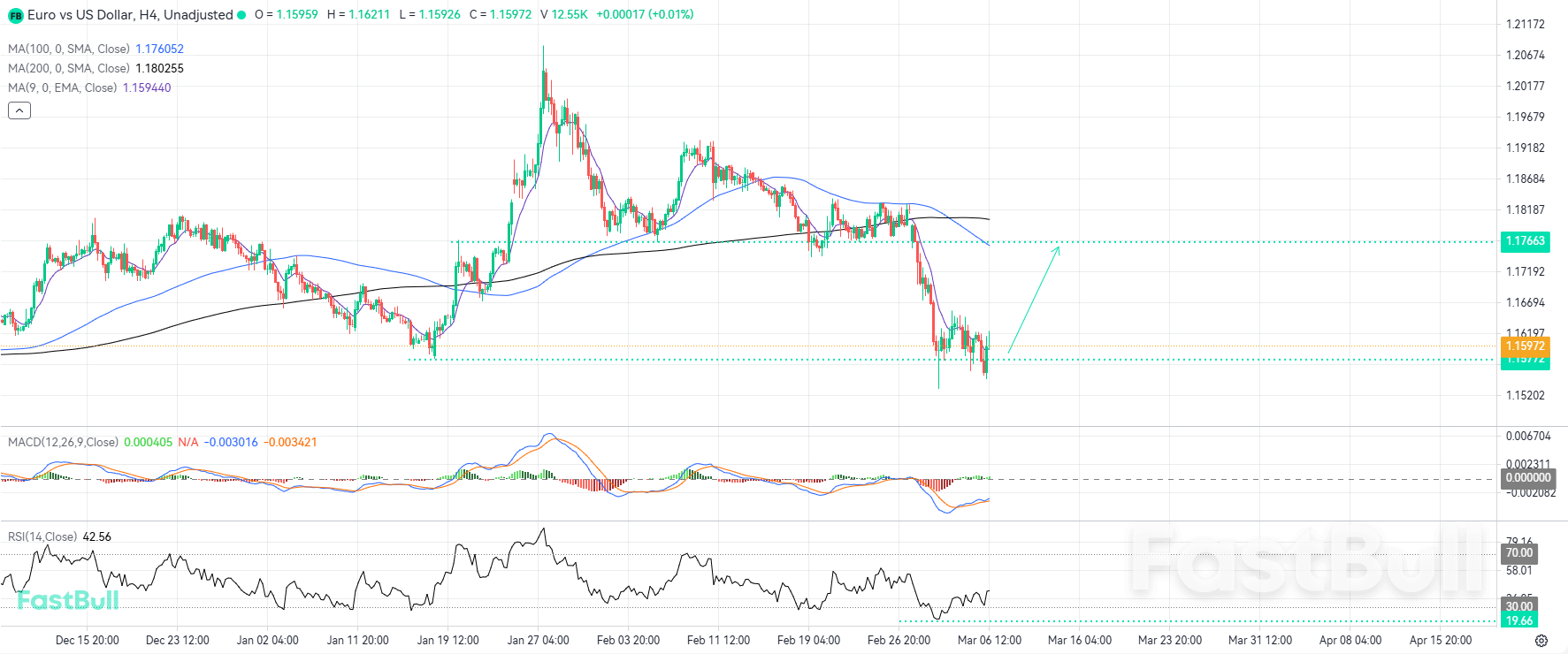
From a technical standpoint, EUR/USD has once again validated the critical support handle at 1.1577, a level that served as a major pivot point on January 18. While the pair briefly traded beneath this threshold amidst the recent volatility, buyers were quick to reclaim the level, demonstrating strong structural defense. If this floor continues to hold, we anticipate a bullish impulse targeting the primary resistance zone at 1.1766.
The structural significance of this upside target is magnified by a high-confluence cluster: the 100 and 200-period Moving Averages (MAs) are currently situated at 1.1760 and 1.1802, respectively. The proximity of these dynamic averages to the horizontal resistance significantly increases the probability of a price "magnet" effect toward this region.
Our analysis of momentum oscillators provides a compelling case for a reversal. The RSI recently plummeted to 19.66, moving deep into extreme oversold territory. Such readings historically serve as a precursor to significant short-covering rallies or bullish pivots. Simultaneously, the MACD is printing a persistent bullish histogram. Should these bars gain structural depth, it would confirm the start of a corrective recovery, with the signal lines likely crossing above the neutral threshold to validate an extended move toward the 1.1800 handle.
Trading Recommendations
Trading direction: Buy
Entry price: 1.1578
Target price: 1.1766
Stop loss: 1.1510
Validity: Mar 13, 2026 15:00:00


