Market sentiment was jolted Wednesday following reports that former President Donald Trump is privately weighing a withdrawal from the USMCA, a cornerstone trade agreement he originally championed. Given that the treaty facilitates approximately $2 trillion in annual trade of goods and services, even the mere suggestion of a U.S. exit could trigger significant waves of uncertainty among global investors and policymakers.
Simultaneously, geopolitical attention remains fixed on Eastern Europe, as Ukrainian President Volodymyr Zelensky indicated that territorial issues will be the central pillar of upcoming negotiations with the U.S., signaling a potential openness to concessions to secure a diplomatic end to the conflict.
The domestic economic landscape offered a complex narrative with the delayed release of the Nonfarm Payrolls (NFP) report on Wednesday. January’s data initially appeared robust, showing the creation of 130,000 jobs, nearly doubling the 70,000 consensus and dwarfing December’s revised 48,000. However, annual benchmark revisions by the Bureau of Labor Statistics (BLS) painted a much bleaker picture; total nonfarm employment for 2025 was adjusted downward by a staggering 898,000 positions. This revision effectively slashed the monthly job creation average from the previously reported 49,000 to a mere 15,000. Despite these structural adjustments, the unemployment rate edged down to 4.3% from 4.4%, and average hourly earnings advanced by 0.4% monthly, exceeding the 0.3% estimate.
Against this backdrop, Federal Reserve rhetoric remains characteristically nuanced. Kansas City Fed President Jeffrey Schmid advocated for a continued restrictive stance as inflation hovers near 3%, noting that demand continues to outpace supply growth. In contrast, Dallas Fed President Lorie Logan adopted a more balanced tone, highlighting that the labor market is stabilizing and that downside risks have largely diminished.
These developments coincide with recent data from Statistics Canada, which reported an unexpected contraction in the labor market, with the economy shedding 24,800 jobs in January. However, a deeper dive into the figures reveals that these losses were entirely confined to part-time positions, suggesting a shift in labor composition rather than a systemic collapse. Paradoxically, the national unemployment rate dropped to 6.5%, its lowest level since September 2024, outperforming market consensus expectations of 6.8%. This resilient unemployment figure has significantly mitigated downside risks regarding Canada’s growth trajectory, cooling the anticipation for aggressive monetary easing from the Bank of Canada (BoC) and providing a stable fundamental floor for the Canadian Dollar (CAD).
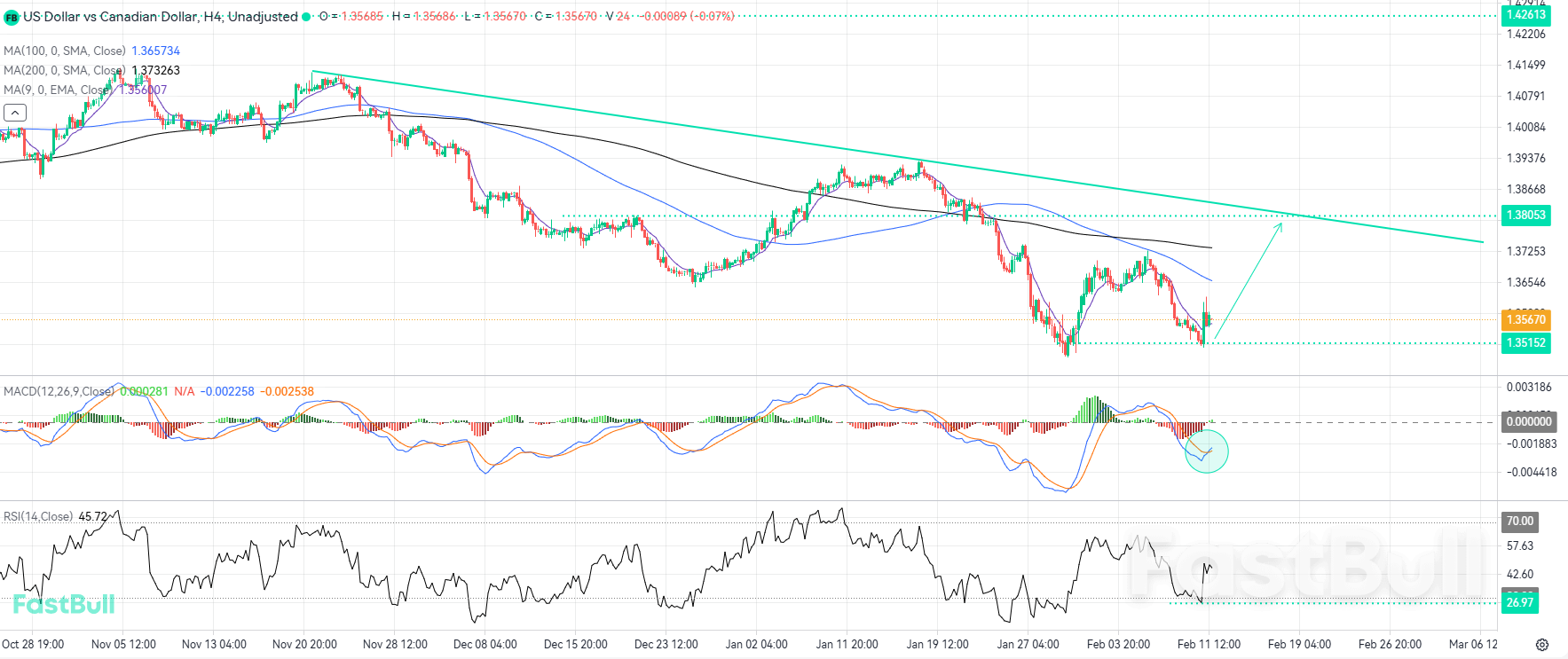
Technical Analysis
USDCAD has undergone a significant retracement toward the primary support zone at 1.3515, a level situated in close proximity to the yearly low of 1.3485 established on January 29. Historically, this demand zone acted as a powerful catalyst, propelling the pair to 1.3729 in early February following a brief interaction with the 100-period Moving Average.
While the pair recently faced renewed bearish pressure, the aggressive bullish reaction near the current support floor suggests that buyers are reclaiming control. This technical pivot sets the stage for a new bullish impulse with an objective targeting the major descending trendline that has dictated price action since November 24 of last year. This trendline converges near the 1.3805 handle, which also serves as a critical structural resistance.
The structural outlook is further reinforced by the 100 and 200-period Moving Averages on the 4-hour chart, currently positioned at 1.3657 and 1.3732, respectively. Supporting the reversal thesis, the Relative Strength Index (RSI) struck a deeply oversold reading of 26.9 as the price approached the support zone, signaling an exhausted bearish drive.
Furthermore, our MACD analysis shows a positive histogram crossover, even as the signal lines remain below the neutral threshold. If the histogram continues to gain depth and momentum, it would provide the necessary technical confirmation for a sustained rally toward the trendline. Conversely, a decisive break below the 1.3485 local low would invalidate this bullish setup and signal a deeper structural breakdown.
Trading Recommendations
Trading direction: Buy
Entry price: 1.3540
Target price: 1.3800
Stop loss: 1.3450
Validity: Feb 24, 2026 15:00:00


