RBA Deputy Governor Andrew Hauser issued a cautionary outlook during an informal address on Tuesday, signaling that the coming months may prove exceptionally intricate for the Australian economy. Hauser highlighted a challenging nexus of energy-driven shocks—stemming from systemic volatility in the Middle East—and persistent inflationary pressures. He noted that the domestic economy is currently struggling to absorb these exogenous shocks, largely due to entrenched supply-side constraints. This complex dynamic significantly heightens the risk of a burgeoning stagflationary environment, where stagnant growth meets rising price pressures.
This deteriorating sentiment was mirrored in April’s consumer data, as the Westpac Consumer Confidence index recorded a sharp 12.5% collapse. This reflects heightened household anxieties regarding soaring energy costs and broader global economic uncertainty. Looking ahead, investors are pivoting their focus toward high-impact catalysts, specifically the upcoming Australian employment report and China’s GDP figures, both of which are expected to dictate the Australian Dollar’s (AUD) medium-term valuation and the RBA’s subsequent policy trajectory.
Across the Atlantic, European Central Bank (ECB) policymaker Joachim Nagel recently emphasized that the upcoming April policy decision will remain heavily contingent upon evolving developments surrounding the Strait of Hormuz. Highlighting a persistent lack of "sufficient clarity" regarding the geopolitical landscape, Nagel underscored that the ECB intends to maintain "full institutional optionality" in its upcoming deliberations. He further clarified that there is no predetermined commitment regarding interest rate trajectories, reiterating the bank’s primary and unwavering mandate to ensure long-term price stability.
This institutional caution is unfolding against a backdrop of shifting political dynamics. The recent election results in Hungary—marking the conclusion of Viktor Orbán’s 16-year tenure—have been widely interpreted as a significant relief factor for the Eurozone. This political transition has provided a localized tailwind for the Euro, bolstering the common currency across several major pairs as markets price in a more cohesive and predictable European landscape.
However, despite this burst of political optimism, structural industrial fragility continues to plague the Eurozone’s core. In Germany, industrial production recorded a 0.3% monthly decline in February, significantly underperforming the anticipated 0.9% growth and following a stagnant January performance. On a year-over-year basis, the sector remains effectively stalled, coming off a revised 0.9% contraction in the preceding month. Further complicating the outlook, Eurozone annual inflation climbed to 2.5% in March—its highest level since January 2025—exceeding the ECB’s 2% target. In response, ECB President Christine Lagarde reaffirmed that monetary policy will remain restrictive until inflation is sustainably anchored at the target.
Technical Analysis
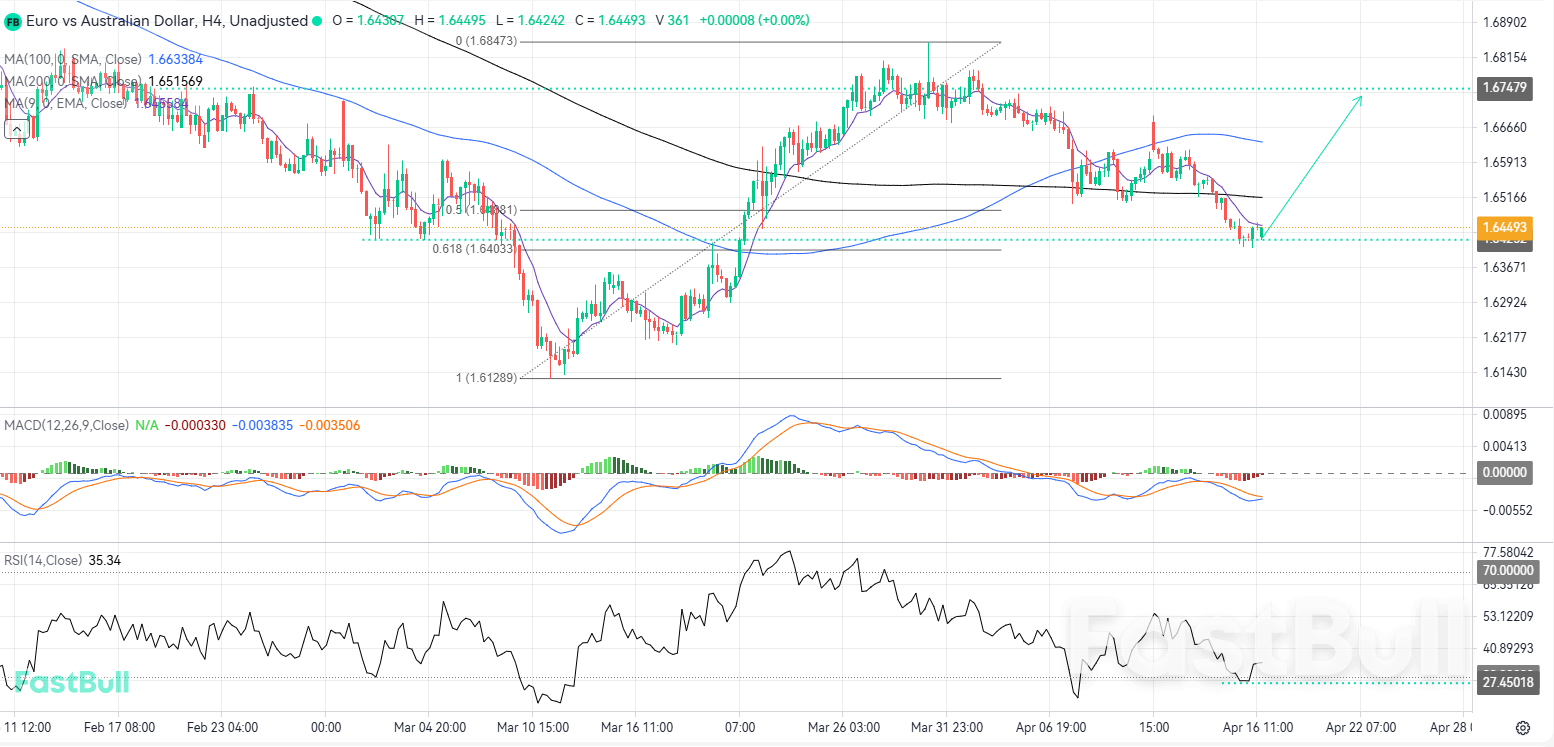
From a technical perspective, EUR/AUD executed a powerful bullish impulse originating from the 1.6128 handle on March 11, ascending to a local peak of 1.6847 by March 31. Following this expansion, price action initiated a corrective retracement, recently descending to test the primary support zone at 1.6424.
This specific level is of high technical interest as it sits precisely between the 0.50 and 0.618 Fibonacci retracement levels—a territory often referred to as the "golden pocket" for trend resumption. Provided this structural floor remains unbreached, the pair is technically positioned for a bullish rebound. It is worth noting that the 100 and 200-period Moving Averages (MAs) on the H4 chart are currently tracking at 1.6633 and 1.6515, respectively. A decisive reclamation of the 200-period MA would likely serve as the technical confirmation required for a sustained move back toward recent highs.
Our analysis of momentum oscillators provides a compelling case for a bullish pivot. The Relative Strength Index (RSI) recently struck the 27 level, moving deeply into oversold territory. This follows a similar reading of 21 recorded on April 7; the formation of a higher trough in the RSI while price remains at support suggests a bullish divergence, signaling that the downward momentum is reaching a point of technical exhaustion.
Simultaneously, the MACD is printing a bearish histogram, but the bars are visibly losing depth, indicating that a bullish crossover may be imminent. While the signal lines are currently entrenched beneath the neutral baseline, a transition into a positive histogram would likely catalyze the next leg of the bullish impulse. Traders should monitor the 1.6424 zone closely for a high-volume rejection.
Trading Recommendations
Trading direction: Buy
Entry price: 1.6425
Target price: 1.6747
Stop loss: 1.6280
Validity: Apr 29, 2026 15:00:00


