On Wednesday, the latest inflationary data from Australia revealed a largely stable trajectory throughout February, offering a degree of much-needed relief to domestic households. The Consumer Price Index (CPI) exhibited a slight moderation, retreating from 3.8% to 3.7% year-over-year. Despite this welcome cooling, the figure remains entrenched above the Reserve Bank of Australia’s (RBA) mandated 3% target.
Concurrently, the underlying measure—the trimmed mean CPI—settled at 3.3% year-over-year, remaining unchanged from January’s figure, which was itself revised downward from an initial 3.4%. It is crucial to note that these figures were tabulated prior to the recent escalation of hostilities in the Middle East, a conflict that has since propelled global energy costs higher and intensified systemic inflationary risks.
In this volatile environment, RBA Deputy Governor Christopher Kent recently observed that the conflict involving Iran has contributed to a tightening of global financial conditions. He underscored that such supply-side shocks represent a primary risk to the disinflationary process. Kent clarified that while central banks lack the tools to prevent the immediate impact of these shocks, they must act decisively to ensure that localized price spikes do not manifest as long-term inflationary expectations or more persistent price pressures.
Regarding monetary policy, the RBA elevated the cash rate to 4.1% last week following a narrowly contested vote. Governor Michele Bullock characterized the decision as a strategic matter of timing rather than a fundamental pivot in the bank’s broader policy orientation.
Across the Atlantic, the Bank of Canada (BoC) has maintained a posture of significant caution, electing to leave its benchmark overnight rate unchanged at 2.25%, a level sustained since October. During the post-meeting press conference, Governor Tiff Macklem signaled that the Governing Council remains prepared to further tighten monetary policy should surging energy costs generate broad-based and persistent inflationary pressures. Conversely, he maintained a degree of strategic optionality, suggesting that rate cuts remain on the table should energy prices retreat and economic activity exhibit further signs of deceleration.
In the official communiqué, Macklem emphasized that the economic landscape remains clouded by a high degree of uncertainty, primarily driven by shifting U.S. trade policy and heightened geopolitical risks. Specifically, he warned that the Middle Eastern conflict is driving crude prices higher, which could trigger an immediate—albeit likely transitory—inflationary spike.
While elevated oil prices typically bolster Canada’s energy export revenues, Macklem cautioned that this macroeconomic benefit is often neutralized by higher costs for domestic consumers. This dynamic effectively curtails discretionary spending across other vital sectors of the economy. Consequently, the BoC reaffirmed its intention to "look through" temporary inflationary volatility. However, Macklem made it clear that if energy-derived pressures show signs of becoming entrenched, the institution will not hesitate to act firmly to fulfill its price stability mandate.
Technical Analysis
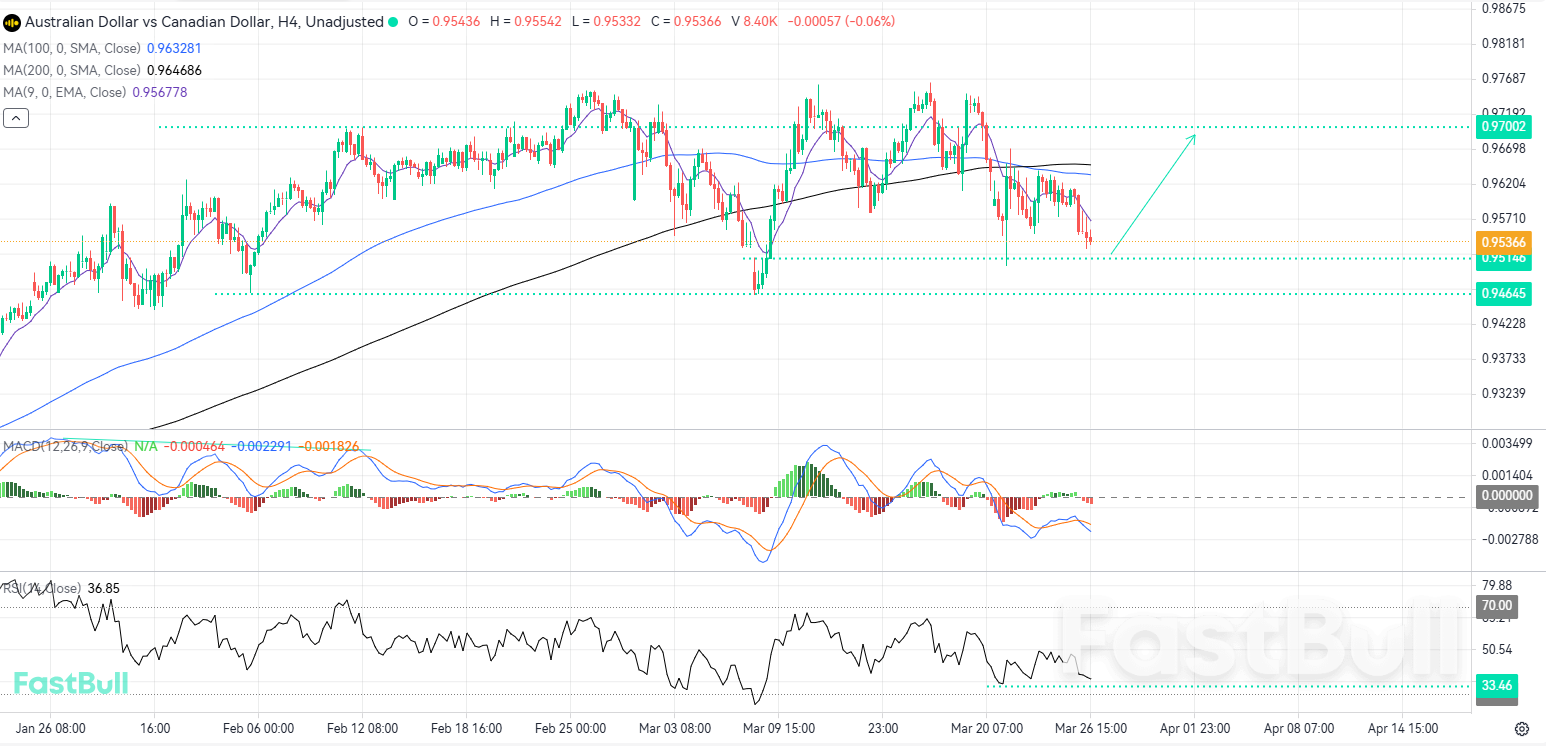
From a technical perspective, AUD/CAD has undergone a bearish correction that has brought the pair back to a critical support floor at the 0.9514 handle. This specific level is of high structural significance, as it aligns with a gap-fill zone established in early March. Price action recently exhibited a bullish rejection from this same area at the start of the week, suggesting that buy-side interest remains active at these depths.
Should the pair successfully defend this support, we could witness the inception of a bullish correction targeting the 0.9700 resistance zone. En route to this target, the pair must contend with the 100 and 200-period Moving Averages (MAs), situated at 0.9632 and 0.9646, respectively. A decisive reclamation of these dynamic averages would provide the necessary technical validation for a renewed and sustained upward impulse.
Our analysis of momentum oscillators reinforces the importance of these levels. The RSI is currently tracking at 37, which—while bearish—has not yet reached oversold extremes, leaving "runway" for further depreciation if support fails. Simultaneously, the MACD is printing a bearish histogram with signal lines entrenched beneath the neutral baseline.
Given the MACD’s current trajectory, there is a technical possibility that the price could test the secondary support at 0.9464 before a meaningful bullish resumption occurs. Conversely, a clean break beneath 0.9464 would signal a more profound trend reversal. Consequently, the integrity of these support levels remains the primary focal point for determining the pair's next major directional move.
Trading Recommendations
Trading direction: Buy
Entry price: 0.9514
Target price: 0.9700
Stop loss: 0.9425
Validity: Apr 07, 2026 15:00:00


