Market participants are currently fixated on the Bank of England’s (BoE) interest rate decision, scheduled for this upcoming Thursday. Until recently, investors had assigned nearly equal probabilities to a potential rate cut in March; however, the resurgent volatility in crude oil prices—triggered by intensifying geopolitical friction in the Middle East—has effectively neutralized that possibility. Under prevailing conditions, the market consensus overwhelmingly suggests that the benchmark interest rate will remain anchored at 3.75%.
The previous policy meeting in February was defined by a razor-thin 5-4 vote in favor of maintaining the status quo. Consequently, the degree of internal dissent within the Monetary Policy Committee (MPC) will be a critical barometer this week. Analysts will be closely monitoring how policymakers weigh the visible deceleration of the domestic economy against the resurfacing threat of energy-driven inflation.
The fundamental backdrop remains exceptionally nuanced. On one hand, the British labor market is exhibiting clear signs of structural fatigue, with the unemployment rate ascending to 5.2%—its highest level in five years. Conversely, services sector inflation delivered a hawkish surprise by reaching 4.4% in January, significantly overshooting the BoE's internal projections. While Governor Andrew Bailey has previously characterized the March decision as a “genuinely open question,” the recent appreciation in energy costs has significantly restricted the central bank's maneuverability regarding short-term policy easing.
Simultaneously, the Bank of Canada (BoC) elected to maintain its benchmark overnight rate at 2.25%, a level that has remained unchanged since October. During the post-meeting press conference, Governor Tiff Macklem signaled that the Governing Council is prepared to implement further tightening should energy-driven costs translate into persistent, broad-based inflationary pressures. Conversely, he maintained a degree of optionality, suggesting that rate cuts remain on the table if energy prices retreat and economic activity exhibits further signs of deceleration.
In the official communiqué, Macklem emphasized that elevated levels of uncertainty persist, primarily driven by U.S. trade policy and heightened geopolitical risks. Specifically, he warned that the Middle Eastern conflict is driving crude prices higher, which could trigger a short-term inflationary spike. While higher oil prices historically bolster Canada’s energy export revenues, Macklem cautioned that this benefit is often offset by increased costs for domestic consumers, which effectively curtails discretionary spending across other sectors of the economy.
Ultimately, the BoC indicated a preference to "look through" the transitory inflationary effects of the conflict. However, Macklem made it clear that if energy-derived pressures show signs of becoming entrenched, the bank will act decisively. The institution remains in a state of high vigilance, continuously evaluating the combined impact of U.S. tariffs, trade uncertainty, and the evolving situation in the Middle East on the Canadian economic outlook.
Technical Analysis
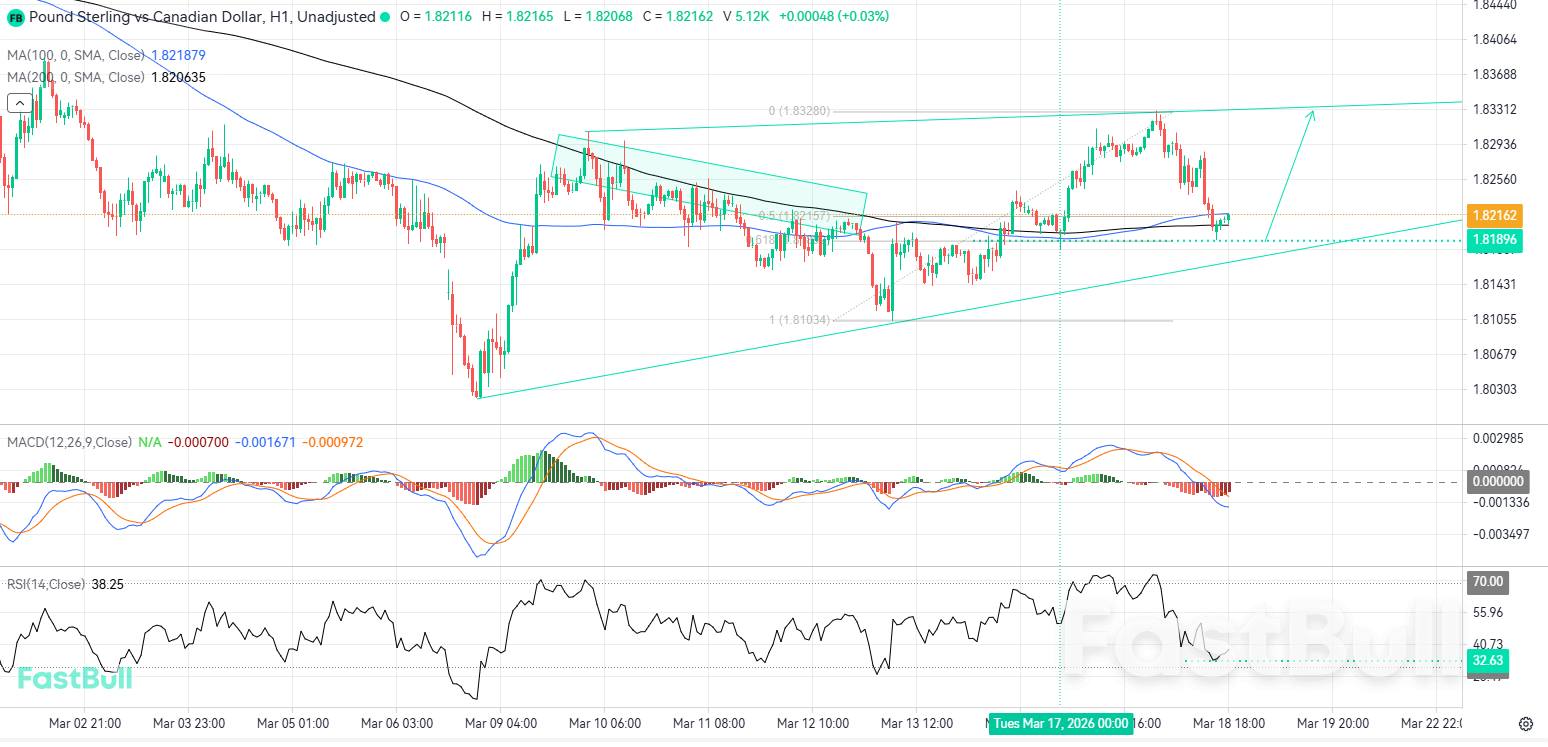
From a technical perspective, GBP/CAD has undergone a technical retracement to the 1.8189 handle, descending from the session highs of 1.8331. This movement appears to be a classic corrective phase within a broader bullish structure, as price action encountered significant buy-side rejection upon testing the 0.618 Fibonacci retracement level—a zone often referred to as the "Golden Ratio."
Crucially, the pair has successfully reclaimed the 200-period Moving Average (MA) situated at 1.8206. This dynamic average has historically functioned as a pivotal structural zone, shifting between support and resistance throughout recent sessions. The successful defense of this floor suggests that the primary bullish trend is poised for resumption.
Our analysis of momentum oscillators reinforces this reversal thesis. The RSI recently struck the 32 level, nearing oversold extremes. Interestingly, when the price touched similar support levels on March 17, the RSI was significantly higher at 49. This relatively rapid descent into oversold territory suggests that bearish momentum is exhausting quickly, potentially clearing the path for buyers to retake control.
Simultaneously, the MACD is printing a bearish histogram that is visibly losing depth. While the signal lines are currently oscillating just beneath the neutral baseline, a transition into a positive histogram accompanied by a bullish signal line crossover would provide the necessary technical validation for a sustained upward impulse. In this environment, long positions initiated from current levels are increasingly favored as the bullish trend attempts to establish a fresh leg higher.
Trading Recommendations
Trading direction: Buy
Entry price: 1.8189
Target price: 1.8328
Stop loss: 1.8130
Validity: Mar 27, 2026 15:00:00


