Fundamentals
On Tuesday, February 10th, European Central Bank (ECB) Vice President Luis de Guindos stated that current interest rate levels are appropriate and that recent data fully align with the ECB's forecasts. He noted that headline inflation has reached the 2% target, and previously concerning service sector inflation is now slowing, providing grounds for maintaining current rates. However, he also warned of enormous "uncertainty" due to a complex geopolitical environment, adding that some things happening now were unimaginable just a few quarters ago. In terms of specific impacts, he believes this environment could suppress business investment, which is currently showing only a very mild recovery. Meanwhile, although real incomes have improved, households remain highly cautious and keep savings rates high due to concerns about the future and fiscal policy. That said, he assessed that the complex geopolitical situation, including conflict-related worries, failed to have a material impact on the eurozone economy, and interest rates are in a "comfortable" observation phase. ECB Governing Council member, Peter Kazimir, also stated that rates should only be adjusted if there is a significant change in the economic outlook. In a commentary article on Monday, Kazimir said: "For now, the baseline holds. "Looking forward, it would take a major departure from our baseline scenario for me to consider recalibrating the policy setting." The ECB kept rates unchanged last week, with President Christine Lagarde downplaying the impact of the euro's recent appreciation and reiterating that inflation is in "good shape." Lithuanian central bank governor Gediminas Simkus, also an ECB Governing Council member, said earlier on Monday that unless there is a shock, the ECB will continue along the projected path. While Kazimir warned of further global volatility ahead, he agreed with Lagarde's assessment of price trends and the euro's movement. In addition, he repeated the ECB's view that inflation risks are balanced. Although the ECB does not target exchange rates, "any further appreciation will have to be evaluated against the relative strength of the euro area's economic performance and ultimately our medium-term inflation target," Kazimir said. On the same day, ECB President Lagarde emphasized in a speech that the ECB is working to ensure inflation remains under control as part of strengthening the European economy, while urging lawmakers to implement necessary reforms. She said: "The ECB's commitment is clear: we remain focused on price stability and fostering a stronger Europe." "Yet, Europe's resilience and competitiveness ultimately depend on the wider policy framework." ECB officials noted that the EU's economic foundation still needs strengthening, particularly due to concerns over low productivity and sluggish growth.
The market's focus has now shifted to the upcoming US nonfarm payrolls report. With bullish sentiment and risk appetite gradually recovering, the narrowing of trading ranges reflects a relatively cautious and neutral stance ahead of key US data releases. However, it is worth noting that ahead of the crucial nonfarm payrolls report, the White House has tried to manage expectations: Kevin Hassett hinted that lower-than-expected job growth should not cause panic. This statement leaves the market uncertain about how it will truly react once the data is published. Before the release of the heavyweight nonfarm payrolls report, President Trump's chief economic advisor was already preparing the ground, attempting to cushion potential disappointment in the job numbers. On Wednesday, Eastern Time, February 9th, White House National Economic Council Director Kevin Hassett said job growth data over the next few months will weaken, but this does not mean momentum is fading; rather, it reflects structural changes in the labor market. On a media program, Hassett stated in an interview, "Given the current high GDP growth, a slight decrease in the number of new jobs can be expected." He emphasized that there is no need to panic because population growth is slowing down and productivity growth is increasing rapidly. Hassett attributed this trend in job growth to two factors: slower population growth and a "surge" in productivity growth, calling it "an unusual combination." He mentioned that the combination of strong GDP growth and a pretty big decline in the labor force, "because of illegals leaving the country," could lead to lower job numbers, which, combined with strong GDP growth, could lead to lower employment numbers. Hassett attempted to reframe potentially weak jobs data as a structural shift in the labor market rather than a sign of weakening economic momentum. He stressed in the interview that when companies achieve higher output through technological progress and efficiency gains, demand for new workers naturally declines.
Technical Analysis
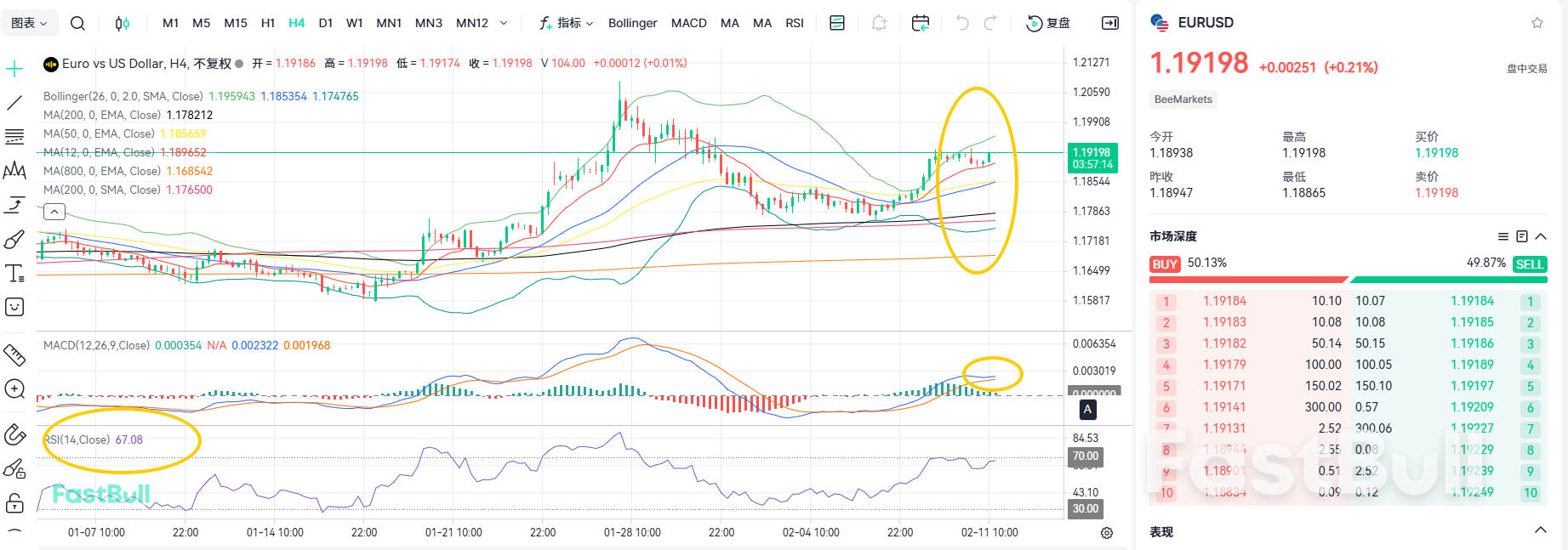
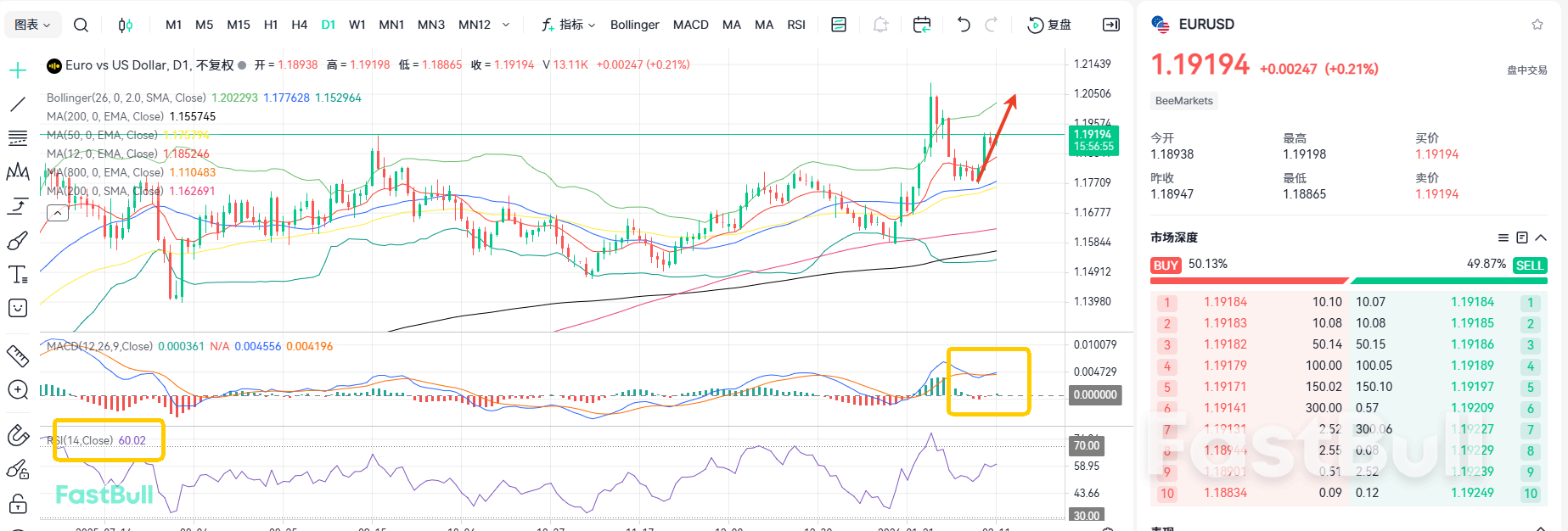
According to the daily chart, the Bollinger Bands are expanding upward, and the moving averages are diverging higher. After the release of a golden cross signal, prices surged strongly in the form of a large bullish candle. Overall, the bullish trend continues, with resistance near the Bollinger Upper Band and previous highs at 1.202 and 1.208. RSI stands at 60, indicating strong bullish sentiment, and lows are gradually rising. Based on the four-hour chart, Bollinger Bands are also expanding upward, and moving averages are diverging higher. Besides, the MACD and signal lines have broken above the zero axis, forming a "Kiss of the angels" pattern signaling the market is in a bullish zone and likely to continue rising. Prices are climbing strongly along the EMA12, with no signs of weakening in the short term. RSI is at 67, nearing the overbought region, but as long as prices do not effectively break below EMA12, the bullish trend will not end. In the short term, it is better to buy at lows.
Trading Recommendations:
Trading direction: Buy
Entry Price: 1.19
Target Price: 1.21
Stop Loss: 1.18
Support: 1.18/1.16/1.15
Resistance: 1.2/1.208/1.21


