Fundamentals
The Bank of Canada has decided to keep interest rates steady at 2.25%, considering the policy to be "roughly appropriate," which suppresses market expectations of recent aggressive easing measures and supports the Canadian dollar. Meanwhile, Canadian inflation data shows the overall CPI stabilizing at 2.2%, with the core inflation rate dropping to 2.8%, the lowest in ten months, reinforcing confidence that price pressures are aligning with the Bank of Canada's inflation target. On Wednesday, crude oil prices extended prior declines, with Brent crude dropping below US$60 per barrel for the first time since May, reflecting increasingly evident signs of global supply exceeding demand. Amid increased production from OPEC members and non-Middle Eastern countries, the International Energy Agency forecasts a significant oversupply in the global oil market this year and next, with the surplus potentially reaching record highs next year. Market structure indicators showed that some Middle Eastern and U.S. Gulf Coast crude grades briefly shifted to contango, signaling rising inventory pressures, although some regions maintained backwardation, indicating localized supply tightness. While declining oil prices partly ease inflationary pressures, expectations of an imminent resolution to the Ukraine conflict continue to exert downward pressure on market sentiment. Ukraine has indicated efforts to negotiate a legally binding security arrangement, with recent rounds of talks held in Berlin between Ukrainian representatives and U.S. officials. Market observers note that the news cycle surrounding the Russia-Ukraine situation is weighing on spot prices, but the prospects for substantive breakthroughs in negotiations remain uncertain. The decline in oil prices alleviates inflationary pressures and provides major economies' central banks with increased policy flexibility. In the United States, recent data shows a gradual slowdown in economic momentum. Non-farm employment rebounded in November after significant declines, but the unemployment rate rose to 4.6%, the highest in over four years. However, this data is limited in its reliability due to statistical distortions caused by the prolonged federal government shutdown. Employment growth is concentrated in healthcare and construction sectors, while government and transportation-related positions continue to decline, with wage growth also decelerating, indicating a gradual cooling of the labor market.
The mixed labor market data has not bolstered market expectations for further Federal Reserve interest rate cuts. The November employment report showed an increase of 64,000 jobs, slightly above forecasts, but the October figures were significantly revised downward, with the unemployment rate rising to 4.6%, the highest since 2021, indicating a gradual cooling of the labor market. Retail sales remained flat month-over-month, further suggesting waning consumer demand. Federal Reserve officials are divided on whether additional monetary policy easing will be necessary next year. The median forecast among Fed policymakers is a single rate cut in 2026, though some policymakers anticipate no further cuts. Meanwhile, traders are pricing in two rate reductions next year. According to The Wall Street Journal, U.S. President Donald Trump is scheduled to interview Federal Reserve Board member Christopher Waller on Wednesday to assess his suitability for the Fed Chair position. An October poll indicated that Waller is the economists' leading choice, as his rationale for rate cuts this year is viewed as the most logically consistent and capable of resolving internal Fed disagreements.
Technical Analysis
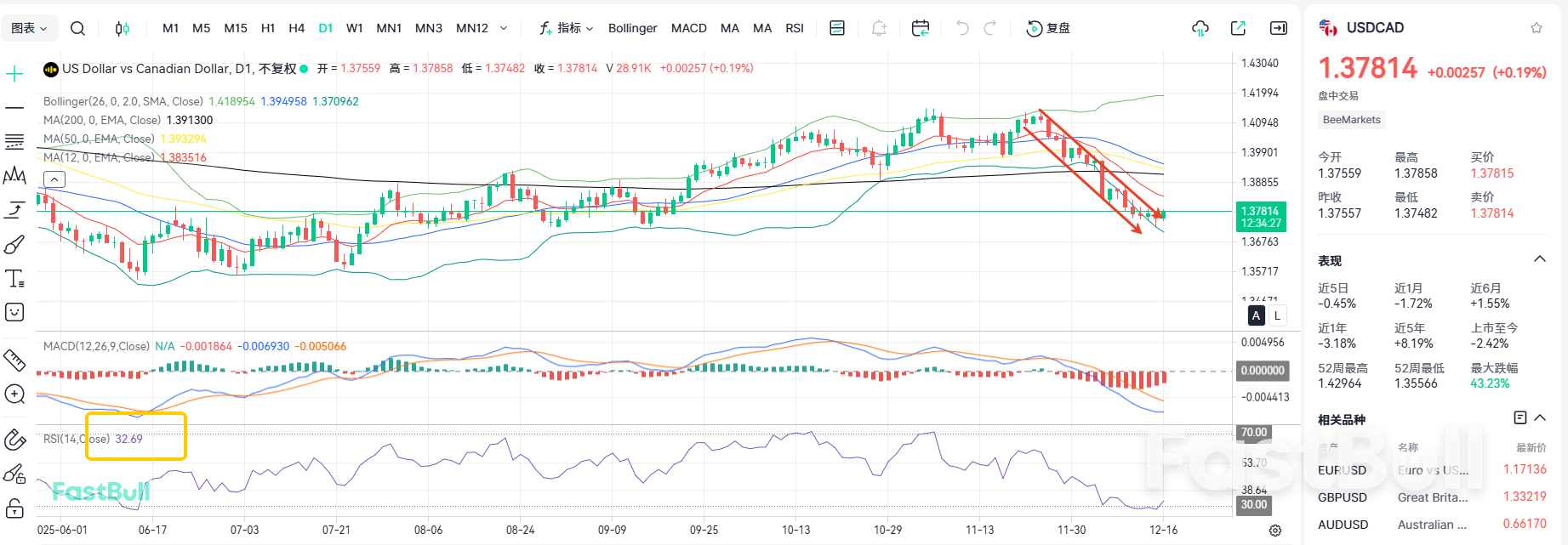
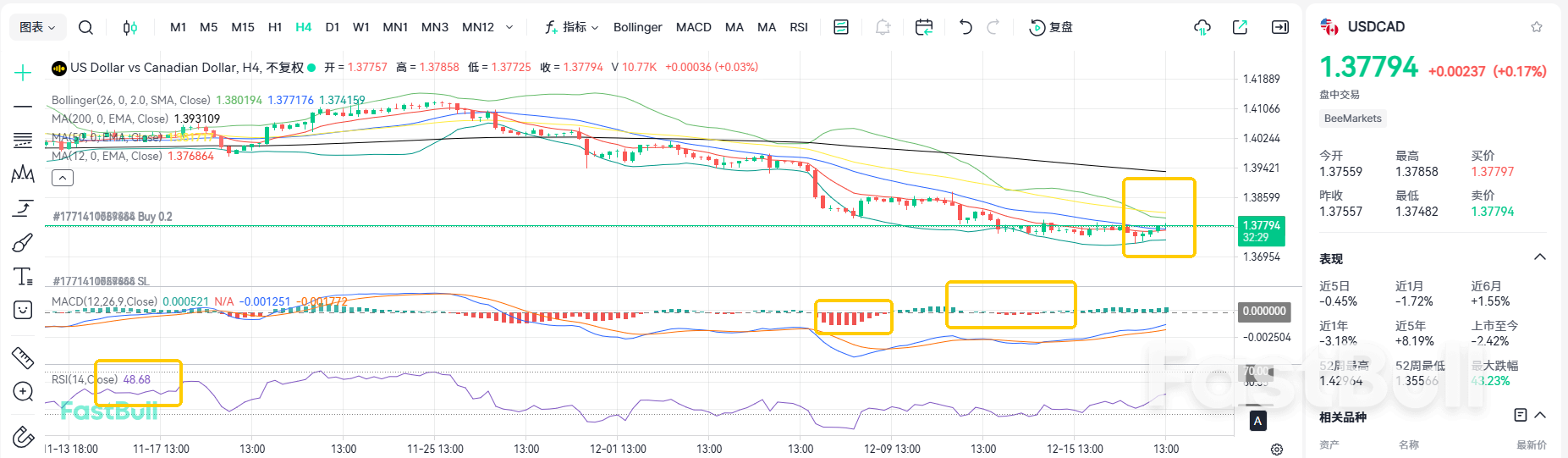
In the 1D timeframe, the price has broken below the EMA200 and is trending along the lower Bollinger Band, but a bullish engulfing pattern has emerged, breaking out of the downtrend channel, indicating a potential short-term rebound. After the MACD death cross, the MACD line and signal line fell below the zero-axis, signaling a shift to a bearish trend. The RSI at 32 indicates the market is in oversold territory, suggesting the decline is not yet exhausted but a rebound could occur at any time. In the 4H timeframe, Bollinger Bands are converging and narrowing, with SMAs converged. Following the MACD golden cross, the MACD line and signal line are retracing toward the zero-axis, yet still have some distance to go, implying the rebound is incomplete. Resistance levels are near the EMA50 and EMA200, at approximately 1.381 and 1.393, respectively. The RSI at 48 indicates a neutral market sentiment. It is recommended to go long before going short.
Trading Recommendations
Trading Direction: Buy
Entry Price: 1.378
Target Price: 1.42
Stop Loss: 1.357
Support: 1.373, 1.37, 1.357
Resistance: 1.414, 1.42, 1.44