The Reserve Bank of Australia (RBA) is widely anticipated to implement another 25-basis point hike to the cash rate, which would elevate the target to 4.10%. However, the upcoming decision is shaping up to be exceptionally tight, as market participants are far from reaching a consensus on the move. Currently, cash rate futures reflect approximately a 53% probability of another increase, highlighting the significant uncertainty surrounding the central bank's next step.
Persistent inflationary pressures remain the primary driver of this internal debate. Headline inflation in Australia continues to hover at an elevated 3.8% year-over-year, and this figure does not yet account for the potential impact of a fresh energy shock. Furthermore, internal RBA modeling indicates a positive output gap, suggesting that the domestic economy continues to operate at or above full capacity, with structural constraints becoming increasingly evident across various sectors.
On the external front, Australia’s export structure underscores the critical role of the energy sector in its broader economic health. During 2025, mineral fuels—including crude oil—accounted for approximately 27% of the nation’s total exports. This solidified fuels as the second most significant export category, trailing only ores, slag, and ash. However, this heavy reliance also introduces systemic risks for the Australian Dollar (AUD). Should oil prices continue their upward trajectory, fueling concerns of a global economic slowdown, risk sentiment could deteriorate sharply. In such a "risk-off" environment, the AUD could face significant bearish pressure, potentially offsetting any support derived from high commodity prices.
In Washington, U.S. Treasury Secretary Scott Bessent has provided new insights into how the administration is quantifying the energy risks associated with the escalating confrontation with Iran. According to Bessent, any coordinated intervention to stabilize global energy prices will be heavily contingent upon the duration and severity of the regional conflict. He specifically highlighted the strategic importance of the Strait of Hormuz, a vital maritime chokepoint for the global crude trade, warning that the market could face a staggering supply deficit estimated between 10 and 14 million barrels if disruptions persist.
On the domestic front, recent macroeconomic data continues to reflect moderate growth in U.S. industrial activity. Industrial production rose by 0.2% month-over-month in February. While this represents a deceleration from the 0.7% surge recorded in January, it slightly outperformed the market consensus of 0.1%. Simultaneously, capacity utilization was reported at 76.3%, matching the previous month’s revised figures and marginally exceeding analyst estimates of 76.2%.
These resilient figures have prompted investors to aggressively recalibrate their expectations for Federal Reserve policy. According to the CME FedWatch Tool, the probability of a 25-basis point rate cut in June has collapsed to 23.6%, down from over 51% just one month ago. Consequently, financial markets are now pricing in a solitary rate reduction by year-end, a hawkish shift from the two cuts previously anticipated by the street.
Technical Analysis
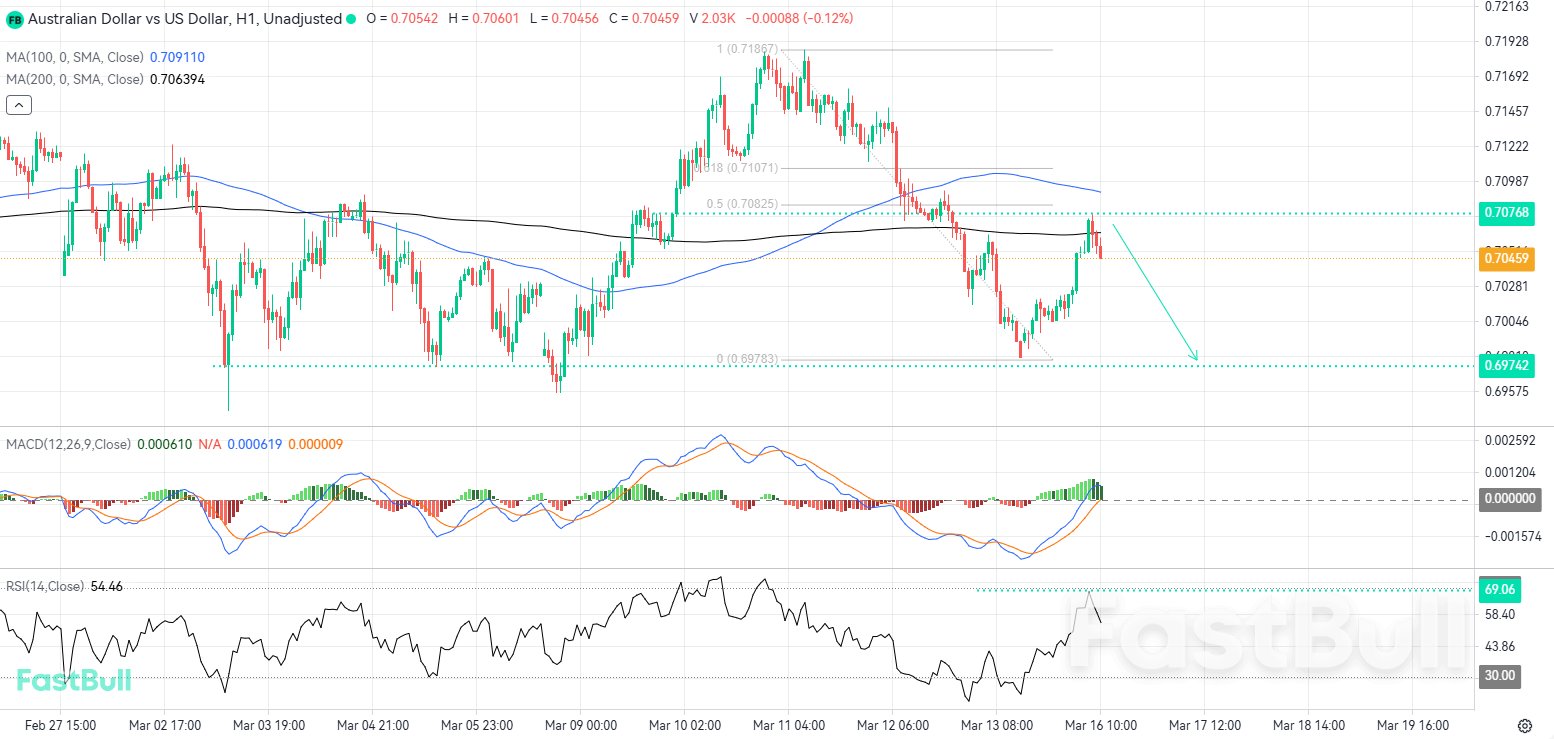
From a technical perspective, AUD/USD executed a bullish corrective move, ascending from the 0.6978 floor to a local peak of 0.7076. This zone is of high technical significance as it aligns closely with the 0.50 Fibonacci retracement level. Notably, the price action met significant resistance at the 200-period Moving Average (MA), currently situated at 0.7063 on the 1-hour (H1) chart.
With the 100-period MA tracking just above at 0.7091, the pair is currently trapped beneath a heavy cluster of dynamic resistance. This rejection suggests that the corrective phase may have reached its conclusion, potentially clearing the path for a resumption of the primary bearish trend.
Our analysis of momentum oscillators reinforces this bearish bias. The RSI recently struck the 69 level, approaching overbought territory and signaling that the bullish recovery is nearing exhaustion. Simultaneously, while the MACD still shows a bullish histogram, the bars are visibly diminishing in size.
The signal lines are currently oscillating just above the neutral threshold. A transition into a negative histogram, coupled with a bearish signal line crossover, would provide the necessary technical validation for a sustained move to the downside.
Trading Recommendations
Trading direction: Sell
Entry price: 0.7048
Target price: 0.6974
Stop loss: 0.7110
Validity: Mar 27, 2026 15:00:00


