On Wednesday, Chancellor Rachel Reeves delivered the Spring Statement, accompanied by a somber assessment from the Office for Budget Responsibility (OBR). The fiscal watchdog significantly downgraded its growth projections for the United Kingdom, slashing the 2026 economic expansion forecast to 1.1%, a sharp decline from the 1.4% estimate provided in November.
The OBR issued a stern warning that the intensifying conflict in the Middle East—which escalated during the finalization of the report—poses substantial systemic risks to both the global and domestic economies. Under this backdrop, the OBR now projects that the national unemployment rate could peak at 5.3% later this year, notably higher than the previously anticipated 4.9%.
Regarding monetary policy, the Bank of England (BoE) maintained its benchmark rate at 3.75% in February following a narrow 5-4 vote within the Monetary Policy Committee. However, the subsequent spike in crude oil prices—triggered by the effective closure of the Strait of Hormuz—has fundamentally reshaped market expectations for the interest rate trajectory. Investors currently assign a mere 20% probability to a rate cut at the upcoming March 19 meeting, a dramatic collapse from the 75% probability priced in just a week ago. Markets are now pricing in a solitary 25-basis point reduction for the entirety of the year.
Across the Atlantic, the United States labor market delivered a profound shock in February. The latest Non-Farm Payrolls (NFP) report revealed a surprising contraction of 92,000 positions, starkly contradicting the consensus forecast that had anticipated a gain of 59,000 jobs. Consequently, the unemployment rate edged higher to 4.4%, though it remains just beneath the 4.5% threshold the Federal Reserve projected for 2026.
Despite the labor market's visible cooling, consumer spending remains remarkably robust. The Census Bureau reported that Retail Sales hit $733.5 billion in January, defying the forecasted 0.3% decline. On a year-over-year basis, sales expanded by 3.2%, an acceleration from the previous 2.4% gain. Within the sub-sectors, e-commerce led with a 10.9% annual surge, while food services and drinking establishments advanced by 3.9%.
Federal Reserve officials are currently navigating these diverging data points with extreme caution. Susan Collins, President of the Boston Fed, emphasized the need for "definitive evidence" of disinflation before pivoting toward cuts. Similarly, Kansas City Fed President Jeffrey Schmid noted a slowdown in corporate hiring, while Governor Stephen Miran warned against over-interpreting a single report, despite acknowledging that policy may be nearing "excessively restrictive" territory. Mary Daly, President of the San Francisco Fed, characterized the data as "disappointing," signaling that the Fed will likely maintain its "wait-and-see" posture for the immediate future.
Technical Analysis
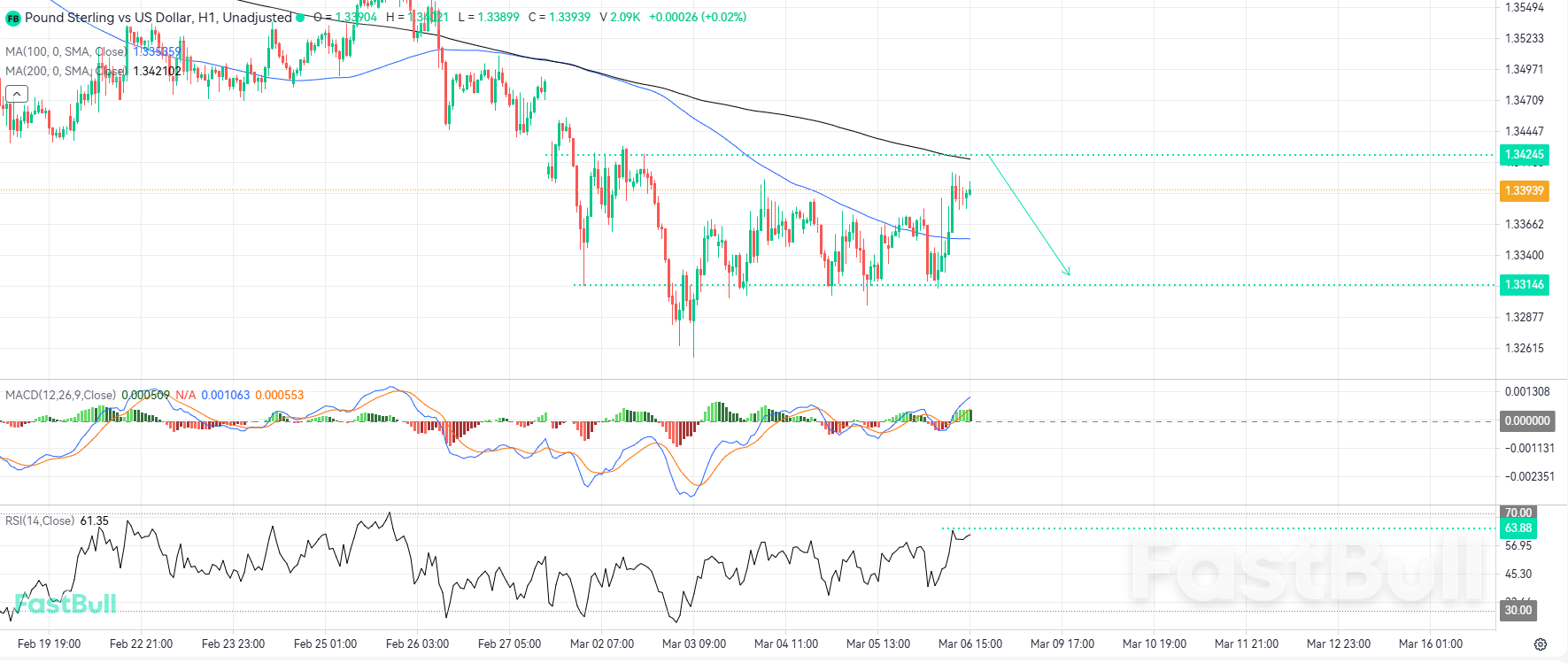
From a technical perspective, GBP/USD has completed a significant recovery drive and is currently testing a formidable technical ceiling. The pair is approaching the 200-period Moving Average at 1.3424 on the 1-hour (H1) chart, while the 100-period Moving Average is situated at 1.3353.
This technical cluster represents a critical resistance zone. Notably, this area aligns with the weekly opening gap, suggesting that a bearish rejection from this handle could signal the resumption of the primary downward impulse. If the pair fails to secure a decisive close above the 1.3424 handle, a technical correction toward the lower support levels appears highly probable.
Our analysis of momentum oscillators reinforces this potential for a pivot. The RSI has ascended to the 63 level, nearing overbought territory, which may allow for a final marginal push before exhaustion sets in. Simultaneously, the MACD is currently well-entrenched in a bullish histogram with signal lines above the neutral threshold.
While the immediate momentum remains bullish, traders should monitor for a transition in the histogram toward negative territory. A bearish crossover following a test of the 1.3424 resistance would provide the technical validation required to confirm that the bears have successfully defended the supply zone.
Trading Recommendations
Trading direction: Sell
Entry price: 1.3424
Target price: 1.3315
Stop loss: 1.3470
Validity: Mar 19, 2026 15:00:00


