Recent data from the Eurozone has intensified the bearish pressure on the common currency, following a preliminary Consumer Confidence reading for April that plummeted to -20.6, down significantly from the previous -16.3. This pronounced deterioration in household sentiment is largely attributed to persistent geopolitical anxieties and the escalating costs of energy, which continue to weigh heavily on the regional outlook.
In this context, the broader macroeconomic landscape remains exceptionally challenging. Current estimates suggest that inflation will average 3.1% in 2026 before moderating toward 2.5% in 2027—levels that remain conspicuously higher than pre-conflict projections. On a cumulative basis, this trajectory implies an inflationary overshoot of 1.7 percentage points compared to previous forecasts. Simultaneously, economic expansion is projected to decelerate from 1.5% in 2025 to a tepid 0.6% this year, with only a marginal recovery to 0.9% anticipated by 2027.
Regarding monetary policy, the internal debate within the European Central Bank (ECB) remains unsettled. Gediminas Šimkus, a member of the Governing Council and Governor of the Bank of Lithuania, noted during Wednesday's European session that a rate hike later this year cannot be entirely dismissed. However, he maintained a preference for holding rates steady during the upcoming policy decision scheduled for April 30.
This institutional caution is unfolding against a volatile geopolitical backdrop. The Islamic Revolutionary Guard Corps (IRGC) of Iran recently announced the seizure of two vessels in the Strait of Hormuz, corroborating reports from the UKMTO regarding attacks on maritime traffic in this critical energy artery. These episodes are occurring as the United States maintains its naval blockade following an extension of the ceasefire with Iran—a strategic maneuver intended to sustain economic pressure on Tehran. For their part, Iranian authorities have reiterated that any diplomatic progress remains strictly contingent upon the unconditional lifting of these maritime restrictions.
Concurrently, Brussels is attempting to mitigate fears of systemic disruptions in air travel, even as major carriers like Lufthansa have already canceled thousands of flights to manage escalating operational costs. The situation has become so acute that European legislators have even proposed suspending the monthly parliamentary sessions in Strasbourg as a drastic energy-saving measure.
In Asia, Japanese trade data for March revealed a surplus of ¥667 billion—a figure that fell significantly short of the ¥1.106 trillion consensus. This miss was driven by a 10.9% year-over-year surge in imports, which outpaced the 7.1% forecast, despite exports rising by 11.7%. Looking ahead to Thursday, investors await the National Consumer Price Index (CPI) report. Underlying inflation—excluding fresh food—is projected to climb to 1.8% year-over-year, up from the previous 1.6%. This anticipated uptick may bolster market expectations that the Bank of Japan (BoJ) will consider further interest rate adjustments in the near term.
Technical Analysis
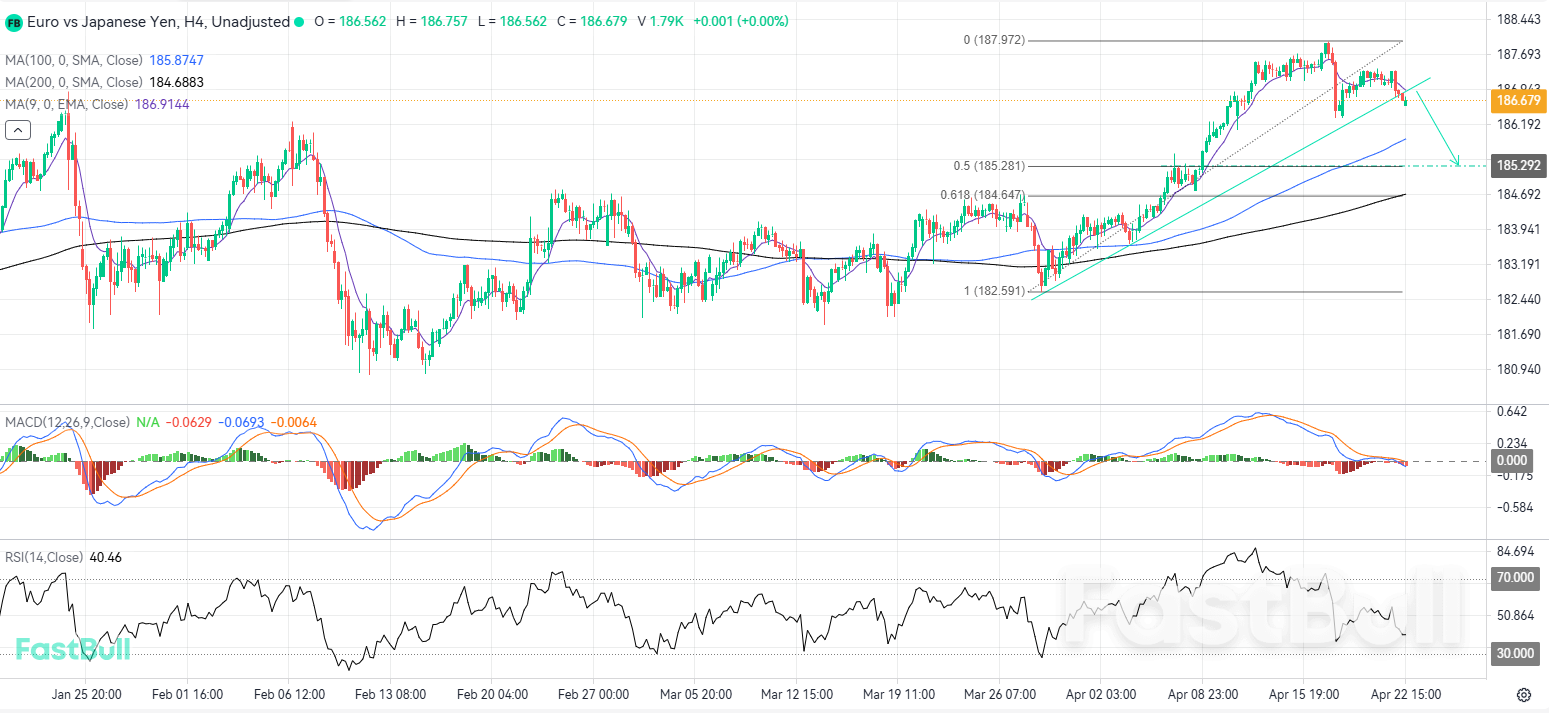
From a technical perspective, EUR/JPY recently executed a powerful bullish impulse that culminated in a local peak of 187.97 on April 16. Since striking that high, the pair has entered a corrective phase that recently resulted in a breakdown below the primary ascending trendline. This structural shift opens the door for a new bearish leg, with primary downside objectives targeted at the 185.29 support zone.
This target carries significant technical weight as it aligns with the 0.50 Fibonacci retracement level. Furthermore, the 100 and 200-period Moving Averages (MAs) are currently tracking at 185.18 and 184.22, respectively. This concentration of indicators is expected to act as a "liquidity magnet," potentially accelerating the downward move as the price seeks its next major structural floor.
Our analysis of momentum oscillators provides further validation for this bearish bias. The Relative Strength Index (RSI) is currently hovering at the 40 level, comfortably beneath technical neutrality but retaining ample "runway" for a more profound corrective move before reaching oversold extremes.
Simultaneously, the MACD is printing a bearish histogram that is once again gaining negative depth. With the signal lines actively executing a bearish crossover, the technical conviction for a continued slide in the short term remains high. Traders should monitor the 185.29 zone closely; a failure to stabilize there could open the path toward the 200-period MA at 184.22.
Trading Recommendations
Trading direction: Sell
Entry price: 186.67
Target price: 185.29
Stop loss: 187.80
Validity: May 01, 2026 15:00:00


