The United States private sector continued its expansionary trend in February, albeit with a notable loss of momentum compared to the previous month. According to the preliminary S&P Global Composite PMI, the index retreated to 52.3 from 53.0, signaling a broader moderation across the economic landscape. Sector-specific data underscored this cooling effect: the Manufacturing PMI descended to 51.2 from 52.4, while the Services component dipped to 52.3 from 52.7. Both figures underperformed market consensus, highlighting a pervasive slowdown in domestic activity.
On the inflationary front, the latest Core PCE (Personal Consumption Expenditures) figures have reinforced the narrative that the Federal Reserve will likely maintain a restrictive policy stance for the foreseeable future. In December, the indicator advanced by 0.4% on a monthly basis, exceeding both the previous reading of 0.2% and the anticipated 0.3%. Annually, the rate accelerated to 3.0% from 2.8%, suggesting that underlying price pressures remain stubbornly persistent.
Adding to the complexity, the preliminary Q4 2025 GDP estimate provided a significant negative surprise. The U.S. economy expanded at an annualized rate of 1.4%, a sharp deceleration from the robust 4.4% recorded in the third quarter and well below the 3.0% projected by analysts. Simultaneously, consumer sentiment as measured by the University of Michigan adopted a more moderate tone, with the headline index falling to 56.6. Interestingly, inflation expectations saw a slight retreat, with the one-year projection descending to 3.4% and the five-year outlook settling at 3.3%.
In the geopolitical and trade arena, the U.S. Supreme Court recently delivered a blow to the previous administration's trade policy, declaring tariffs imposed under the guise of "national security" by Donald Trump to be illegal. In response, Trump signaled during a White House press conference that his administration would seek alternative legal frameworks—such as Section 301 of the Trade Act of 1974—to implement even higher levies. This potential shift toward more aggressive protectionist measures continues to be a primary focus for market participants monitoring trade stability.
Across the Atlantic, the Swiss Franc (CHF) has gained significant traction as markets recalibrate their expectations for the Swiss National Bank (SNB). With Swiss inflation printing at a marginal 0.1% in January—situated at the lower extremity of the entity's 0–2% target range—the likelihood of near-term rate cuts has diminished. This data aligns with the central bank’s broader projections, supporting the consensus that the SNB will maintain a policy status quo through its March meeting and potentially well into 2026.
Technical Analysis
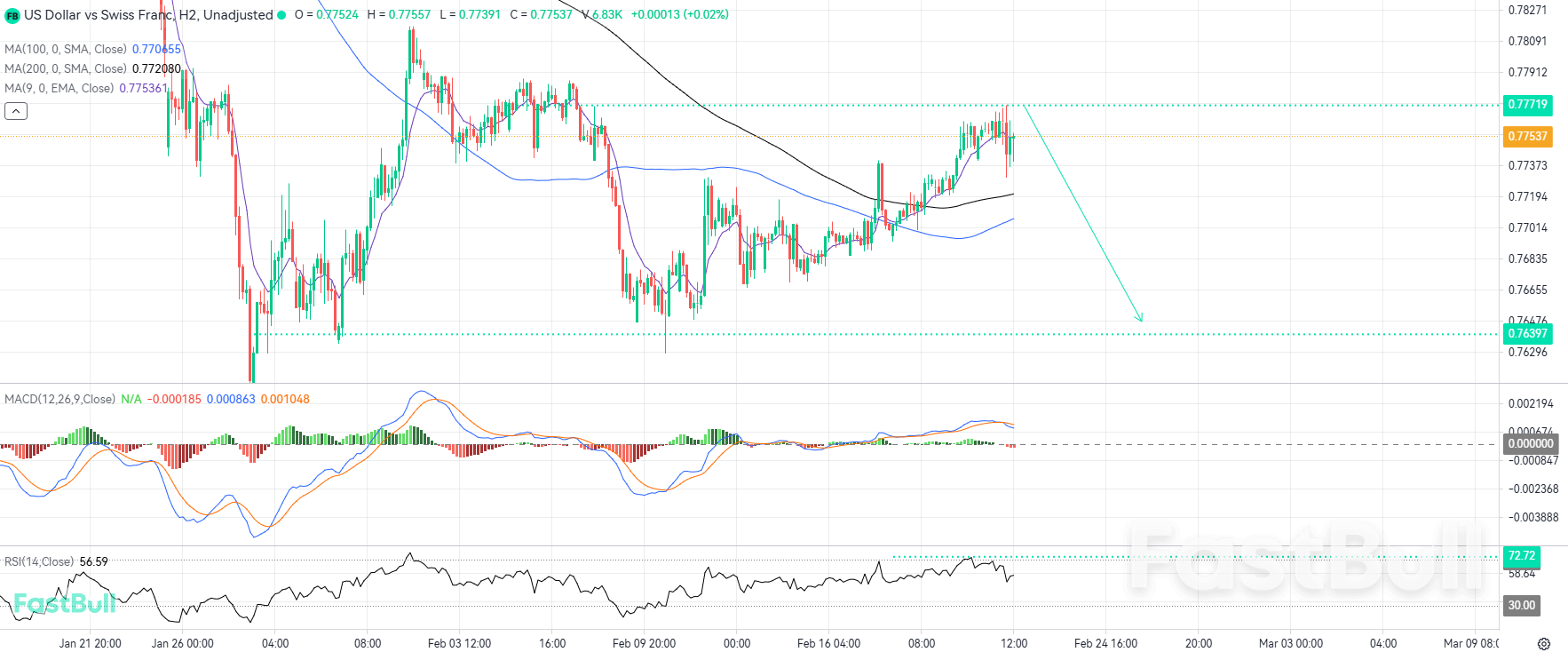
From a technical perspective, USD/CHF has recently completed an impulsive move toward the 0.7771 resistance handle. The price action has begun to show a clear bearish rejection from this ceiling, suggesting that a corrective phase is now the most probable scenario.
The primary objective for this potential retracement is the structural support floor located at 0.7639. On the 4-hour (H4) chart, the 100 and 200-period Moving Averages are currently positioned at 0.7706 and 0.7720, respectively. A decisive close beneath this moving average cluster would likely serve as a catalyst for an accelerated decline toward the aforementioned support target.
Our momentum oscillators further reinforce this bearish outlook. The Relative Strength Index (RSI) recently peaked at 72, briefly entering overbought territory and signaling that the preceding bullish drive has reached a point of exhaustion. Simultaneously, the MACD has transitioned into a negative histogram, although the signal lines remain tentatively above the neutral baseline. Should the bearish histogram gain depth and volume, it would provide the necessary technical confirmation for a sustained move toward the lower demand zone.
Trading Recommendations
Trading direction: Sell
Entry price: 0.7770
Target price: 0.7640
Stop loss: 0.7820
Validity: Mar 04, 2026 15:00:00


