In the United States, the publication of January’s Nonfarm Payrolls (NFP) has been rescheduled to February 11th, a direct consequence of the partial government shutdown. Meanwhile, the latest University of Michigan (UoM) survey indicates a budding improvement in consumer sentiment, though the underlying data necessitates a cautious interpretation. Survey director Joanne Hsu highlighted a significant structural divergence, noting that sentiment "soared for consumers with the largest stock portfolios while remaining at discouraging levels for those without equity holdings."
A cooling labor market, evidenced by a decline in job openings, an uptick in layoffs per the Challenger report, and a notable surge in weekly jobless claims, has reinforced market convictions regarding Federal Reserve rate cuts in 2026. Simultaneously, the UoM Consumer Sentiment Index for February climbed to 57.3 from 56.4, outperforming the 55 forecast. While one-year inflation expectations moderated to 3.5% from 4.0%, long-term five-year expectations edged slightly higher to 3.4%. San Francisco Fed President Mary Daly warned that the prevailing "low-hiring, low-layoff" environment could rapidly transition into a "no-hiring and more layoffs" scenario, emphasizing that workers are keenly aware of how quickly labor conditions can erode.
Furthermore, Fed Governor Philip Jefferson signaled that future policy will remain strictly data-dependent, maintaining a cautiously optimistic outlook with a 2.2% GDP growth forecast for the year. Jefferson reiterated that the Fed’s commitment to price stability is mitigating risks and suggested that monetary policy is nearing a neutral stance, viewing the 2025 tariffs as a transitory price level adjustment.
Parallel to these developments, the Bank of Canada (BoC) elected to maintain its overnight rate at 2.25% late last month, signaling its intention to hold this level at least through 2026 unless the economic outlook shifts dramatically. Governor Tiff Macklem acknowledged the resilience of the Canadian economy but cautioned that risks remain elevated due to uncertainties surrounding the renegotiation of the Canada-United States-Mexico Agreement. With inflation hovering near the 2% target and the labor market exhibiting continued slack, the BoC views its current policy stance as an appropriate anchor as the economy navigates structural adjustments linked to U.S. protectionism and slowing population growth.
In the energy sector, West Texas Intermediate (WTI) crude is staging a recovery, trading near $64.00 per barrel after moderate losses. Despite this rebound, WTI remains on track to snap its six-week winning streak, weighed down by diplomatic expectations regarding a potential summit between U.S. and Iranian officials.
Technical Analysis
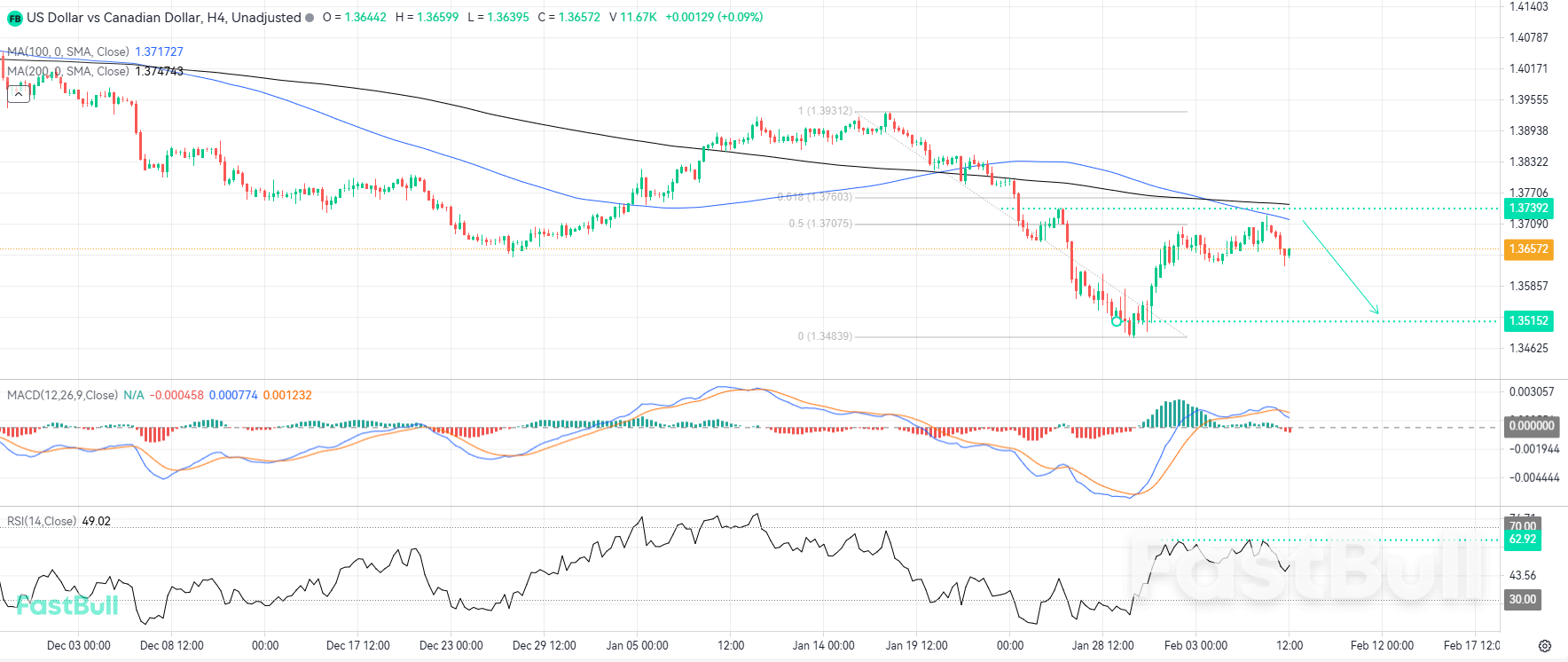
The USD/CAD pair has recently experienced a bullish impulse that brought the price toward a critical technical intersection. The 4-hour chart shows the price testing the 100-period Moving Average at 1.3717, with the 200-period MA providing an additional layer of overhead resistance just above at 1.3747.
This recovery originated after the pair struck a fresh yearly low of 1.3480 on January 29th. However, this upward move is currently struggling within the 0.50 and 0.618 Fibonacci retracement zones. The convergence of these Fibonacci levels with the moving average cluster suggests that the recent advance is a corrective retracement rather than a structural trend reversal. This increases the probability that a new bearish cycle is currently in development.
Our momentum analysis via the MACD reinforces this bearish thesis. The histogram has exhausted its bullish territory, transitioning from green bars to red bars that are now gaining significant depth. While the signal lines are still situated marginally above the neutral zone, they are poised to cross back into bearish territory, which would significantly bolster the case for a move toward the 1.3515 support area.
Unless the price manages a decisive and sustained breakout above the 1.3739 resistance level, the technical path of least resistance remains to the downside. Consequently, short-side positions are favored as the pair looks to resume its primary bearish trend.
Trading Recommendations
Trading direction: Sell
Entry price: 1.3717
Target price: 1.3515
Stop loss: 1.3800
Validity: Feb 19, 2026 15:00:00


