The Bank of England (BoE) recently elected to maintain its benchmark interest rate at 3.75%. While the "hold" was widely anticipated, the decision delivered a significant structural shock via a 9-0 unanimous vote. This starkly contrasted with the 7-2 split expected by the street and represents a profound hawkish shift from the previous, narrowly contested 5-4 decision. Governor Andrew Bailey underscored this proactive stance, affirming that the central bank remains prepared to act decisively should inflationary pressures prove more entrenched than currently modeled.
The Monetary Policy Committee (MPC) has significantly revised its inflation outlook for the third quarter, now projecting a peak near 3.5%—a substantial leap from the previous 2% target. This upward revision is primarily driven by surging energy costs tied to the ongoing hostilities in the Middle East. The hawkish sentiment appears to be permeating the committee; Catherine Mann is now suggesting the potential for a prolonged pause or further tightening, while even the traditionally dovish Swati Dhingra acknowledged that higher rates may be necessary to achieve price stability.
In a recent communication via Truth Social, U.S. President Donald Trump indicated that he has instructed the Department of Defense to defer "any and all" military strikes against Iranian energy and electrical infrastructure for five days. Trump characterized these diplomatic efforts as increasingly "constructive," though he emphasized that this strategic pause remains contingent upon continued progress in negotiations scheduled throughout the week.
However, Tehran moved swiftly to contradict this narrative. According to reports from the Fars News Agency, internal sources claim there has been no direct or indirect contact with the United States. Furthermore, the Iranian Ministry of Foreign Affairs, via Mehr News, suggested that Trump’s remarks are a calculated effort to suppress global energy prices and secure a tactical advantage for future military maneuvers.
Against this volatile backdrop, West Texas Intermediate (WTI) is currently trading near $85.75 per barrel, marking a sharp decline of approximately 12%. Despite this localized retracement, prices remain significantly elevated compared to pre-conflict levels. Until a definitive de-escalation occurs and maritime traffic through the Strait of Hormuz is fully restored, systemic uncertainty is likely to persist, keeping the risk of energy-driven inflation at the forefront of market concerns.
Simultaneously, the market has been digesting a series of cautious remarks from Federal Reserve officials. Governor Stephen Miran cautioned against an overreliance on short-term headlines, signaling that he does not currently perceive a structural necessity for further interest rate hikes. Meanwhile, Chicago Fed President Austan Goolsbee highlighted the stagflationary nature of energy shocks, noting their propensity to simultaneously drive inflation higher and weaken employment. Goolsbee suggested that while a policy pivot toward rate cuts could materialize by late 2026, the committee still requires "clear and convincing" evidence of a sustained disinflationary trajectory.
Technical Analysis
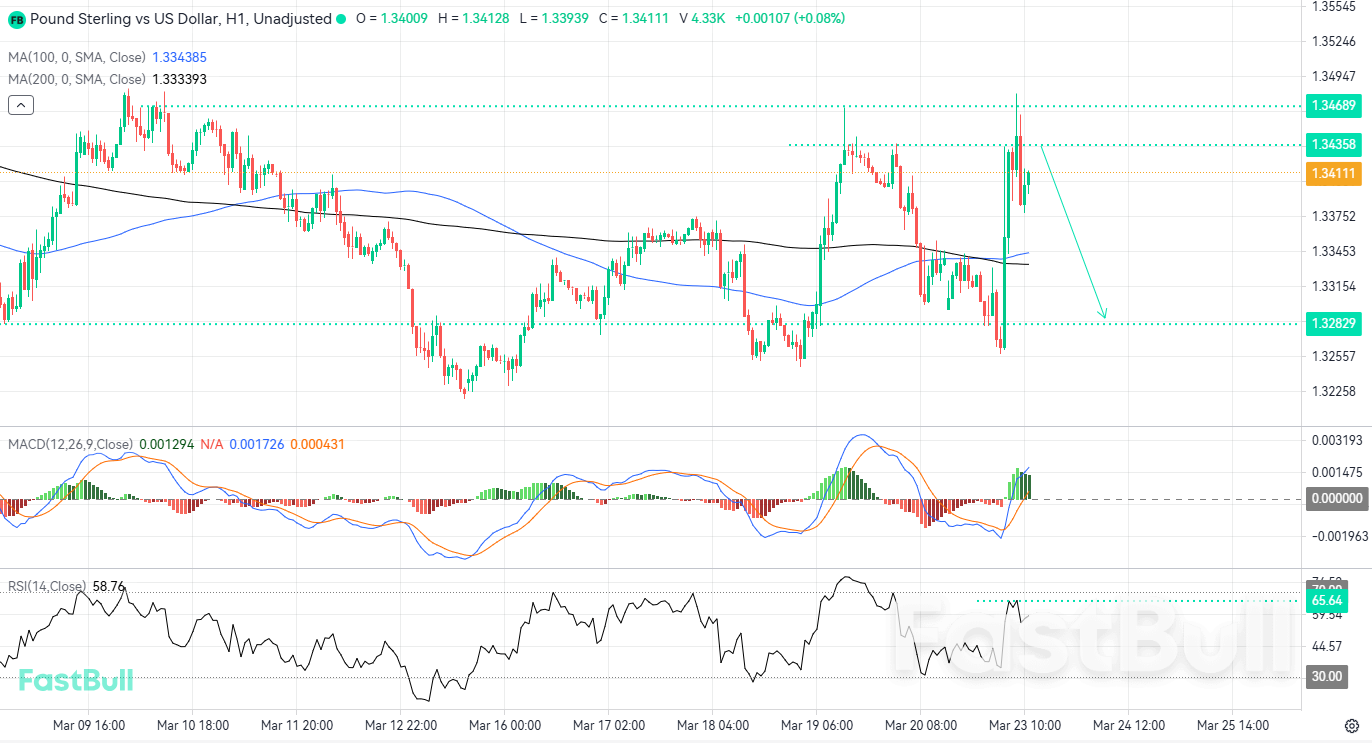
From a technical perspective, GBP/USD momentarily tested the 1.3468 resistance handle—a supply wall that has successfully thwarted upside attempts on three separate occasions. Earlier in the session, the pair reached this ceiling once again, only to encounter an immediate bearish rejection. As long as price action remains capped beneath this structural limit, the path of least resistance favors a corrective move toward the 1.3282 support zone, which represents the most relevant local floor in the short term.
Notably, the 100 and 200-period Moving Averages (MAs) are currently situated at 1.3343 and 1.3333, respectively. These dynamic indicators have acted as the "median" of the recent range in which GBP/USD has been oscillating. A mean-reversion move that targets these averages appears highly probable unless a decisive breakout above the current resistance occurs.
Our analysis of momentum oscillators reinforces the bearish thesis through a notable technical divergence. While price action retested the previous highs, the RSI only reached the 65 level, failing to surpass the previous peak of 77. This suggests that bullish conviction is dissipating.
The MACD is currently printing a bullish histogram that has begun to lose depth. Should we witness a bearish crossover of the signal lines accompanied by the histogram transitioning into negative territory, it would provide the necessary technical validation for a sustained downward correction.
Trading Recommendations
Trading direction: Sell
Entry price: 1.3435
Target price: 1.3282
Stop loss: 1.3510
Validity: May 03, 2026 15:00:00


