In Switzerland, economic expectations reflected by the ZEW survey underwent a significant deterioration at the start of the year. The indicator plummeted to -4.7 in January from 6.2 in December, exerting substantial downward pressure on the Swiss Franc (CHF). This devaluation has brought the Swiss National Bank (SNB) back into sharp focus; an excessively strong currency poses persistent challenges for an export-driven economy and complicates the SNB’s price stability mandate.
With Switzerland already grappling with exceptionally low inflation, the prospect of sustained Franc strength increases the risk of deflationary pressure, raising the probability of SNB intervention or a potential return to negative interest rates. Earlier this week, SNB President Martin Schlegel addressed these concerns, stating: "My primary concern is, of course, inflation and price stability, and we [SNB] will do everything possible to ensure that," according to reports from Reuters.
In the United States, the release of January Nonfarm Payrolls (NFP) has been delayed until February 11th due to the partial government shutdown. Meanwhile, consumer sentiment has shown signs of improvement according to the University of Michigan (UoM) survey, though the data requires careful interpretation. Survey director Joanne Hsu noted a sharp divergence, as sentiment "soared for consumers with the largest stock portfolios while remaining at discouraging levels for those without equity holdings."
A decline in job openings, an uptick in layoffs highlighted by the Challenger report, and a significant jump in weekly jobless claims have solidified market expectations for Federal Reserve rate cuts in 2026. Simultaneously, the UoM Consumer Sentiment Index for February improved to 57.3 from 56.4, surpassing the 55 forecast. One-year inflation expectations moderated to 3.5% from 4.0%, while five-year expectations edged slightly higher to 3.4% from 3.3%.
San Francisco Fed President Mary Daly cautioned the current "low-hiring, low-layoff" environment could persist or shift rapidly toward a "no-hiring and more layoffs" scenario, noting that workers are increasingly aware of how quickly labor market conditions can deteriorate. Furthermore, Fed Governor Philip Jefferson indicated that future policy decisions will remain data-dependent. He maintained a cautiously optimistic outlook, forecasting 2.2% GDP growth this year and observing a stabilizing labor market moving toward a new equilibrium. Regarding inflation, Jefferson reiterated that a firm commitment to price stability helps mitigate risks and supported last year’s rate cuts, suggesting policy is nearing a neutral stance. He viewed 2025 tariffs as a one-time price level adjustment, with pressures expected to ease throughout 2026, supported by productivity improvements.
Technical Analysis
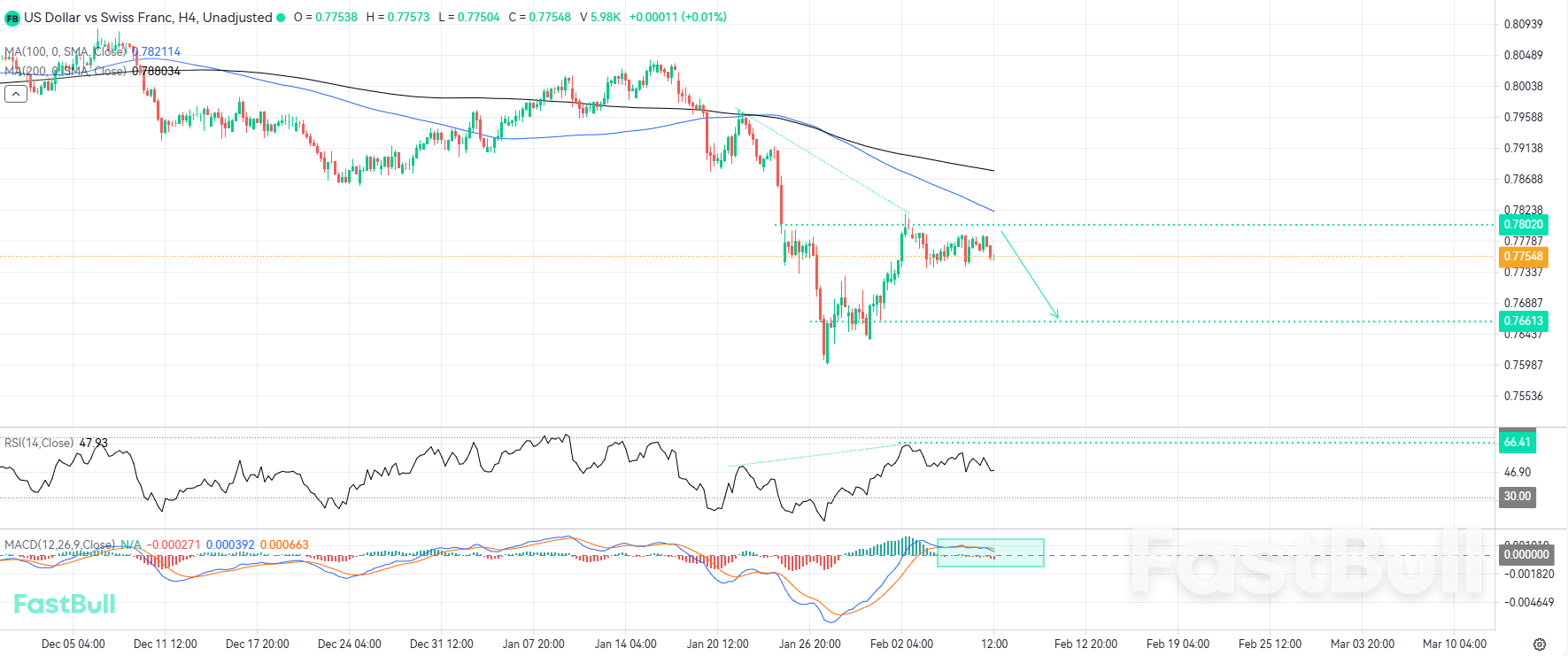
The USD/CHF pair has successfully completed a "gap fill" following the bearish opening on January 25th. After bottoming at the 0.7600 level on January 27th, the price staged a corrective recovery to 0.7813, where it encountered significant selling pressure and was rejected.
This rejection has validated a primary horizontal resistance at 0.7802. Throughout recent sessions, the pair has consistently failed to breach this zone, suggesting that the broader bearish impulse remains the dominant force. From a structural perspective, the 100 and 200-period Moving Averages are situated at 0.7821 and 0.7880 respectively, these averages are rapidly converging with the price and are expected to provide dynamic resistance upon contact.
Our momentum analysis via the MACD indicates that a bearish shift is imminent. The histogram has ceased printing bullish green bars and is transitioning into bearish territory with increasing depth. Although the signal lines remain slightly above the neutral level, the trajectory favors a continuation of the downward trend.
Furthermore, the Relative Strength Index (RSI) reached a reading of 66, and while it has not yet touched overbought territory, it is exhibiting a clear hidden bearish divergence. This technical signal suggests that the recent bullish strength is fading rapidly. Unless the price manages a decisive daily close above the resistance, the path of least resistance remains to the downside, with sell-side positions favored for a bearish continuation.
Trading Recommendations
Trading direction: Sell
Entry price: 0.7753
Target price: 0.7661
Stop loss: 0.7840
Validity: Feb 19, 2026 15:00:00


