The Federal Reserve recently elected to maintain its benchmark interest rate within the 3.50%–3.75% range, a decision that aligned seamlessly with broader market expectations. Throughout the proceedings, the committee reiterated its commitment to a data-dependent strategy, emphasizing that subsequent policy maneuvers will be meticulously guided by the ongoing evolution of economic indicators. This approach underscores the dual-sided risks currently facing the Fed: the preservation of maximum employment and the stabilization of inflation. Despite the current pause, the updated "dot plot" continues to project a rate reduction by 2026. However, inflationary forecasts underwent a notable upward revision, with the Personal Consumption Expenditures (PCE) index now estimated at 2.7% for December 2026—a significant jump from the previously anticipated 2.4%.
The FOMC’s official communiqué highlighted that job creation has begun to moderate, while the unemployment rate has remained relatively static. Nevertheless, inflation continues to hover at stubbornly elevated levels. The committee also acknowledged the persistent fog of economic uncertainty arising from ongoing geopolitical tensions in the Middle East.
In a subsequent press conference, Fed Chair Jerome Powell adopted a decidedly more hawkish tone. He observed that the persistence of inflation is largely driven by the rising cost of goods, a trend significantly influenced by recent tariffs. Powell further cautioned that surging energy prices could exert renewed upward pressure on inflation in the short term, noting a recent uptick in inflationary expectations linked to the Middle Eastern conflict. While the central path for interest rates remained unchanged, Powell hinted at a preference for fewer cuts, stressing that the Fed requires "clear and convincing" progress on the disinflationary front before considering further policy easing. Consequently, market participants have aggressively recalibrated their expectations, with a 25-basis point cut by year-end no longer being fully discounted.
Against a backdrop defined by surging oil and natural gas prices—which continue to drive global energy costs higher—the European Central Bank (ECB) Governing Council opted to maintain its current monetary policy stance. Consequently, the deposit facility rate remains at 2.00%, the main refinancing rate at 2.15%, and the marginal lending facility at 2.40%.
In its official communiqué, the ECB noted that the conflict in the Middle East is likely to exert a significant upward impact on inflation in the short term, primarily through the channel of volatile energy prices. However, policymakers also emphasized that the medium-term economic impact remains contingent upon the duration and intensity of the conflict, as well as how effectively these cost increases are transmitted to the end consumer and the broader economy.
During the press conference, ECB President Christine Lagarde underscored the Eurozone’s underlying resilience. She asserted that the current low-inflation environment positions monetary policy effectively to absorb evolving external shocks. Furthermore, Lagarde reaffirmed that the central bank will continue to evaluate policy on a meeting-by-meeting basis, maintaining a strictly data-dependent approach to dictate the future trajectory of interest rates.
Technical Analysis
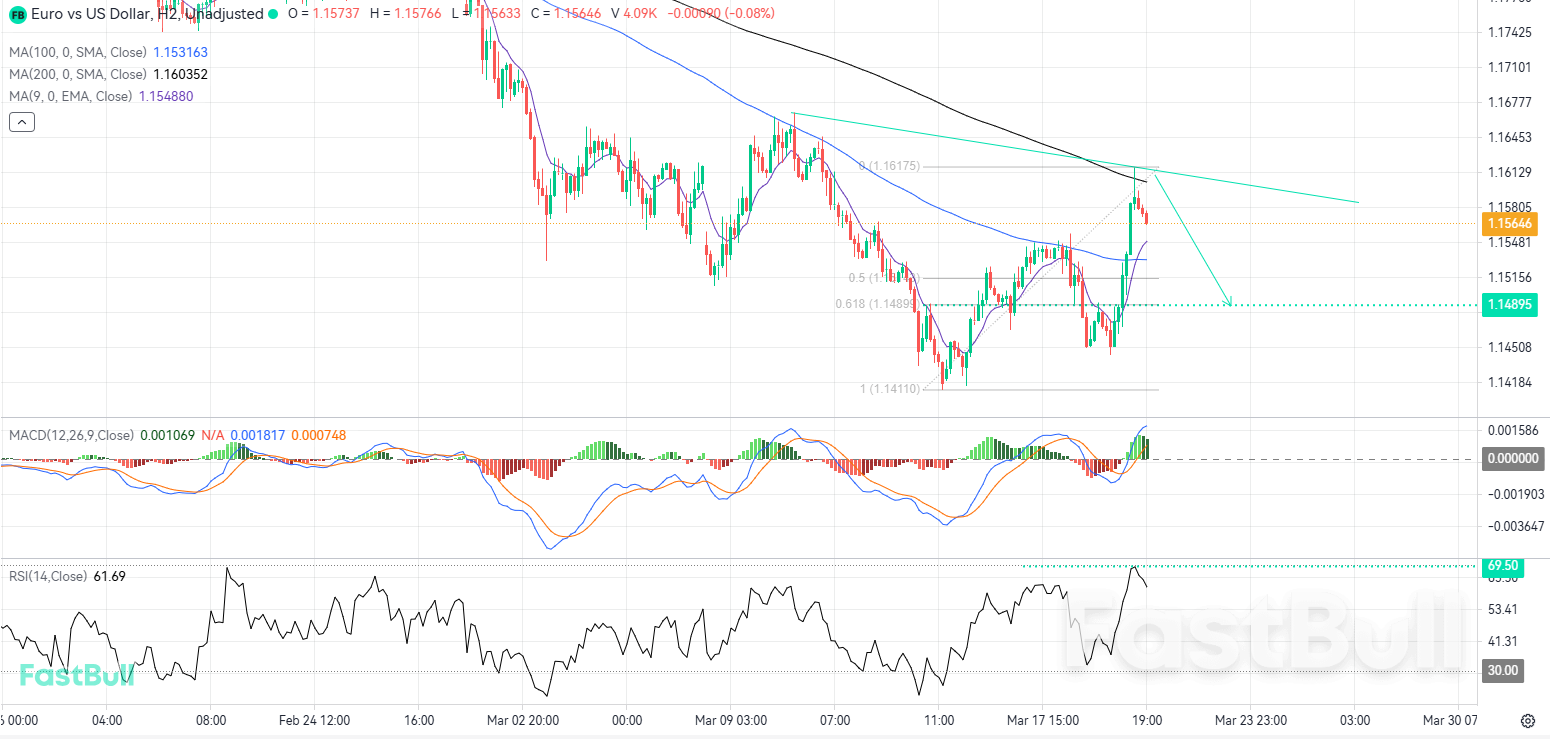
From a technical perspective, the EUR/USD pair on the 2-hour (H2) timeframe has recently executed a sharp bearish rejection at the 200-period Moving Average (MA), situated at 1.1603. Meanwhile, the 100-period MA tracks closely at 1.1531. Unless the 200-period MA is decisively breached to the upside with significant bullish conviction, the path of least resistance appears to be a downward correction.
The primary technical objective for this move is the local support floor at 1.14889, a zone that aligns perfectly with the 0.618 Fibonacci retracement level—a high-confluence target for corrective impulses within a broader trend.
Analyzing the momentum oscillators, the Relative Strength Index (RSI) recently struck the 69 level, bordering on overbought territory. This provides a clear signal for bears to begin scaling into short positions as the upward move loses steam. Simultaneously, the Moving Average Convergence Divergence (MACD) is currently printing a bullish histogram that is visibly losing depth.
While the signal lines remain above the neutral threshold, a transition into a negative histogram would likely drag the signal lines lower. A crossover beneath the neutral baseline would provide definitive technical confirmation for a sustained bearish reversal toward the Fibonacci support zone.
Trading Recommendations
Trading direction: Sell
Entry price: 1.1564
Target price: 1.1489
Stop loss: 1.1640
Validity: Mar 27, 2026 15:00:00


