High-level diplomatic deliberations between President Donald Trump and President Xi Jinping commenced this week, with the American administration confirming a landmark agreement. According to the reports, Beijing has committed to the acquisition of 200 Boeing aircraft, alongside a strategic authorization for the sale of NVIDIA H200 chips to ten prominent Chinese firms. Despite these commercial breakthroughs, geopolitical friction remains palpable; the Chinese President cautioned Trump at the onset of the two-day summit that ongoing disagreements regarding Taiwan could move bilateral relations into a "very dangerous place." Nevertheless, Xi indicated that parallel trade negotiations held between U.S. and Chinese delegations in South Korea have yielded "balanced and positive results," suggesting a complex duality of cooperation and contention.
On the domestic front, U.S. economic indicators provided a nuanced perspective on the consumer landscape. Retail Sales for April recorded a 0.5% month-over-month expansion, aligning with market forecasts but representing a significant cooling from the 1.6% growth witnessed in March. On an annualized basis, however, sales grew by a robust 4.9%, comfortably exceeding the 3.3% consensus. This resilience in spending is juxtaposed against a slightly softening labor market, as initial jobless claims for the week ending May 9 ascended to 211,000, overshooting the anticipated 205,000. These figures emerge amidst a backdrop of intensifying price pressures; the latest inflation data continues to reflect a severe energy-driven shock, with the Producer Price Index (PPI) surging to 6% year-over-year and the Consumer Price Index (CPI) reaching 3.8%—drifting further away from the Federal Reserve’s 2% mandate.
The institutional landscape of the Federal Reserve is also undergoing a significant transition. Governor Stephen Miran submitted his formal resignation this Thursday, a move timed to coincide with the ascension of Kevin Warsh as the next Fed Chairman. Miran had been appointed by President Trump to fulfill the remaining months of former Governor Adriana Kugler’s term as a temporary measure prior to Warsh's nomination. With Warsh now confirmed to lead the central bank, Miran’s departure clears the final seat on the seven-member board. Amidst this transition, Kansas City Fed President Jeffrey Schmid reaffirmed that entrenched inflation remains the most immediate threat to economic stability. Schmid noted that while the U.S. economy is structurally less vulnerable to global oil disruptions than in previous decades, elevated energy prices continue to erode household purchasing power and inflate corporate operational costs.
This environment of persistent price pressure has catalyzed a hawkish shift in market expectations. Traders have notably increased their bets on additional monetary tightening before the close of the 2026 calendar year. According to the CME FedWatch Tool, the implied probability of a rate hike during the December assembly has climbed to approximately 42%, a significant jump from the 33% probability recorded just one session prior. This recalibration suggests that the "higher-for-longer" narrative may be transitioning into an active tightening bias as the central bank struggles to anchor inflationary expectations.
Technical Analysis
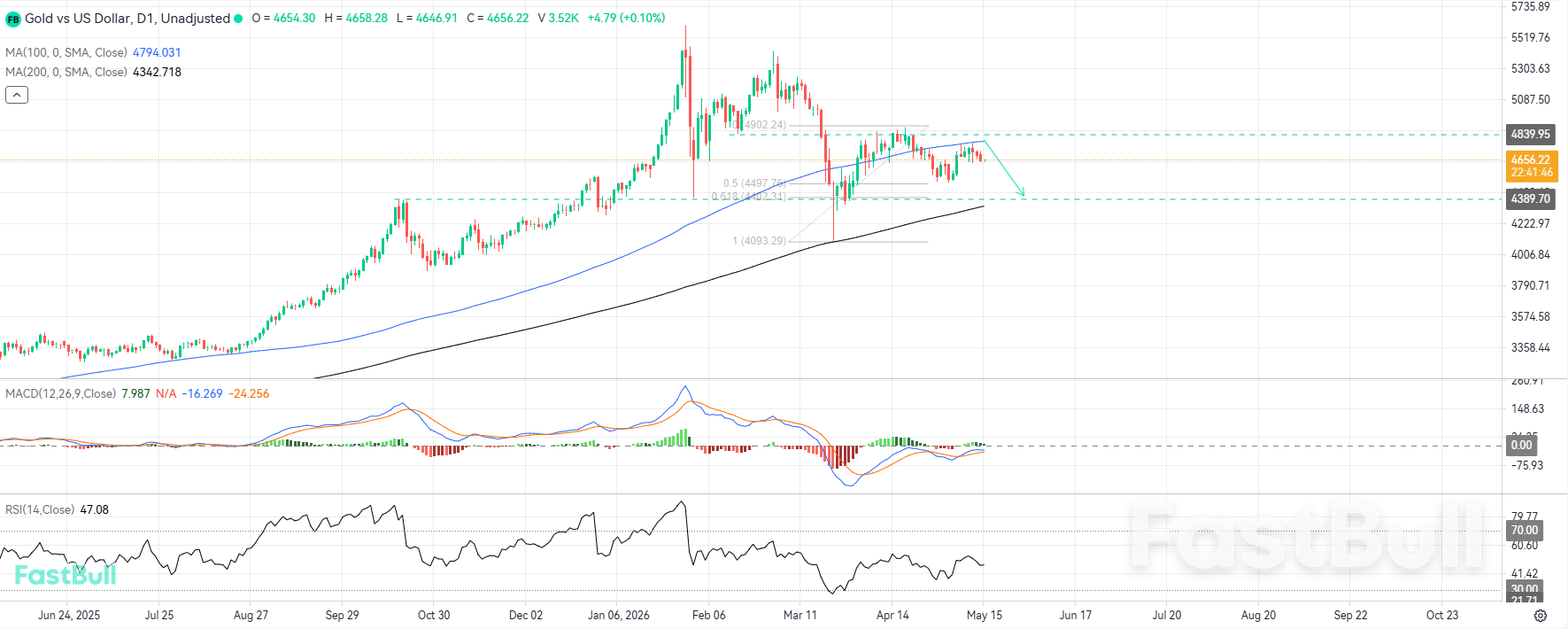
From a technical perspective, XAU/USD (Gold) has exhibited a sharp bearish rejection upon testing the 100-period Moving Average (MA), currently situated at the 4794 handle. Price action challenged this dynamic supply wall on two separate occasions in the daily timeframe, failing to achieve a decisive close above it both times. This repeated failure to clear structural resistance suggests that a corrective leg is now in development, with the pair likely gravitating toward a primary downside objective at 4389. This target area represents a high-confluence zone, as it is in close proximity to the 200-period Moving Average tracking at 4342.
This downside objective carries additional technical weight as it aligns precisely with a well-established horizontal support floor and the 0.618 Fibonacci retracement level of the most recent bullish impulse. The convergence of these indicators creates a powerful "liquidity magnet," reinforcing the thesis that a deeper correction toward this cluster is the path of least resistance.
Our analysis of momentum oscillators further corroborates this bearish outlook. The Relative Strength Index (RSI) is currently tracking at the 47 level, positioned just beneath technical neutrality and retaining ample "runway" to facilitate a deeper move toward oversold extremes. Simultaneously, the MACD is printing a bullish histogram that is losing depth with significant velocity; the exceptionally small bars suggest that a transition into a negative histogram is imminent. With the signal lines already oscillating beneath the neutral threshold, a confirmed bearish crossover in the histogram would likely provide the necessary catalyst for a high-velocity expansion toward the 4389 support cluster.
Trading Recommendations
Trading direction: Sell
Entry price: 4658
Target price: 4400
Stop loss: 4970
Validity: May 27, 2026 15:00:00


