The Federal Reserve opted to maintain the federal funds target range at 3.50%–3.75% for the third consecutive meeting. Despite the pause, the central bank delivered a notably hawkish shift in its rhetoric, upgrading its assessment of inflation from "somewhat elevated" to "elevated." This recalibration underscores the growing concern within the board regarding surging global energy expenditures and the persistent systemic uncertainty stemming from ongoing volatility in the Middle East.
The Federal Open Market Committee (FOMC) decision revealed an uncharacteristic and deep-seated division, resulting in an 8-4 vote. This represents the highest level of internal dissent witnessed since October 1992. While Stephen Miran advocated for a 25-basis-point cut, Beth Hammack, Neel Kashkari, and Lorie Logan supported the hold but explicitly opposed the inclusion of any "easing bias" in the official statement.
Chairman Jerome Powell characterized the outcome as a significantly tighter decision than the one reached in March. He observed that the inflationary pressures catalyzed by rising energy costs have likely not yet reached their zenith, noting a growing cohort of officials who now view a rate hike as equally probable as a cut. Powell maintained a strictly data-dependent stance, suggesting that any pivot toward a more accommodative policy would require clear evidence of moderating energy prices and a de-escalation of global tariff tensions.
On the domestic front, U.S. economic indicators provided a nuanced, bifurcated narrative. The ADP Employment Report signaled a marginal cooling of the labor market, with private-sector job creation slowing to 39.25K from the previous 40.25K. However, this tepid labor growth was effectively offset by the resilience of the American consumer; the Conference Board Consumer Confidence Index ascended to 92.8 in April, comfortably exceeding the 89.0 consensus and improving upon the revised prior reading of 92.2. This suggests that household sentiment remains structurally sound despite the prevailing global volatility.
Geopolitically, the outlook remains shrouded in uncertainty. Reports suggest that President Donald Trump has engaged in high-level discussions with oil executives regarding the feasibility of maintaining a prolonged maritime blockade against Iran. Trump voiced significant skepticism regarding Tehran’s diplomatic capacity, stating that the nation "does not know how to close a non-nuclear deal" while urging a rapid resolution. These remarks reinforce Washington’s entrenched escepticism toward Iran's proposal to end the conflict and reopen the Strait of Hormuz, particularly as nuclear negotiations remain at a total impasse.
In Australia, the Consumer Price Index (CPI) recorded a 4.6% year-over-year expansion in March, arriving slightly beneath market forecasts. Nevertheless, underlying inflation continues to oscillate above the Reserve Bank of Australia’s (RBA) mandated target range. Following the release, three-year bond yields retreated, and the implied probability of a rate hike at the next assembly moderated to 68%. This reflects a delicate equilibrium between slightly softer underlying data and the reality of elevated crude oil prices heading into the second quarter.
Heading into the May 5, 2026 policy meeting, the consensus expectation is that the RBA will extend its tightening cycle with a third consecutive increase to the Official Cash Rate (OCR). Markets currently assign a 74% probability to a 25-basis-point hike, which would elevate the benchmark rate to 4.35%.
Technical Analysis
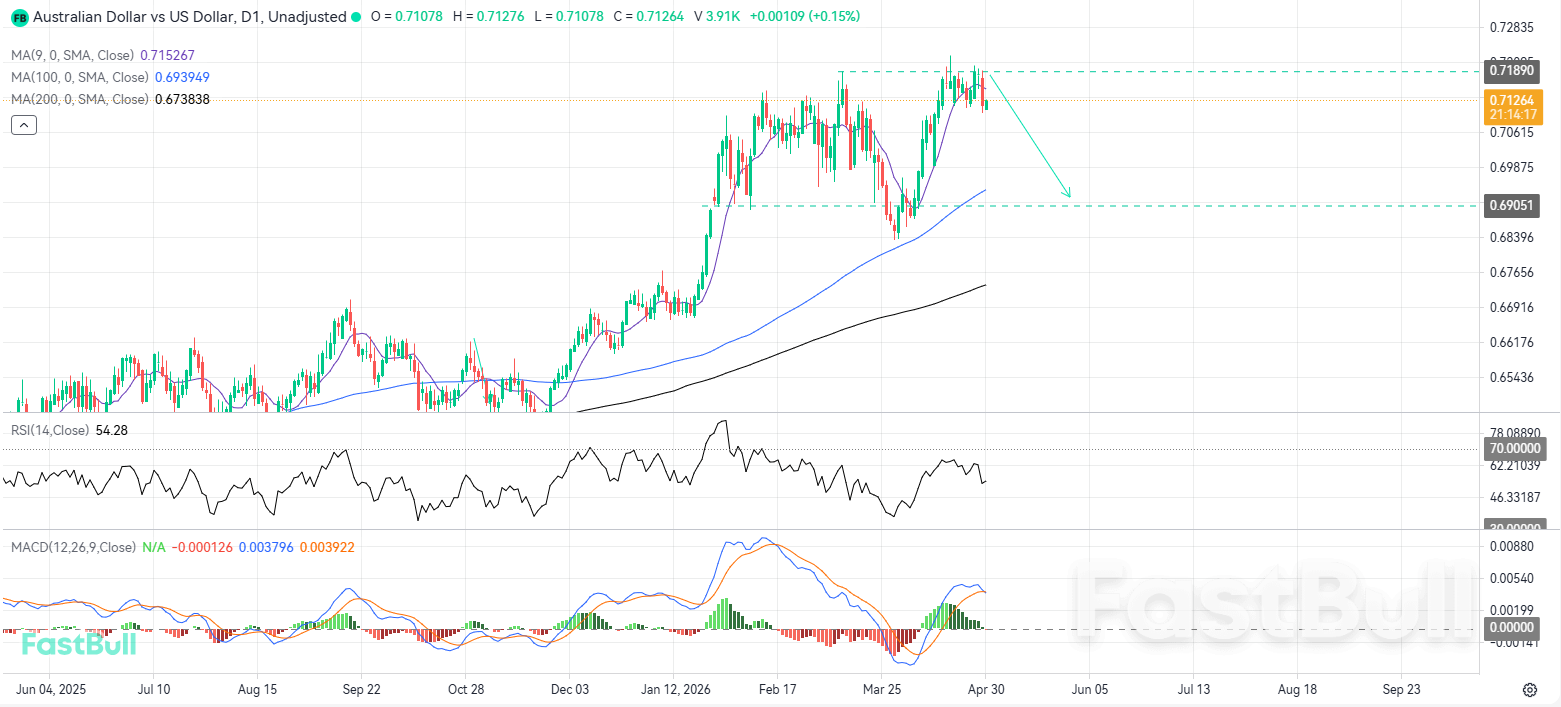
From a technical perspective, AUD/USD has once again exhibited a sharp bearish rejection at the primary resistance handle of 0.7189. This zone has functioned as a supply wall, thwarting multiple breakout attempts in recent sessions. Crucially, the pair has achieved a daily close beneath the 9-period Moving Average, a technical signal that adds weight to the thesis that a trend reversal or significant correction is now in play.
Should the current bearish momentum persist, the primary downside objectives are situated at the 100-period Moving Average (0.6939) and the local horizontal support floor at 0.6905. The 200-period MA tracks much further below at 0.6737, serving as the ultimate structural safety net for the broader trend.
Our analysis of momentum oscillators validates this nascent downward pivot. The Relative Strength Index (RSI) is currently tracking at the 53 level, positioned just above technical neutrality but retaining ample "runway" to facilitate a deeper corrective move.
Simultaneously, the MACD is printing a bullish histogram that is rapidly losing depth, signaling an imminent bearish crossover. While the signal lines remain in the upper quadrant, a decisive crossover and a move toward the neutral threshold would provide the final confirmation for a more profound bearish expansion toward the 0.6900 handle.
Trading Recommendations
Trading direction: Sell
Entry price: 0.7126
Target price: 0.6905
Stop loss: 0.7260
Validity: May 12, 2026 15:00:00


