Aggressively hawkish rhetoric from European Central Bank (ECB) policymakers continues to provide a vital structural tailwind for the common currency. The institution remains steadfast in its mandate to combat persistent price pressures, with President Christine Lagarde and other high-ranking members of the Governing Council maintaining a remarkably consistent narrative. They have repeatedly emphasized that monetary policy will remain entrenched in restrictive territory until inflation returns to the 2% target in a durable and sustainable manner.
This burgeoning hawkish sentiment has been further reinforced by Governing Council member Gabriel Makhlouf, who recently asserted that the institution stands ready to intervene aggressively once the broader economic ramifications of the current regional conflict become more transparent. Makhlouf cautioned that a protracted military engagement would likely push the Eurozone economy toward the "adverse scenario" currently modeled by the bank’s analysts. For the time being, the ECB is maintaining a posture of strategic neutrality, carefully avoiding either the confirmation or discounting of any specific policy trajectory until more definitive data becomes available.
In Switzerland, inflationary pressures exhibited a slight uptick, rising to 0.3% year-over-year in March from 0.1% in February. While this represented the highest reading in a year—largely reflecting elevated energy costs tied to Middle Eastern tensions—it fell short of the 0.5% forecast. As price growth remains near the lower bound of the Swiss National Bank’s (SNB) 0–2% target, the pressure for a significant shift in monetary policy remains minimal. Consequently, the SNB opted for stability during its March deliberations, maintaining its primary policy rate at 0.00%. However, the true focal point of the session was the bank’s recalibration of its foreign exchange guidance, signaling an increased readiness to intervene in the currency markets to prevent any excessive appreciation of the Swiss Franc (CHF).
On the geopolitical front, U.S. President Donald Trump recently indicated via Truth Social a two-week suspension of planned military strikes against Iran. This strategic moratorium is strictly contingent upon Tehran ensuring the immediate, complete, and secure navigation of the Strait of Hormuz. Simultaneously, Iranian Foreign Minister Seyed Aragchi announced that the U.S. has accepted the broad framework of a 10-point proposal, suggesting that Tehran will cease defensive operations provided that hostilities against the country are halted. This fragile detente provides a momentary window of calm for energy markets, though the underlying risk premium remains high.
Technical Analysis
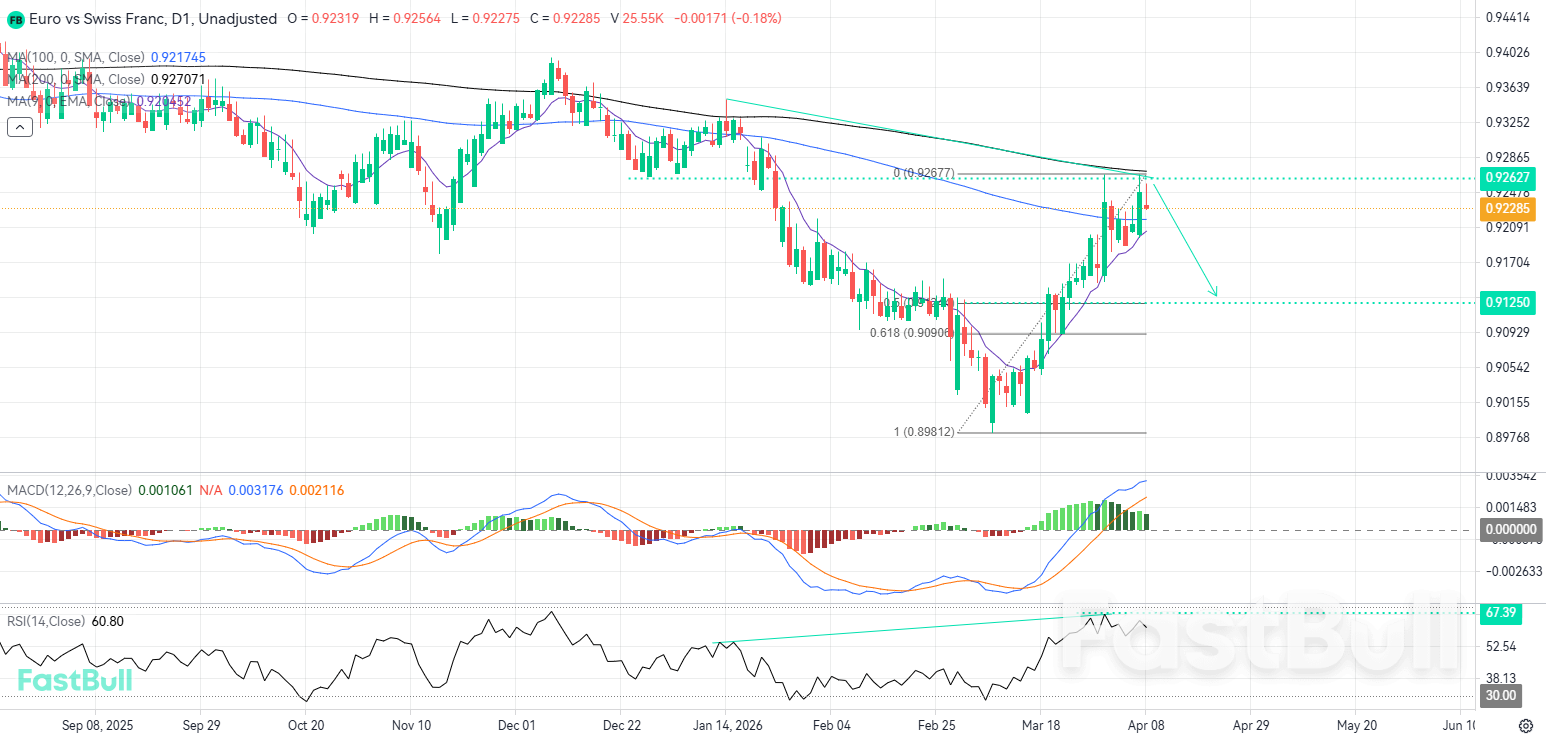
From a technical perspective, EUR/CHF has recently executed a powerful bullish impulse, originating from the 0.8981 handle on March 8 and ascending to a recent peak of 0.9268. As the pair enters this territory, it is encountering a high-confluence resistance cluster. Specifically, the 200-period Moving Average (MA) on the daily chart is situated at 0.9270, while the 100-period MA tracks lower at 0.9217.
This technical ceiling at 0.9262 is proving to be a formidable barrier; a decisive rejection from this level could catalyze the inception of a corrective retracement. In such a scenario, we anticipate a mean-reversion move toward the 0.9125 zone, which aligns with the 0.50 Fibonacci retracement level. This area is expected to function as a primary downside objective for any short-term bearish correction.
Our analysis of momentum oscillators provides further validation for a potential downside pivot. The Relative Strength Index (RSI) recently struck the 67 level, moving into overbought territory on the daily timeframe. Crucially, a bearish divergence has materialized; while current prices are testing local highs, the RSI remains higher than the peaks observed in mid-January with higher prices, suggesting that bullish conviction is beginning to wane.
Simultaneously, the MACD is showing early signs of exhaustion as the bullish histogram begins to lose significant depth. A confirmed bearish crossover of the histogram would provide the final technical validation required to signal a corrective movement. Traders should monitor the 0.9262 zone closely; a failure to clear this level on a daily closing basis would strongly favor a tactical move toward the Fibonacci support at 0.9125.
Trading Recommendations
Trading direction: Sell
Entry price: 0.9227
Target price: 0.9125
Stop loss: 0.9310
Validity: Apr 17, 2026 15:00:00


