In the United Kingdom, the Bank of England (BoE) remained consistent with its established policy trajectory, electing to maintain interest rates at 3.75%, a move that aligned seamlessly with broader market expectations. The decision was underscored by a significant 8-1 split within the Monetary Policy Committee; Chief Economist Huw Pill emerged as the sole hawk, dissenting in favor of an immediate rate hike. Governor Andrew Bailey characterized the bank’s current position as a "difficult decision," emphasizing the delicate balance required between implementing proactive tightening and awaiting definitive data on sustained inflationary acceleration. Furthermore, Bailey took the opportunity to explicitly push back against current swap market pricing, which had previously discounted two additional rate increases for the calendar year.
This institutional resistance follows a consistent pattern observed throughout April, where Bailey repeatedly dismissed investor sentiment favoring a more aggressive BoE tightening cycle. Nevertheless, the released meeting minutes suggest a simmering internal debate, revealing that several policymakers may prefer to act pre-emptively to prevent inflationary pressures from becoming structurally entrenched.
Across the Atlantic, the Federal Reserve opted to maintain the federal funds target range at 3.50%–3.75% for the third consecutive assembly. Despite this tactical pause, the central bank’s rhetoric underwent a notably hawkish recalibration; the Board upgraded its assessment of inflation from "somewhat elevated" to simply "elevated". This shift highlights deepening institutional concern regarding surging global energy expenditures and the persistent systemic uncertainty generated by ongoing volatility in the Middle East.
The Federal Open Market Committee (FOMC) decision unveiled an uncharacteristic and deep-seated division, resulting in a notable 8-4 split—the most significant internal friction recorded since October 1992. While Stephen Miran advocated for a 25-basis-point cut, Beth Hammack, Neel Kashkari, and Lorie Logan supported the hold while explicitly opposing the inclusion of any "easing bias" in the official statement. Chairman Jerome Powell described the outcome as a significantly "tighter" decision than the one reached in March, noting a growing cohort of officials who now view a rate hike as equally probable as a cut. Powell maintained a strictly data-dependent stance, suggesting that any pivot toward an accommodative policy would require clear evidence of moderating energy prices and a de-escalation of global tariff tensions.
Adding weight to this hawkish sentiment:
Beth Hammack (Cleveland Fed) observed that escalating oil prices are broadening inflationary pressures, arguing that an easing bias is no longer justified.
Neel Kashkari (Minneapolis Fed) warned that disruptions in the Strait of Hormuz or critical energy infrastructure could catalyze a price shock, potentially forcing the Fed to further tighten policy.
Lorie Logan (Dallas Fed) signaled that the Federal Reserve’s next move could feasibly be either a rate cut or an additional hike.
On the economic data front, the U.S. Manufacturing ISM PMI for April printed at 52.7, remaining unchanged from March and signaling continued robustness in manufacturing activity. However, the report contained a sobering metric: the prices paid index surged from 78.3 to 84.6, marking its highest reading since April 2022 and suggesting that input cost pressures are far from extinguished.
Technical Analysis
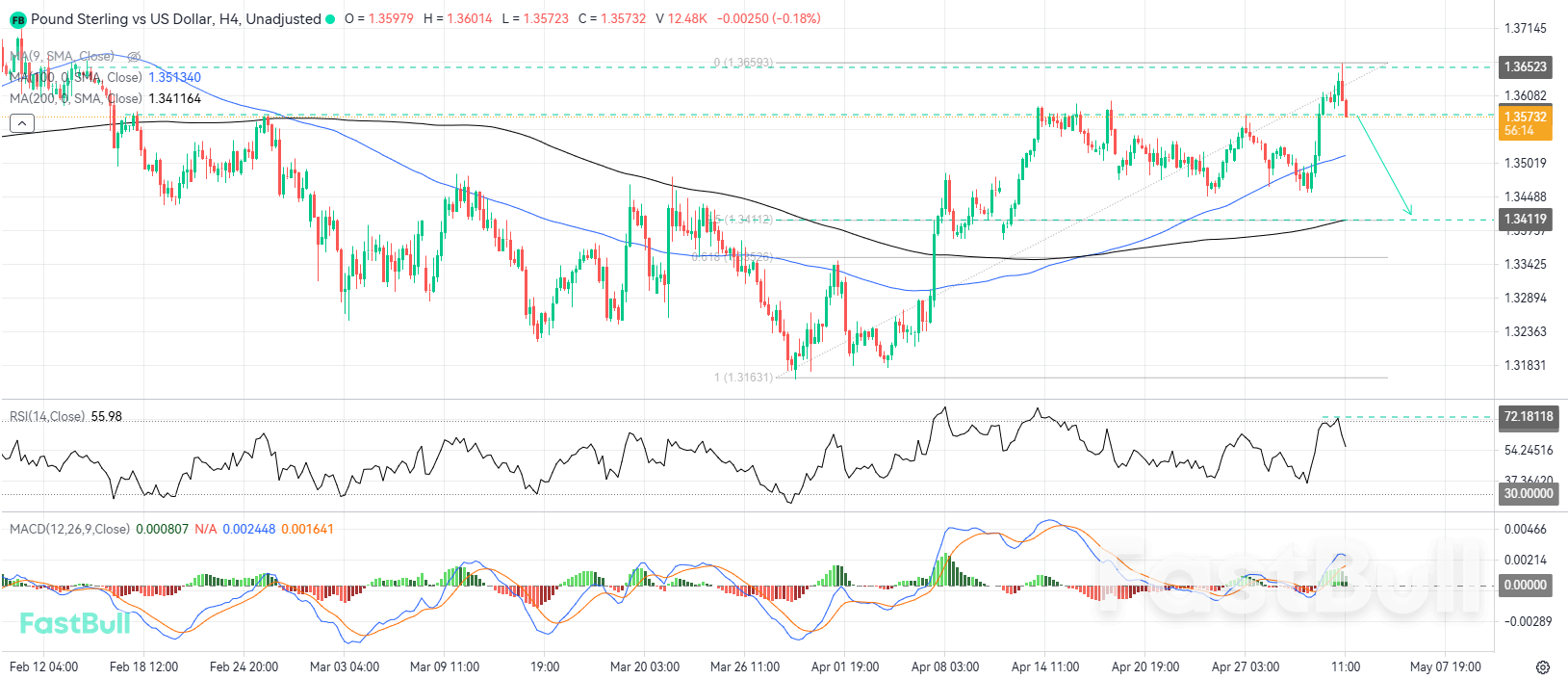
From a technical perspective, GBP/USD has retreated beneath the primary resistance handle at 1.3579. This move followed a test of the local peak at 1.3659, where the pair encountered a secondary resistance level and suffered a sharp bearish rejection. This decisive turn suggests that a corrective downward move is now in development, with price action likely gravitating toward the 1.3411 support zone.
This downside target carries significant technical confluence:
- It aligns precisely with the 0.50 Fibonacci retracement level.
- The 200-period Moving Average is currently situated at this exact 1.3411 handle.
- The 100-period Moving Average is tracking higher at 1.3513, potentially acting as the first layer of dynamic support.
This aggroupment of technical signals suggests that the 1.3411 area may act as a "magnet" for price action in the near term.
Meanwhile, momentum oscillators further validate this bearish outlook. The Relative Strength Index (RSI) recently peaked at 72, signaling overbought conditions that effectively catalyzed the current reversal. Meanwhile, the MACD continues to print a bullish histogram, but it is losing depth with significant velocity. With the signal lines hovering only marginally above the neutral threshold, a bearish histogram crossover accompanied by a signal line breakdown would provide the necessary technical confirmation for an extended downward impulse.
Trading Recommendations
Trading direction: Sell
Entry price: 1.3570
Target price: 1.3411
Stop loss: 1.3670
Validity: May 12, 2026 15:00:00


