The February Gross Domestic Product (GDP) figures delivered a notable upside surprise, vastly outperforming consensus estimates by showcasing robust, broad-based strength across the services, production, and construction sectors. Collectively, this data suggests that economic activity for the first quarter of 2026 is proving far more resilient than the Bank of England’s (BoE) Monetary Policy Committee (MPC) had initially anticipated in their prior forecasts.
The services sector spearheaded this expansionary trend with a monthly increase of 0.5%, a figure significantly higher than the 0.2% expansion expected by analysts. Within this crucial segment, 12 of the 14 sub-components reported positive growth, with wholesale and retail trade exhibiting particular dynamism alongside professional and administrative services.
Despite these constructive figures, UK policymakers remain deeply concerned about entrenched inflationary pressures. They have repeatedly cautioned that the full impact of the recent energy shock—fueled by surging global prices—may take several months to fully permeate the domestic economy. Furthermore, because this GDP data reflects a period prior to the most recent geopolitical escalations, it is unlikely to be the primary driver of the BoE’s April policy decision, thereby limiting its immediate impact on Sterling’s near-term valuation.
Across the Atlantic, U.S. economic indicators reflected a similarly robust domestic landscape in March. Retail Sales ascended by 1.7% month-over-month, significantly outperforming the 1.4% market consensus and improving upon February's 0.7% print. This surge was primarily driven by elevated gasoline expenditures, which bolstered station receipts, alongside seasonal tax refunds providing a structural fiscal tailwind for consumer spending. On an annualized basis, sales growth remained remarkably resilient at 4%, mirroring the previous month's performance.
Concurrent with this consumer strength, the U.S. labor market exhibited continued vitality. The ADP Employment Change four-week average trended upward from 39,000 to 54,800, further reinforcing the narrative of a tight and resilient labor landscape.
However, this domestic optimism is increasingly overshadowed by a deteriorating geopolitical environment. Uncertainty regarding the resumption of diplomatic negotiations between Washington and Tehran has reached a fever pitch following renewed hostilities in the Strait of Hormuz. Current reports suggest a diplomatic vacuum, as neither party has dispatched negotiation teams to the region. With J.D. Vance’s schedule remaining focused on high-level meetings in Washington, hopes for a ceasefire extension are rapidly evaporating ahead of tomorrow’s expiration. While Iranian state-affiliated channels have denied these claims, the continued absence of an official delegation strongly suggests a diplomatic stalemate.
In Washington, Fed Chair nominee Kevin Warsh utilized his Senate testimony to advocate for a profound "regime change" in the conduct of monetary policy. Warsh emphasized the critical necessity of a modernized inflationary framework to navigate the current systemic shifts in the global economy. These comments arrive just as Federal Reserve officials have formally entered their "blackout period" ahead of the April 28–29 meeting, leaving the market to digest his hawkish tone in a communication vacuum.
Technical Analysis
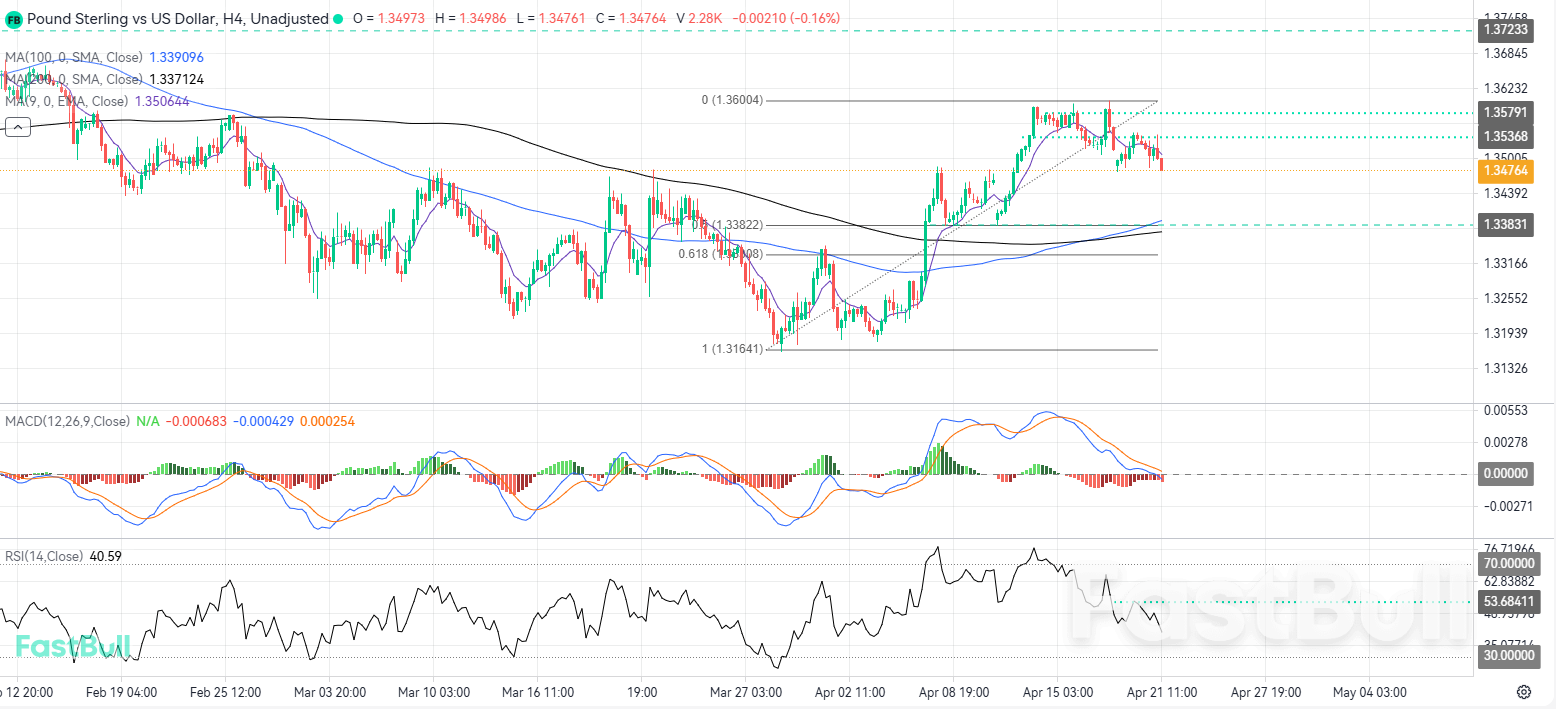
From a technical perspective, GBP/USD has failed to reclaim the territory above the primary resistance handle at 1.3536. Following the weekly opening, price action was decisively rejected at this level on two separate occasions, printing a clearly bearish sequence.
The path of least resistance now appears skewed to the downside. The 100 and 200-period Moving Averages (MAs) are currently tracking at 1.3391 and 1.3371, respectively. These levels are expected to function as dynamic support zones in the near term. However, the primary focus for sellers remains the 1.3383 level, where local support aligns with the 0.50 Fibonacci retracement. This area represents a high-confluence target should the current corrective movement persist.
Our analysis of momentum oscillators provides further validation for this bearish leg. The Relative Strength Index (RSI) is currently hovering at the 41 level, suggesting that the pair retains ample "runway" to continue its descent before reaching oversold extremes.
At the same time, the MACD is printing a bearish histogram that is actively gaining negative depth. With the signal lines fast approaching a bearish crossover, technical conviction is mounting for a sustained move lower. Traders should monitor the 1.3383 zone closely; a failure to stabilize there could open the door for a deeper test of the 200-period MA at 1.3371.
Trading Recommendations
Trading direction: Sell
Entry price: 1.3477
Target price: 1.3383
Stop loss: 1.3540
Validity: Apr 30, 2026 15:00:00


