he Australian Dollar came under renewed pressure against the Japanese Yen during Tuesday’s European session, with the pair slipping toward the 110.60 region after failing to sustain momentum above the 111.00 handle. The move lower reflects a broader shift in market sentiment, as traders begin to unwind bullish positioning following a breakdown in key technical support.
The decline is being driven primarily by a resurgence in Yen strength, with the Japanese currency benefiting from a modest risk-off tone across global markets. The Yen, traditionally viewed as a safe-haven asset, has attracted inflows amid growing uncertainty surrounding global growth prospects and monetary policy divergence. This has placed downside pressure on AUD/JPY, particularly as carry trade dynamics begin to reverse.
At the same time, the Australian Dollar is struggling to maintain traction, weighed down by a combination of softer commodity sentiment and a more cautious outlook for China’s economic recovery. As Australia’s largest trading partner, any signs of slowing demand from China tend to have an outsized impact on the AUD, reducing its appeal in risk-sensitive environments.
From a monetary policy standpoint, the divergence between the Reserve Bank of Australia and the Bank of Japan is also beginning to narrow. While the RBA has signaled a more measured approach to further tightening, markets are increasingly speculating that the Bank of Japan could continue normalizing policy after years of ultra-loose settings. Even a gradual shift in Japanese yields is enough to disrupt the long-standing carry trade that has supported AUD/JPY.
This evolving rate dynamic is critical. AUD/JPY has historically been one of the most sensitive currency pairs to interest rate differentials, and any compression in yield spreads tends to trigger repositioning. As Japanese yields edge higher and Australian rate expectations stabilize or soften, the relative attractiveness of holding AUD diminishes.
Meanwhile, broader risk sentiment remains fragile. Equity markets have shown signs of hesitation, while persistent inflation concerns continue to cloud the global monetary policy outlook. In such an environment, high-beta currencies like the Australian Dollar typically underperform, while defensive currencies like the Yen gain traction.
The result is a fundamental backdrop that increasingly aligns with the recent technical breakdown. What initially appeared as a simple trendline breach is, in reality, a reflection of deeper macro forces—ranging from shifting central bank expectations to evolving global risk dynamics and commodity-linked pressures on the Australian economy.
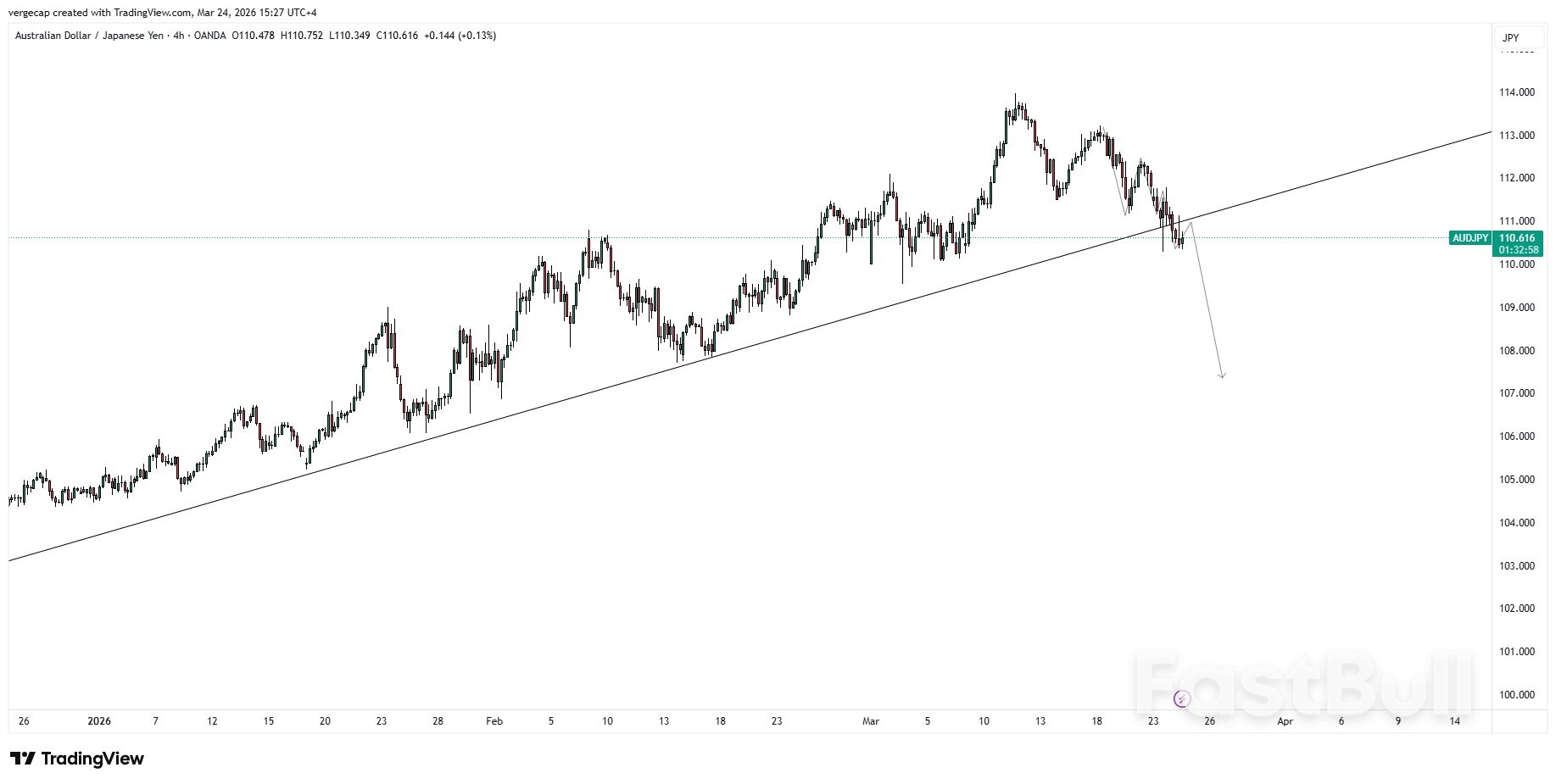
AUD/JPY is showing early signs of a potential trend reversal after an extended period of bullish price action supported by a well-defined ascending trendline. On the 4-hour chart, price has recently broken below this rising trendline support, signaling a shift in market structure and raising the risk of a deeper corrective move.
The prior uptrend was characterized by consistent higher highs and higher lows; however, the recent breakdown suggests that bullish momentum is weakening. Price is now attempting to retest the underside of the broken trendline near the 111.00–111.50 region, which is acting as immediate resistance. This retest phase is critical, as failure to reclaim this level would confirm the breakdown and reinforce a bearish bias.
On the downside, immediate support is seen around the 110.00 psychological level. A decisive break below this threshold would likely accelerate selling pressure and expose the 107.50–108.00 region as the next downside target. This area aligns with prior consolidation and represents a logical zone for price to seek stability. A sustained move below this region would signal a more pronounced trend reversal, shifting the broader outlook firmly bearish.
Conversely, if buyers manage to reclaim the broken trendline and push price back above the 112.00 level, the breakdown would be considered a false move. In that scenario, bullish momentum could re-emerge, with upside targets extending toward 113.50 and potentially the recent highs near 114.00.
Momentum indicators suggest a transition phase rather than a confirmed downtrend. The recent breakdown indicates fading bullish strength, while the current retest reflects indecision. This aligns with a potential shift from bullish continuation to corrective or bearish conditions, depending on confirmation.
TRADE RECOMMENDATION
SELL AUD/JPY
ENTRY PRICE: 110.50
STOP LOSS: 112.20
TAKE PROFIT: 108.00
Risk Warnings and Investment Disclaimers
You understand and acknowledge that there is a high degree of risk involved in trading with strategies. Following any strategies or investment methodologies is the potential for loss. The content on the site is being provided by our contributors and analysts for information purposes only. You alone are solely responsible for determining whether any trading assets, or securities, or strategy, or any other product is suitable for you based on your investment objectives and financial situation.


