The Australian Dollar is going nowhere fast. AUD/USD traded around the mid-0.6900s during early European hours Thursday, essentially flat on the day but uncomfortably close to its lowest print since early February, touched earlier this week. For a currency that had been riding a wave of domestic optimism just weeks ago — buoyed by a hawkish Reserve Bank of Australia and a resilient economy — the mood has turned decidedly sour, and in my view, the market is right to be cautious.
The reason is straightforward: the world has a major crisis on its hands, and risk-sensitive currencies like the Australian Dollar tend to suffer when that happens.
Any optimism that had briefly flickered around ceasefire talk this week was extinguished almost as quickly as it appeared. Iran's Foreign Minister Abbas Araghchi stated plainly in a state TV interview that his government has not engaged in talks to end the war and has no plans to do so. That is about as unambiguous as diplomatic language gets.
Washington had made a genuine attempt at resolution. Pakistan, acting as intermediary, transmitted a 15-point US proposal to Tehran covering sanctions relief, a rollback of Iran's nuclear program, limits on missiles and the reopening of the Strait of Hormuz — through which a fifth of the world's oil is shipped. Tehran, however, was having none of it. Iran's five-point counteroffer demanded war reparations, sovereignty over the Strait of Hormuz, and sweeping guarantees against future attacks — conditions that Washington is unlikely to accept in any form.
That exchange of proposals, dressed up as diplomacy, is anything but progress. It looks more like two sides talking past each other while the guns keep firing. At least 1,000 troops from the 82nd Airborne Division are being sent to the Middle East in the coming days, underscoring that the US is still very much in escalation mode. This is not a conflict winding down — it is one actively being fed from multiple directions.
The single most consequential development keeping markets on edge is what is happening — or more precisely, what is not happening — in the Strait of Hormuz. Iran's effective closure of the waterway, which handles around 20 million barrels of oil per day representing roughly 20% of global seaborne oil trade, has triggered what the International Energy Agency described as the largest-ever disruption to oil supply.
The economic consequences are rippling through every asset class, and currency markets are no exception. International benchmark Brent crude futures surged above $106 per barrel on Thursday, while WTI climbed to $93.61, as Iran signaled it had no intention of holding direct talks with the United States. An Iranian military spokesman was particularly blunt, warning that the situation in the strait "will not return to what it was" — a statement that, if taken at face value, signals energy market disruption for weeks, if not months, to come. The IEA has warned that the closure has sparked fears of a global inflation crisis and worldwide food shortages. For currency traders, surging crude means one thing above all else: the Federal Reserve's already complicated inflation calculus just got even messier.
Here is the uncomfortable truth for AUD/USD bulls: in an environment of geopolitically-driven energy inflation, the US Dollar wins almost by default. It is the world's reserve currency, the safe-haven destination of choice in a crisis, and right now it has the additional tailwind of markets repricing Fed rate expectations in a more hawkish direction.
At the March FOMC meeting, Chair Powell and colleagues voted to keep interest rates unchanged for a second straight gathering, with Powell acknowledging that the implications of developments in the Middle East for the US economy remain "uncertain." That studied ambiguity, however, is being interpreted by bond markets as a clear signal that rate cuts are off the table for now. Treasury yields have moved higher in response, and higher US yields are a magnet for global capital — pulling it toward the Dollar and away from higher-beta plays like the Australian Dollar.
TD Securities noted that while markets have begun pricing in the risk of rate hikes amid elevated inflation expectations, the Fed is more likely to remain in "wait and see" mode, with its leadership still leaning toward rate cuts later in 2026. That nuance matters enormously. The Fed will not hike because of oil — but it will also not cut while inflation expectations are drifting higher. The result is a kind of monetary paralysis that keeps the Dollar elevated and leaves rate-sensitive currencies like the AUD in limbo.
This is the most frustrating part of the AUD/USD story right now. The Reserve Bank of Australia has done everything right by conventional playbook standards. The RBA raised its cash rate to 3.85% at its February meeting, cementing its status as one of the most hawkish central banks in the developed world in 2026. Australia's economy has been growing, the labour market remains tight, and inflation — while uncomfortably elevated — has been giving the RBA the justification it needs to stay aggressive on policy.
And yet none of that has been enough to prevent the Aussie from sliding. The pair dipped toward $0.69 earlier this week as risk aversion took hold, with investors brushing aside domestic fundamentals in favour of the overwhelming weight of global uncertainty. Softer-than-expected domestic inflation — with annual CPI easing slightly to 3.7% — only added to the pressure, giving traders one more reason to stay on the sidelines.
RBA Assistant Governor Christopher Kent tried to frame the crisis in both directions, noting that the Iran war tightens financial conditions but also increases the risk of an inflation spiral — a double-edged sword that could force the RBA to keep rates elevated even as growth softens. Kent added that the Board remains committed to achieving low, stable inflation and full employment, regardless of the external environment. His remarks, while hawkish in tone, did little to lift the Aussie. When the world is burning, domestic central bank rhetoric tends to get drowned out.
One factor that could theoretically shift the AUD/USD calculus is China. Australia's economy is deeply tied to Chinese demand for its commodities, and Beijing's response to the Middle East crisis carries significant implications for the Aussie. China receives a third of its oil via the Strait of Hormuz, meaning Beijing has enormous economic skin in this game. So far, China's defence ministry has urged all parties to stop military actions and pledged to work toward de-escalation — but that is a far cry from meaningful intervention. Markets are watching, but not yet pricing in any Chinese diplomatic breakthrough.
This is not a market where you want to be buying AUD/USD dips with conviction, at least not yet. The structural picture has not changed — the RBA is hawkish, Australia's growth story is intact, and in a world of normalcy, AUD/USD should be trading higher. But we are not in a world of normalcy.
Until the Strait of Hormuz reopens, until Iran and the US find a genuine off-ramp, and until oil prices stop climbing, the US Dollar's safe-haven premium will remain stubbornly elevated. Any rally in AUD/USD from current levels is likely to be shallow and short-lived — a technical correction rather than a trend reversal. The 0.6950–0.6970 zone represents a reasonable resistance band, and any push toward the 0.7000 psychological level will likely attract sellers quickly.
Today's trading range of 0.6932 to 0.6957 tells you everything you need to know about the current state of play: tight, directionless, and held hostage to headlines from Tehran. The pair's 52-week range of 0.5914 to 0.7192 illustrates how much ground has already been covered — and how much room there is to fall if the conflict deteriorates further.
Technical Analysis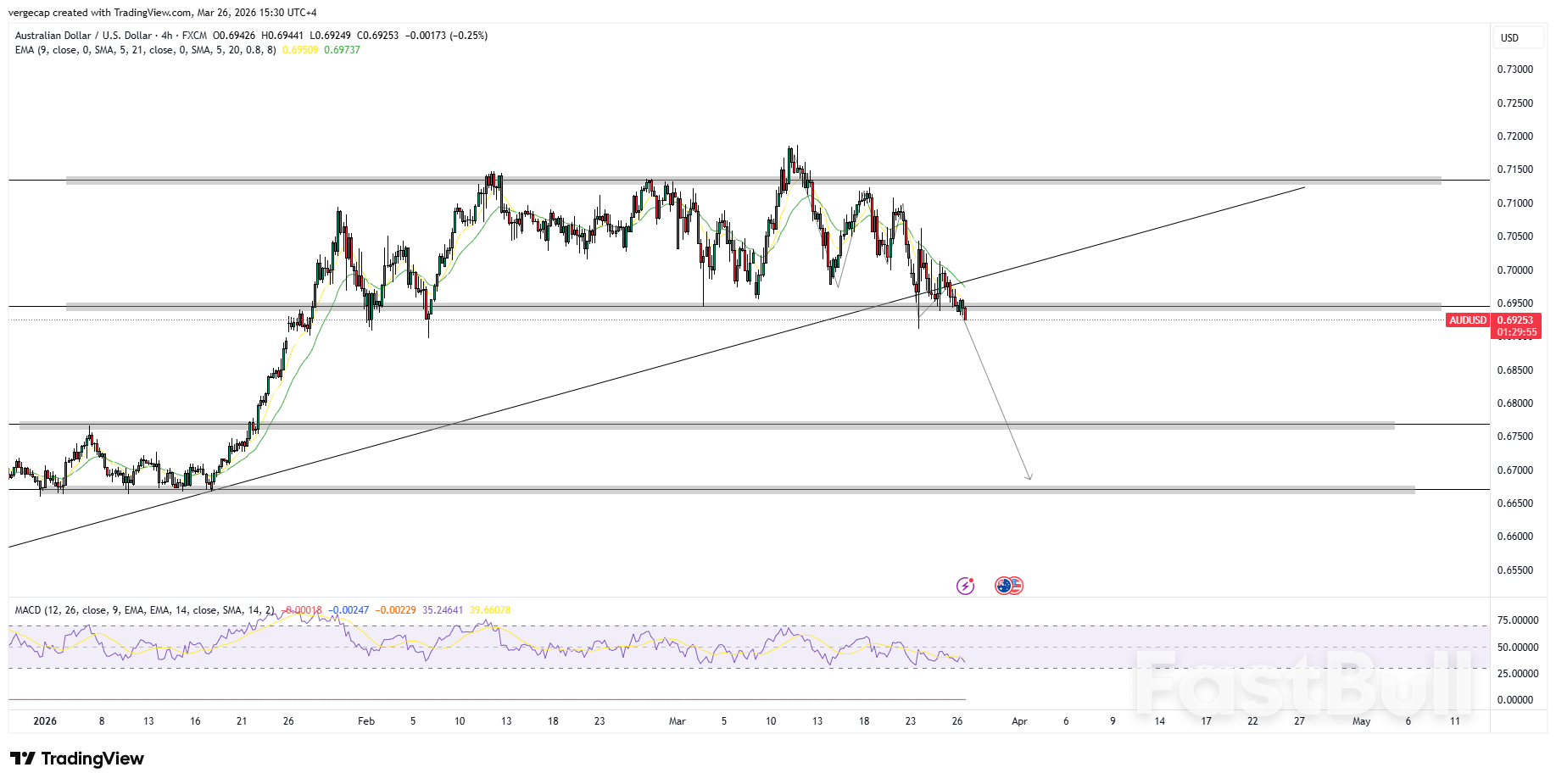
From a technical perspective, AUD/USD is entrenched in a clearly deteriorating structure following a decisive breakdown of its primary ascending trendline. On the 4-hour chart, the pair staged a remarkable recovery from the January 2026 lows near 0.6650, carving out a strong bullish advance that peaked just above the 0.7200 region in mid-February. However, that rally has since fully reversed course, and the price action seen over recent weeks paints an increasingly bearish picture.
The most significant technical development on this chart is the clean breach of the ascending trendline that had been supporting price action since the January low. That trendline, which connected a series of higher lows over nearly two months, served as the structural backbone of the entire bullish advance. Its violation — confirmed by a sustained close beneath the line and follow-through selling — represents a meaningful shift in market character. Price has not only broken the trendline but has failed to reclaim it, a classic "break and retest" rejection pattern that technicians treat as a high-probability bearish signal.
The 9-period EMA and 21-period SMA, both visible on the chart, have now turned lower and are beginning to converge in a bearish formation above current price. Rather than acting as dynamic support during dips — which they did reliably throughout the February rally — these moving averages are now functioning as overhead resistance, capping any attempted recovery and reinforcing the directional shift. The price is trading beneath both, confirming that short-term momentum has decisively turned negative.
Current price action is hovering around the 0.6925–0.6950 zone, an area that previously acted as a consolidation base during the initial stages of the February breakout. This level is now providing a temporary floor, but it is a fragile one. A decisive break and daily close below 0.6920 would eliminate this support entirely and open the door to a swift move toward the 0.6800 region — a horizontal level visible on the chart that corresponds to a prior area of congestion from early February. Should that zone fail to hold, the bearish projection drawn directly on the chart by the analyst targets the 0.6700–0.6680 area, which aligns with a major horizontal support band and represents the next meaningful demand zone on the longer-term structure.
On the upside, any recovery attempts are likely to be met with selling pressure on approach to the 0.7000 psychological level. A reclaim of 0.7000 would represent the first meaningful sign that bears are losing their grip, but even then, the more critical resistance sits at 0.7150 — the former swing high and the upper boundary of the dominant horizontal range that contained price throughout February and early March. A sustained break above 0.7150 would be required to fully negate the current bearish outlook and shift the bias back to neutral, let alone bullish.
Turning to momentum, the MACD indicator at the base of the chart reinforces the bearish case emphatically. The MACD line has crossed below the signal line and both are well below the zero level, confirming that downside momentum is firmly in control. There is no visible sign of a bullish crossover forming, and the histogram bars remain extended to the downside, suggesting the current corrective move still has room to run before any meaningful exhaustion sets in. This is not a MACD that is hinting at a reversal — it is one that is validating the breakdown in full.
In summary, the technical structure for AUD/USD is unambiguously bearish following the trendline violation. The moving averages have flipped to resistance, the MACD confirms negative momentum, the chart's own projected bearish arrow targets 0.6700, and each attempted recovery has been met with fresh selling. Unless price can stage a convincing reclaim of the broken trendline and push back above 0.7000, the bias remains skewed to the downside.
TRADE RECOMMENDATION
SELL AUD/USD
ENTRY PRICE: 0.6925
STOP LOSS: 0.7010
TAKE PROFIT: 0.6700


