The Australian dollar edged lower from a three-month peak on Tuesday after briefly testing the 0.6700 handle, as a resurgence in US economic strength lent fresh support to the greenback and capped upside momentum in AUD/USD. The pair was last trading around 0.6680 at the time of writing, up roughly 0.40% on the day but modestly off its intraday highs, highlighting the growing tug-of-war between diverging central-bank narratives and resilient US macroeconomic data.
Early gains in the Aussie were underpinned by the release of the Reserve Bank of Australia’s minutes from its December policy meeting, which struck a noticeably firmer tone than markets had anticipated. Policymakers acknowledged increasing uncertainty over whether current monetary settings remain sufficiently restrictive, as incoming data suggests inflation pressures may prove more persistent than previously assumed.
While the RBA stopped well short of signaling an imminent policy shift, the discussion revealed that board members are becoming less confident that inflation will return to target as smoothly as earlier projections implied. Officials reiterated their commitment to a data-dependent approach, emphasizing that several key inflation indicators are due ahead of the February meeting and will play a critical role in shaping the policy outlook.
Notably, the minutes showed policymakers openly debating whether additional tightening might eventually be required, with some discussion extending into 2026. However, the board also stressed that it would take time to properly assess the durability of inflationary pressures, signaling caution rather than urgency. This nuanced messaging has reinforced the perception that while the RBA is not done with inflation risks, it remains reluctant to tighten policy prematurely in a slowing global environment.
Market pricing reflects this delicate balance. Australian 30-Day Interbank Cash Rate Futures for February 2026 continue to imply a relatively low probability of a near-term rate hike, even as expectations for a more restrictive stance further down the line remain embedded. Adding to the RBA’s hawkish undertone, Australia’s Consumer Inflation Expectations rose to 4.7% in December, up from November’s three-month low of 4.5%, underscoring the risk that elevated inflation psychology could become entrenched if price pressures fail to ease.
However, any sustained upside in AUD/USD has been tempered by a renewed wave of strength in the US Dollar, driven by a string of better-than-expected US economic releases. Revised figures from the US Bureau of Economic Analysis showed the economy expanded at an annualized rate of 4.3% in the third quarter, sharply above the prior estimate of 3.3% and well ahead of market expectations near 3.8%. The data reinforced the narrative of US economic exceptionalism, even as global growth shows signs of deceleration.
Crucially for Federal Reserve policy expectations, the inflation components of the report also surprised to the upside. The GDP Price Index climbed 3.7% in Q3, while Core Personal Consumption Expenditures rose 2.9%, highlighting the persistence of underlying price pressures and complicating the case for rapid monetary easing in 2025.
Labor market indicators have further supported the dollar. Although the ADP Employment Change report pointed to moderated private-sector job growth, it still reinforced the view of a labor market that remains tight by historical standards. Meanwhile, Industrial Production slipped 0.1% month-on-month in October, missing expectations for a modest gain, but the setback was not severe enough to undermine confidence in the broader economic outlook.
That said, some cracks are emerging beneath the surface. US Consumer Confidence declined to 89.1 in December from 92.9 previously, suggesting households are becoming more cautious amid elevated interest rates and lingering inflation concerns. This softening in sentiment underscores the delicate balance the Federal Reserve faces as it weighs economic resilience against the risk of keeping policy too restrictive for too long.
Taken together, the competing forces of a cautiously hawkish RBA and a resilient US economy have left AUD/USD caught between improving domestic fundamentals and renewed US Dollar demand. From a broader perspective, the pair’s inability to sustain a decisive break above 0.6700 highlights how sensitive risk-aligned currencies remain to shifts in US data momentum. Unless Australian inflation data meaningfully surprise to the upside or global risk sentiment improves further, rallies in AUD/USD may continue to attract selling interest near key resistance levels.
Technical Analysis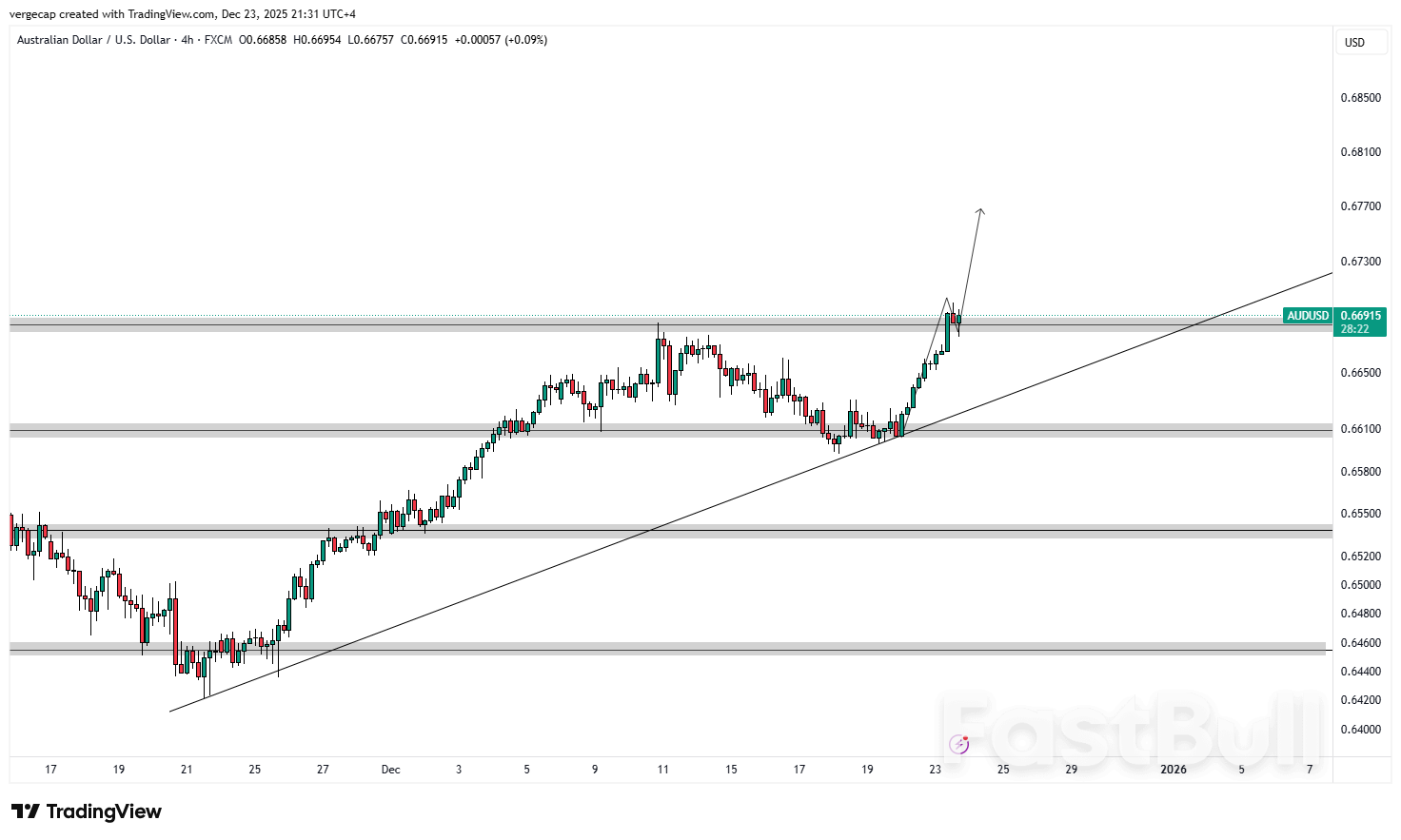
From a technical standpoint, AUD/USD remains constructive despite the intraday pullback. The pair has extended its recent rally after decisively breaking above the 50-period exponential moving average (EMA50), which has now turned into dynamic support. Price action continues to trade along an upward-sloping trendline on the short-term chart, reinforcing the dominance of the prevailing bullish bias.
Momentum indicators support the upside narrative, with the Relative Strength Index flashing positive signals even as it approaches overbought territory. While this raises the risk of near-term consolidation or a shallow corrective move, the broader technical structure suggests dips are likely to be viewed as buying opportunities as long as the pair holds above key support zones.
TRADE RECOMMENDATION
BUY AUDUSD
ENTRY PRICE: 0.6690
STOP LOSS: 0.6640
TAKE PROFIT: 0.6800


