The Australian dollar remained on the back foot for a second consecutive session on Wednesday, with the AUD/USD pair trading near $0.6980 during European hours as investors digested a surprising moderation in domestic inflation. The pullback follows a confluence of forces: softening price pressures at home, a resilient U.S. dollar, and a market increasingly parsing the fine line between geopolitical risk and tentative hopes for diplomatic progress in the Middle East.
Data released overnight by the Australian Bureau of Statistics showed the annual headline Consumer Price Index eased to 3.7% in February, down from a revised 3.8% in January. Economists had broadly expected inflation to hold steady. More notably, the trimmed mean CPI—the RBA’s preferred core measure—came in at 3.3%, undershooting consensus forecasts of 3.4% and matching January’s downwardly revised reading. For a central bank that has spent much of the past year cautioning that the battle against inflation was far from over, the print offered a distinctly dovish tilt.
That nuance was not lost on rate-sensitive markets. The ASX 30 Day Interbank Cash Rate Futures contract for May 2026 was last seen trading at 95.785, implying just a 55% probability of a 25-basis-point hike to 4.35% at the RBA’s upcoming policy meeting. A week ago, those odds were materially higher. The repricing suggests a growing conviction among traders that the RBA may now have room to hold fire, particularly with broader economic momentum showing signs of fragility.
Yet the Australian bond market told a more complicated story. The 10-year government bond yield hovered near 4.95% on Wednesday, retreating only modestly from multi-decade highs reached earlier in the month. The decline—driven in part by a pullback in global oil prices following tentative ceasefire talks—was not a clear endorsement of a peak in rates. Instead, it reflected a market still wrestling with the possibility that the RBA’s next move, whenever it comes, may land later rather than sooner, but is not yet off the table entirely.
Across the Pacific, the U.S. dollar remained broadly firm, adding to the Aussie’s woes. The greenback’s resilience came despite what appears to be incremental progress in high-stakes geopolitical negotiations. Markets are closely tracking discussions around a proposed one-month ceasefire that officials say could serve as a pathway to formal talks between Washington and Tehran. The Trump administration is said to have presented Iran with a 15-point peace proposal aimed at de-escalating hostilities across the Middle East—a region whose stability has become a persistent undercurrent for global risk assets.
For now, Iranian officials have publicly denied any formal breakthrough. But a senior source familiar with the back-channel discussions indicated that indirect communication channels remain active, leaving the door open to a potential thaw. In the currency market, that cautious optimism has helped underpin the dollar, as traders weigh the prospect of reduced geopolitical risk premiums against the enduring reality of U.S. economic exceptionalism.
Technical Analysis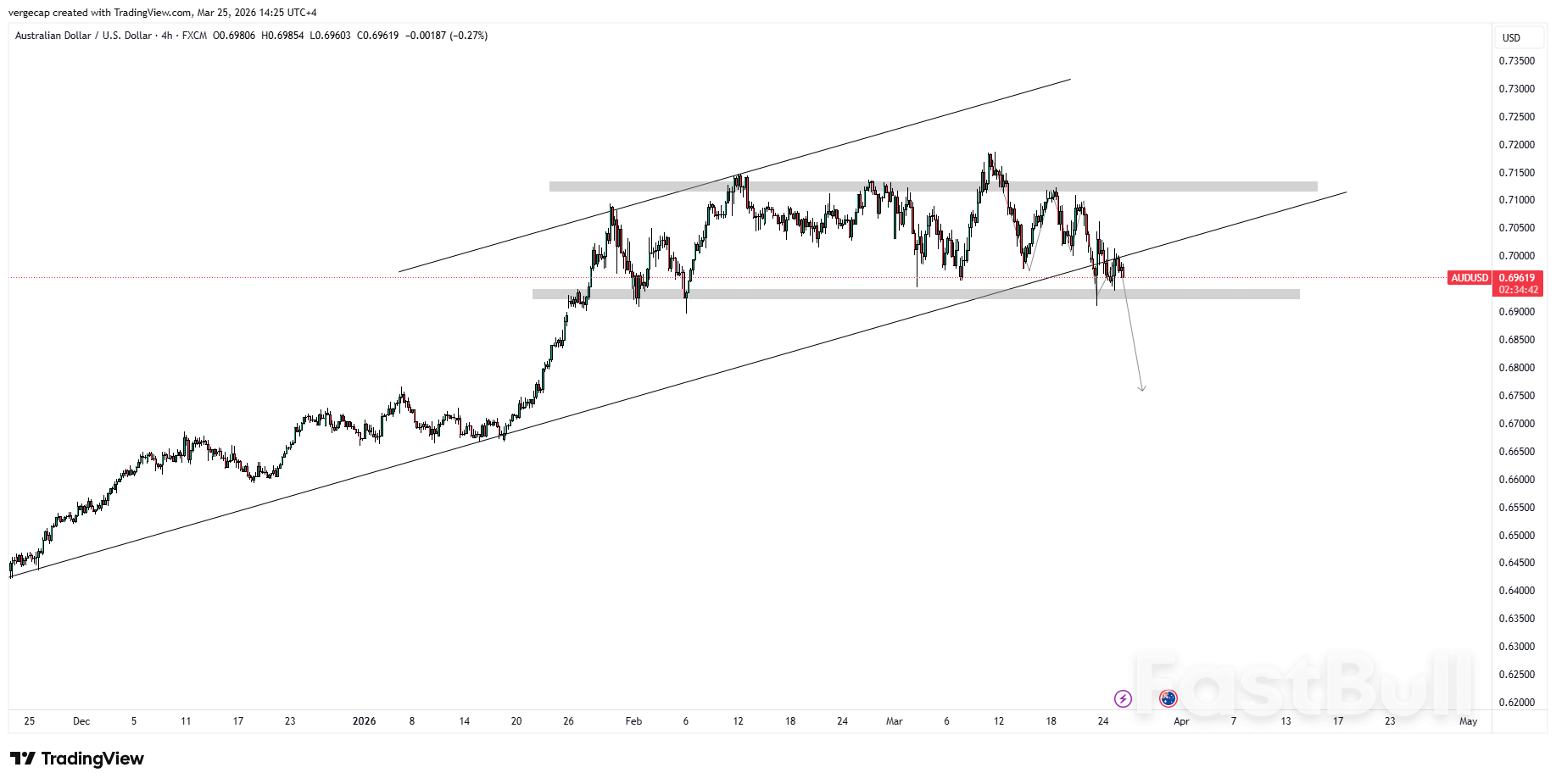
AUD/USD appears to be transitioning out of a previously well-defined bullish structure into a more vulnerable phase. On the 4-hour chart, price action had been contained within a rising channel, respecting both ascending support and resistance. However, recent price behavior shows a clear loss of momentum, with the pair now breaking down toward the lower boundary of this channel and threatening a structural shift.
Price is currently hovering around the 0.6960–0.6970 region, which coincides with a key horizontal support zone that has been tested multiple times. This area has historically acted as a demand base, but repeated tests have weakened its integrity. A sustained break below this zone would confirm a breakdown from both the range and the ascending channel, signaling a transition from consolidation to a potential bearish continuation phase.
The upper resistance zone near 0.7100–0.7130 remains intact and has consistently rejected bullish attempts, forming a clear ceiling. The inability of price to establish higher highs within the channel, combined with increasingly choppy and volatile swings, suggests distribution rather than accumulation.
If price decisively breaks below the 0.6950 support level, downside targets are likely to extend toward the 0.6850 region initially, followed by a deeper move toward 0.6750, which aligns with prior structure and the projected move from the channel breakdown. This would mark a more meaningful correction and confirm bearish control in the near term.
On the upside, bulls would need to reclaim the 0.7050 level and push back into the mid-range of the channel to invalidate the immediate bearish outlook. A sustained move above 0.7100 would be required to restore bullish momentum and shift focus back toward the channel highs near 0.7200.
Momentum-wise, although indicators are not explicitly shown, price action suggests weakening bullish pressure. The series of lower highs and failure to hold rebounds indicate declining demand. This aligns with a potential bearish breakout scenario, especially if supported by increased volatility on the downside.
TRADE RECOMMENDATION
SELL AUD/USD
ENTRY PRICE: 0.6950
STOP LOSS: 0.7020
TAKE PROFIT: 0.6750


