It is a familiar dance for the currency markets, yet the rhythm has suddenly changed. The Australian Dollar is currently performing a delicate high-wire act, hovering just shy of the 0.7128 peak—territory not visited since the early throes of 2023—yet displaying a steely resolve that suggests this isn’t merely a fleeting sugar rush.
As we go to press, the AUD/USD pair is consolidating above the psychologically crucial 0.7100 handle, digesting gains that have left many dollar bulls nursing wounds inflicted not by aggressive Aussie bravado, but by a glaring vulnerability emerging in the United States economic engine room. The Greenback simply cannot catch a bid.
To understand the Aussie’s strength, one must look to the abysmal data emanating from Washington this week. The US consumer, long the Atlas holding up the global economy, visibly shrugged. December retail sales stagnated at 0.0%, a brutal miss against the 0.4% expansion forecast by consensus. You don’t need to squint to see the cracks; the details are damning. The “Control Group” measure—the core metric that strips out volatile categories and feeds directly into GDP calculations—contracted by 0.1% .
This wasn't just a soft patch. November’s robust reading was slashed, rewriting the narrative of a resilient holiday season. When Americans pull back at clothing stores and furniture outlets, it sends a shiver through boardrooms from Bentonville to Beijing .
Simultaneously, the Bureau of Labor Statistics dropped another hint that the great disinflation is taking a toll on workers’ pay packets. The Employment Cost Index (ECI), Chair Powell’s favoured gauge of labour market friction, rose just 0.7% in Q4. While that looks benign, the context is stark: it is the smallest increase since the second quarter of 2021, marking the slowest annual pace of labour cost growth in four years . The wage-price spiral the Fed feared has not just flattened; it is unwinding.
This is the crux of the Greenback’s paralysis. The data gives the Fed’s entrenched "dovish party" all the ammunition they need to scream for immediate, pre-emptive rate cuts. The market is listening. Fed funds futures have fully priced in the next move for June, and Treasury yields are crumbling, with the 10-year hovering near 4.15% .
Yet, while the US frets about stalling momentum, Australia is battling the opposite demon. Let’s be clear: the Reserve Bank of Australia is currently the hawkish outlier in the G10 currency space, and the Aussie is reaping the yield differential rewards.
While other central banks pop champagne on their soft landings, Deputy Governor Andrew Hauser offered a sobering reality check in Sydney yesterday. He posed a question that should unsettle local policymakers: Is Australia simply more inflation-prone than its peers? .
Hauser defended the RBA’s February rate hike to 3.85% with refreshing candour, admitting that the Bank’s models were ‘right, just right at the wrong time.’ He cited three key facts that shifted beneath their feet. First, the world refuses to cool. Second, financial conditions domestically were far looser than the RBA had anticipated. And third—critically—private demand has surged back with a vengeance .
The RBA’s own Statement on Monetary Policy confirms this whiplash. Underlying inflation sits at 3.4%, and the Bank sees it peaking at 3.7% mid-year. Crucially, they don’t see it returning to the top of the 2-3% band until early 2027 . For traders, the equation is simple: a central bank that is hiking (or holding high) while the Fed cuts is a fundamental recipe for AUD strength.
This brings us to the immediate risk event. With the January NFP report delayed but landing today, the stakes couldn't be higher. Consensus is looking for a tepid 70K jobs gain . If we see a number south of 50k, or if the unemployment rate ticks up from 4.4%, the "R" word (recession) will re-enter the US lexicon aggressively.
However, I would caution against reading the NFP print in isolation. We are seeing a fascinating divergence play out globally that complicates the typical risk-on/risk-off matrix. As MUFG pointed out, Asian exports—particularly semiconductors from Korea and Taiwan—are booming on the back of insatiable AI demand, decoupled from the sluggish US consumer . This structural demand for tech is a powerful undertow for the Aussie as a proxy play.
Technical Analysis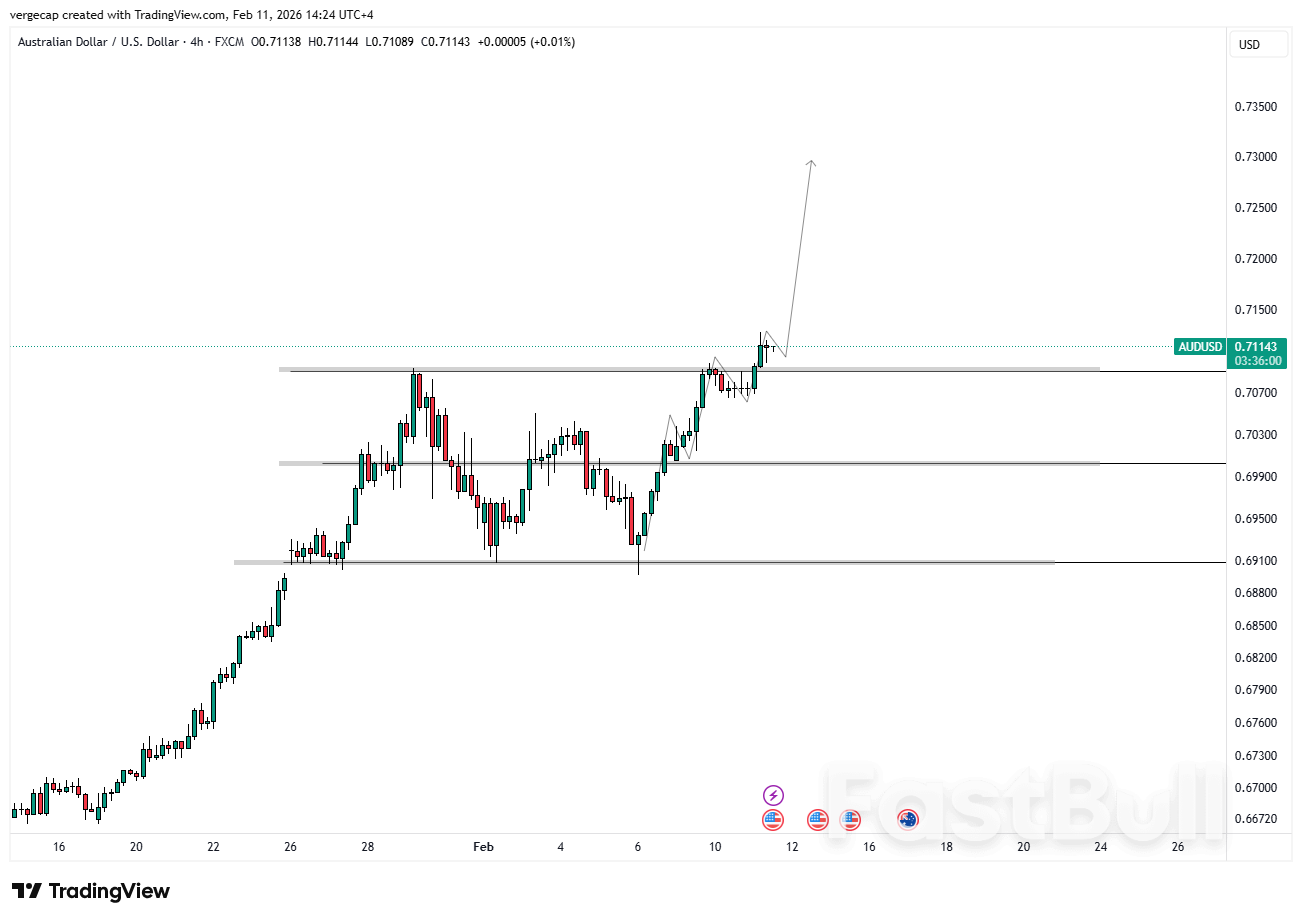
From a technical perspective, AUD/USD remains positioned within a developing bullish structure following a strong impulsive recovery from the late-January lows. On the 4-hour chart, price action shows a clear transition from a prior consolidation phase into a sequence of higher highs and higher lows, confirming that short-term momentum has shifted in favor of buyers.
The pair has recently broken above a former resistance band near 0.7070–0.7090, which had capped price advances multiple times in late January and early February. This zone is now acting as newly established support, reflecting a classic breakout-and-retest dynamic. While price is currently hovering just above this region, the absence of heavy rejection wicks suggests sellers are struggling to regain control.
Below current levels, the next meaningful support is seen around 0.6990–0.7010, aligning with a previous consolidation shelf and the base of the most recent breakout leg. This area represents a stronger structural floor. A sustained move back below this zone would signal that bullish momentum is fading and could open the door for a deeper retracement toward 0.6910, where prior demand emerged. A break beneath that level would begin to undermine the broader recovery structure and shift the bias back toward range conditions rather than trend continuation.
On the upside, immediate resistance sits near 0.7140–0.7160, a short-term supply pocket formed by recent swing highs. A decisive 4-hour close above this barrier would confirm bullish continuation and likely attract momentum-driven flows. Beyond that, the next upside target comes in near 0.7250, followed by the 0.7300 psychological level, which aligns with the projected extension shown on the chart and represents a natural magnet for trend traders.
Price behavior also suggests bullish compression beneath resistance, rather than distribution. The recent pullbacks have been shallow and corrective in nature, indicating that buyers are stepping in on dips rather than exiting positions. This type of structure typically precedes another expansion move in the direction of the prevailing trend.
Overall, the technical landscape favors further upside continuation, provided AUD/USD maintains support above the 0.7070 breakout zone and clears the 0.7160 resistance ceiling.
TRADE RECOMMENDATION
BUY AUD/USD
ENTRY PRICE: 0.7115
STOP LOSS: 0.7045
TAKE PROFIT: 0.7250


